Thank you for visiting SNEWPapers!
Sign up free
Story
June 15, 1862
Sunday Dispatch
New York, New York County, New York
What is this article about?
At a seminary in A-, student Sara Espenlie flirts with widower Colonel Tasseltag, ignoring her fiancé Willard Leslie's visit, causing their engagement to end. After Leslie marries another, Sara weds Tasseltag.
Clipping
OCR Quality
95%
Excellent
Full Text
FLIRTATION
BY CHRISTINE H. CARPENTER.
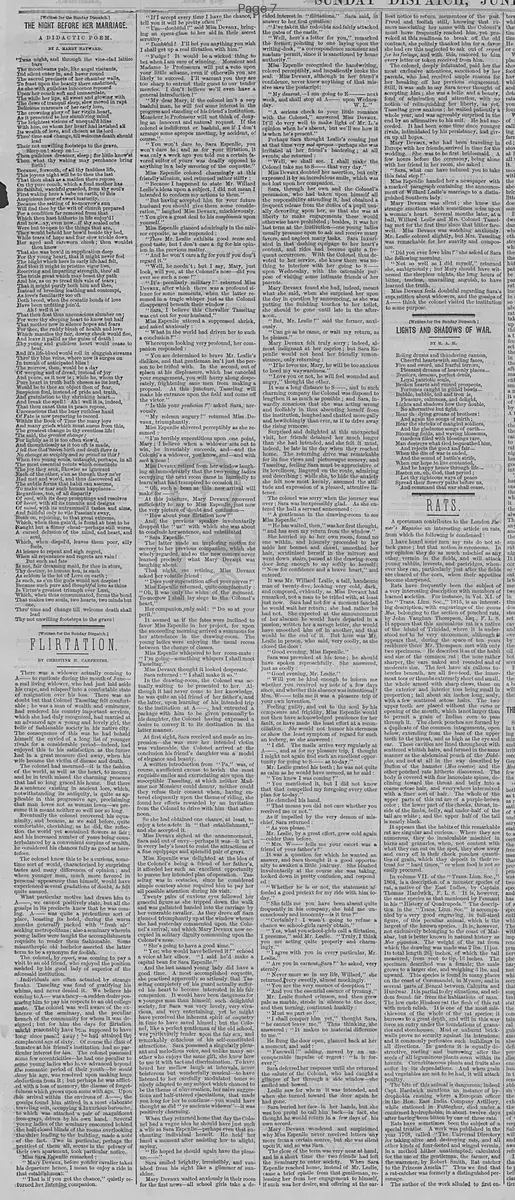
There was a widower actually coming to A- to rusticate during the month of June—a real living widower, who had just laid aside his crape, and relapsed into a comfortable state of resignation over his loss. There was no doubt but that Colonel Tasseltag felt comfortable: he was a man of wealth and eminence, had rendered his country important services, which she had duly recognized, had married at an advanced age a young and lovely girl, the belle of fashionable society in his native city. The consequence of this was he had beheld himself the envied of a long list of younger rivals for a considerable period—indeed, had enjoyed this to his satisfaction as the furore had in a great measure died away, when his wife became the victim of disease and death.
The colonel had mourned—it is the fashion of the world, as well as the heart, to mourn; and he in truth missed the charming presence that had so long graced his home. But there is a sentence existing in ancient lore, which, notwithstanding its antiquity, is quite as applicable in this progressive age, proclaiming that man loves not as woman loves—we presume it is meant neither so well nor so long.
Eventually the colonel recovered his equanimity, and became, as we said before, quite comfortable, cherishing, as he did, the reflection the world yet contained flowers as fair; and his increased number of years being counterbalanced by a convenient surplus of wealth, he considered his chances fully as good as heretofore.
The colonel knew this to be a curious, sometimes sort of world, characterized by surprising tastes and many differences of opinion; and where younger men, much more favored in personal appearance than himself, would have experienced several gradations of doubt, he felt quite assured.
What particular motive had drawn him to A-, we cannot positively state, but all the gossips in its precincts knew that he was coming. A- was quite a pretentious sort of place, boasting its hotel, "during the warm months generally packed with 'fresh air' seeking metropolitans; also a seminary wherein young ladies were taught the accomplishments requisite to render them fashionable. Some misanthropic old bachelor asserted the latter term to be a synonym for foolish.
The colonel, by report, was coming to pay a visit to an old friend, who enjoyed the position, assisted by his good lady of superior of the aforesaid institution.
Individuals are often actuated by strange freaks. Tasseltag was fond of gratifying his whims, and never denied it. We believe his coming to A- was a fancy—a sudden desire possessing him to pay his respects to an old college mate. The colonel was well aware of the existence of the seminary, and the peculiar branch of the community for whom it was designed; but for him the days for flirtation might reasonably have been supposed to have long since passed away: he had attained the complacent age of sixty. Of course the class of inmates at his friend's institution had no particular interest for him. The colonel possessed some few eccentricities—he had one peculiar to some young ladies who have advanced beyond the romantic period of their youth—he would deny his age, was resolved upon making huge deductions from it; but perhaps he was afflicted with a loss of memory, the disease of forgetfulness which grows upon some with age.
Upon his arrival within the environs of A-, the gossips found him attired in a most elaborate traveling suit, occupying a luxurious barouche, to which was attached a pair of magnificent iron-grays, driven by his own hand. Several young ladies of the seminary ensconced behind the half-closed blinds of the rooms overlooking the drive leading to the building, made a note of the fact. Two in particular, perhaps the prettiest of them all, secure in the privacy of their own apartment, took particular notice.
Miss Sara Espenlie remarked:
"Mary Devaux, before yonder cavalier takes his departure hence, I mean to enjoy a ride in that establishment."
"That is if you get the chance," quietly returned her listening companion.
"If I accept every time I have the chance, I tell you it will be pretty often!"
"Undoubtful!" said Miss Devaux, bringing an opera-glass to her aid in their secret scrutiny.
"Doubtful? I'll bet you anything you wish I shall get up a real flirtation with him."
"Fudge! It would be a wicked thing to bet when I am sure of winning. Monsieur and Madame le Professeurs will put a veto upon your little scheme, even if otherwise you are likely to succeed. I'll warrant you they are too sharp to entrust their guest to our tender mercies. I don't believe we'll even have a general introduction!"
"My dear Mary, if the colonel isn't a very bashful man, he will feel some interest in the progress and standing of his friend's institution. Monsieur le Professeur will not think of denying an innocent and natural request. If the colonel is indifferent or bashful, see if I don't arrange some apropos meeting, by accident, of course."
"You won't dare to, Sara Espenlie, you won't dare to; and as for your flirtation, it was only a week ago you told me a certain favored suitor of yours was deadly opposed to anything in a lady savoring of the coquette."
Miss Espenlie colored charmingly at this friendly allusion, and returned rather stiffly:
"Because I happened to state Mr. Willard Leslie's ideas upon a subject, I did not mean I intended to conform my actions to them."
"But having accepted him for your future husband you should give them some consideration," laughed Miss Devaux, mischievously.
"You give a great deal to his compliments upon yourself."
Miss Espenlie glanced admiringly in the mirror opposite, as she responded:
"There Mr. Leslie exhibits good sense and good taste, but I don't care a fig for his opinion in the previous matter."
"And he won't care a fig for you if you don't regard it."
"Well, he needn't; but I say, Mary, just look, will you, at the Colonel's nose—did you ever see such a nose?"
"It's peculiarly military!" returned Miss Devaux, after which there was a profound silence for some moments, when the latter resumed in a tragic whisper just as the Colonel disappeared beneath their window:
"Sara, I believe this Chevalier Tasseltag was cut out for your husband."
Miss Espenlie uttered a suppressed shriek, and asked anxiously:
"What in the world had driven her to such a conclusion?"
Whereupon looking very profound, her companion responded:
"You are determined to brave Mr. Leslie's dislikes, and that gentleman isn't just the person to be trifled with. In the second, out of spleen at his displeasure, which has canceled your engagement, you will hurry along desperately, frightening sane men from making a proposal. At this juncture, Tasseltag will make his entrance upon the field and come off the victor."
"Is this your prediction?" asked Sara, nervously.
"My solemn augury!" returned Miss Devaux, triumphantly.
Miss Espenlie shivered perceptibly as she resumed:
"I'm terribly superstitious upon one point, Mary: I believe when a widower sets out to win, he invariably succeeds, and—and the Colonel's a widower, you know, and—and with such a nose!"
Miss Devaux retired from her window laughing so immoderately that the two young ladies occupying the next room came in hurriedly to learn what had transpired to occasion it.
"Oh, such a beau as this new arrival will make for—"
At this juncture, Mary Devaux recovered sufficiently to say to Miss Espenlie, just now the very picture of doubt and confusion—
"How about your flirtation now?"
And the previous speaker involuntarily dropped the "us" with which she was about to conclude her sentence, and substituted
"Sara Espenlie."
The latter made an imploring motion for secresy to her previous companion, which she wisely regarded, and so the new comers never learned precisely what Mary Devaux was laughing about.
That night, ere retiring, Miss Devaux asked her volatile friend:
"Does your superstition affect your nerves?"
Miss Espenlie returned, quite complacently:
"Oh, it was only the whim of the moment. To-morrow I shall lay siege to the Colonel's heart."
Her companion only said: "Do so at your peril."
It seemed as if the fates were inclined to favor Miss Espenlie in her project, for upon the succeeding morning arrived a summons for her attendance in the drawing-room. The young ladies were enjoying the usual recess between the change of classes.
Miss Espenlie whispered to her room-mate:
"I'm going—something whispers I shall meet Tasseltag."
Miss Devaux thought it looked desperate.
Sara returned: "I shall make it so."
In the drawing-room, the Colonel was actually waiting to be presented to her. Although it had never come to her knowledge, he was quite an old friend of her father's, and the latter, upon learning of his intended trip to the institution at A-, had entrusted a package with him to be given personally to his daughter, the Colonel having expressed a desire to convey it to its destination in the latter manner.
At first sight, Sara received and made an impression—she was sure her intended victim was vulnerable, the Colonel arrived at the conclusion his friend's daughter was a model of elegance and beauty.
A written introduction from "Pa," was, of course, a sufficient excuse to lavish the most exquisite smiles and excruciating airs upon the susceptible Tasseltag, at which neither Madame nor Monsieur could demur, neither could they refuse their consent when, having entered eloquently upon the theme of riding, she found her efforts rewarded by an invitation from the Colonel to drive with him that afternoon.
So she had obtained one chance, at least, to enjoy a tete-a-tete in "that establishment," and she accepted it.
Miss Devaux sighed at the announcement—Sara said out of envy—perhaps it was; it isn't in every lady's heart to resist the attractions of a fine equipage and splendid pair of grays.
Miss Espenlie was delighted at the idea of the Colonel's being a friend of her father's, it afforded her such an excellent opportunity to pursue her intended plan of operation. Tasseltag was in ecstasies, since he considered simple courtesy alone required him to pay her all possible attention during his visit.
Twenty pairs of envious eyes followed her graceful figure as she tripped down the walk and was gallantly handed into the carriage by her venerable cavalier. As they drove off Sara glanced triumphantly up at the window whence she had yesterday commented upon the Colonel's arrival, and which Mary Devaux now occupied in solitary dignity communing upon the Colonel's nose.
"She's going to have a good time."
"Yes; who would have believed it?" echoed a voice at her elbow. "I said he'd make a capital beau for Sara Espenlie."
And the last named young lady did have a good time. A most accomplished coquette, she practised apparently so artlessly that Tasseltag completely off his guard actually suffered his heart to become interested in his fair companion. It would have been dangerous for a younger man than himself; such delightful society, for Sara was very lovely, very vivacious, and very entertaining, yet he might have perceived the inherent spirit of coquetry in time to have saved himself; but the Colonel, like a perfect gentleman of the old school, was particularly tender upon the fair sex, and remarkably conscious of his self-constituted attractions. Sara possessed a singularly pleasant and melodious voice, and unlike many another who enjoys the same gift, she knew how to use it with tact and discrimination. To have heard her mellow laugh at intervals, never boisterous but wonderfully musical—to have listened to her carefully modulated tones so nicely adapted to any subject which chanced to be the theme of conversation, her naive suggestions and half-uttered ejaculations, that made you long for her to continue—you would have thought as did the ancienne widower it was positively charming.
When they returned home that day the Colonel had a vague idea he should have just such a wife as Sara Espenlie—perhaps even that enchanting individual herself. He held her hand a moment after assisting her to alight, saying,
"He hoped he should again have the pleasure—"
Sara smiled brightly, irresistibly, and vanished from his sight like a glimmer of sunshine.
Mary Devaux waited anxiously in their room for the first news—all school girls take a decided interest in flirtations—Sara said.
In answer to her first question:
"I've taken the redoubts and fairly attacked the gates of the castle."
"Well, here's a letter for you," remarked the former, pointing to one laying upon the writing-desk, "a correspondence monsieur and madam permit, since it is sanctioned by home authority."
Miss Espenlie recognised the handwriting, colored perceptibly, and impatiently broke the seal. Miss Devaux, although in her friend's confidence, never knew anything of that missive save the postscript:
"My dearest.—I am going to E- next week, and shall stop at A- upon Wednesday. W.L."
"A serious check to your little romance with the Colonel," answered Miss Devaux.
"It'll do very well to make light of Mr. L.'s opinion when he's absent, but we'll see how it is when he's present."
Perhaps Sara thought Leslie's coming just at that time very mal apropos—perhaps she was irritated at her friend's bantering; at all events, she returned:
"Well, we shall see. I shall make the Colonel take me to S- that very day."
Miss Devaux doubted her assertion, but only expressed it by an incredulous smile, which was not lost upon her companion.
Sara, through her own and the Colonel's persuasion, who had taken upon himself all the responsibility attending it, had obtained a frequent release from the duties of a pupil usually devolving upon her, so that she was at liberty to make engagements these would otherwise have prohibited; besides, it was her last term at the institution—one young ladies usually presume upon to ask and receive many favors, and neglect many tasks. Sara luxuriated in that dashing equipage to her heart's content, and rides had become quite a frequent occurrence. With the Colonel thus devoted to her service, she knew there was nothing to interfere with her going to S- upon Wednesday, with the ostensible purpose of visiting some intimate friends of her parents.
Mary Devaux found she had, indeed, meant what she said, when she surprised her upon the day in question by announcing, as she was putting the finishing touches to her toilet, she should be gone until late in the afternoon.
"But, Mr. Leslie?" said the former, anxiously.
"Can go as he came, or wait my return, as he pleases."
Mary Devaux felt truly sorry; indeed, almost indignant at her caprice; but Sara Espenlie would not heed her friendly remonstrance, only returning:
"If he loves me, Mary, he will be too anxious to heed my waywardness."
"Love you or not, he will feel wounded and angry," thought the other.
It was a long distance to S-, and in such charming company the Colonel was disposed to lengthen it as much as possible; and Sara, inwardly conscious that she was acting wrong and foolishly in thus absenting herself from the institution, laughed and chatted more gaily and bewitchingly than ever, as if to drive away the rising remorse.
Surprised and delighted at this unexpected visit, her friends detained her much longer than she had intended, and she felt it must, indeed, be late in the day when they reached home. The returning drive was remarkable for its fine views and picturesque scenery, and Tasseltag, feeling Sara must be appreciative of its loveliness, lingered on the route, admiring and describing; while she, to hide the anxiety she felt now most keenly, assumed the attitude and expression of a pleased, attentive listener.
The colonel was sorry when the journey was over; Sara was inexpressibly glad. As she entered the hall a servant announced:
"A gentleman in the drawing-room to see Miss Espenlie."
"He has waited, then," was her first thought, "and has seen my return from the window."
She hurried up to her own room, found no one within, and leisurely proceeded to lay aside her bonnet and shawl, smoothed her hair, scrutinized herself in the mirror, and went down stairs, paused at the drawing-room door long enough to say softly to herself:
"Now for confidence and a brave heart," and entered.
It was Mr. Willard Leslie, a tall, handsome man of twenty-five, looking very cold, dark, and composed, evidently, as Miss Devaux had remarked, not a man to be trifled with, at least just now. Sara had not for a moment fancied he would wait her return; she had rather he had not. She expected at the announcement of her absence he would have departed in a passion, written her a savage letter, she would have smoothed him off in another, and that would be the end of it. But here was Mr. Leslie in person, who said, very coolly, as she closed the door:
"Good evening, Miss Espenlie."
Sara was provoked at his tone; he should have spoken reproachfully. She answered just as coolly:
"Good evening, Mr. Leslie."
"Will you be kind enough to inform me whether you received my note of a few days since, and whether this absence was intentional? Mrs. W- tells me it was a pleasure trip of your own invention."
Feeling guilty, and cut to the soul by his composure and frigidity, Miss Espenlie would not then have acknowledged penitence for her fault, or have made the least effort at a reconciliation. She would not humor his sternness or show the least symptom of regard for such an iceberg, so she answered:
"I did. The mails arrive very regularly at A-, and as for my pleasure trip, I thought I might not again find such an excellent opportunity for going to S- as to-day."
Mr. Leslie grated his teeth; he was not quite as calm as he would have seemed, as he said:
"You knew I was coming?"
"You mentioned it, but I did not know that that compelled my foregoing every other plan for to-day."
He clenched his hand.
"That means you did not care whether you received me or not."
As if impelled by the very demon of mischief, Sara returned:
"As you please."
Mr. Leslie, by a great effort, grew cold again—colder than before.
"Mrs. W- tells me your escort was a friend of your father's?"
It was a question for which he wanted an answer, and Sara thought it a good opportunity to awaken a little jealousy. She blushed involuntarily at the course she was taking, looked down in pretty confusion, and responded:
"Whether he is or not, the statement afforded a good pretext for my ride with him to-day."
"She tells me you have been absent quite frequently in his company, she told me unconsciously and innocently—is it true?"
"Certainly! I wasn't going to refuse a chance we school-girls rarely obtain."
"Yes, what you school-girls call a flirtation I presume," said Mr. Leslie. "Truly, I think you are acting quite properly and charmingly."
"I agree with you in every particular, Mr. Leslie."
"Are you in earnest, Sara?" he asked, very sternly.
"Never more so in my life, Willard," she returned, very sweetly, almost mockingly.
"You are the very essence of deception!"
"And you the essential essence of tyranny."
Mr. Leslie flushed crimson, and then grew pale as marble, strode in silence to the door, and then turning, continued huskily:
"Must we part so?"
"I shall conquer him yet," thought Sara, "he cannot leave me."
Thus thinking, she answered: "It makes no material difference to me."
He flung the door open, glanced back at her a moment, and said:
"Farewell!" adding, moved by an unconquerable impulse of regret: "is it for ever?"
Sara deferred her response until she returned the salute of the Colonel, who had caught a glimpse of her through a side window—she smiled and bowed.
Leslie saw for whom it was intended, and when she turned toward the door again he had gone.
Sara buried her face in her hands, but she was too proud to call him back—in fact, she thought he would return in a few days of his own accord.
Mary Devaux wondered and suspicioned why Miss Espenlie never received letters any more from a certain source, but she was silent upon it, and so was Sara.
The close of the term was very near at hand and in a short time the two friends had left the Seminary to enter society. When Sara Espenlie reached home, instead of Mr. Leslie, came a brief epistle from that gentleman, releasing her from her engagement to himself if such was her desire, and offering at the earliest notice to return mementoes of the past.
Proud and foolish still, knowing that rumors associating her name with the Colonel's must have frequently reached him, yet provoked at this readiness to break off the old contract, she politely thanked him for a favor she had ere this neglected to ask out of respect for his feelings, and with this, restored to him every letter or token received from him.
The colonel, deeply infatuated, paid her the most exclusive attentions, sanctioned by her parents, who had received ample reasons for her breaking off her previous engagement.
Still, it was safe to say Sara never thought of accepting him; she was a belle and a beauty, fond of admiration and attention, with no notion of relinquishing her liberty, as yet.
Tasseltag grew anxious; he waited patiently a whole year, and was agreeably surprised in the end by an affirmative to his suit. He had succeeded. It had been some time since younger rivals, intimidated by his persistency, had given up all hopes.
Mary Devaux, who had been traveling in Europe with her friends, arrived in time for the wedding. She was to be first bridesmaid. A few hours before the ceremony, being alone with her friend in her room, she asked:
"Sara, what can have induced you to take this fatal step?"
Miss Espenlie handed her a newspaper with a marked paragraph containing the announcement of Willard Leslie's marriage to a distinguished Southern lady.
Mary Devaux was silent; she knew the strange emotions which sometimes seize upon a woman's heart. Several months later, at a ball, Willard Leslie and Mrs. Colonel Tasseltag met for the first time since that bitter farewell. Miss Devaux was watching anxiously.
Mr. Leslie colored slightly, but Mrs. Tasseltag was remarkable for her suavity and composure.
"Did you ever love him?" she asked of Sara the following morning.
"Not so well as I did myself," returned she, ambiguously; but Mary should have witnessed the sleepless nights, the long hours of bitter, tearless, unavailing anguish, to have learned the truth.
Miss Devaux feels doubtful regarding Sara's superstition about widowers, and the gossips of A- think the colonel visited the institution to some purpose.
[Written for the Sunday Dispatch.]
BY CHRISTINE H. CARPENTER.
There was a widower actually coming to A- to rusticate during the month of June—a real living widower, who had just laid aside his crape, and relapsed into a comfortable state of resignation over his loss. There was no doubt but that Colonel Tasseltag felt comfortable: he was a man of wealth and eminence, had rendered his country important services, which she had duly recognized, had married at an advanced age a young and lovely girl, the belle of fashionable society in his native city. The consequence of this was he had beheld himself the envied of a long list of younger rivals for a considerable period—indeed, had enjoyed this to his satisfaction as the furore had in a great measure died away, when his wife became the victim of disease and death.
The colonel had mourned—it is the fashion of the world, as well as the heart, to mourn; and he in truth missed the charming presence that had so long graced his home. But there is a sentence existing in ancient lore, which, notwithstanding its antiquity, is quite as applicable in this progressive age, proclaiming that man loves not as woman loves—we presume it is meant neither so well nor so long.
Eventually the colonel recovered his equanimity, and became, as we said before, quite comfortable, cherishing, as he did, the reflection the world yet contained flowers as fair; and his increased number of years being counterbalanced by a convenient surplus of wealth, he considered his chances fully as good as heretofore.
The colonel knew this to be a curious, sometimes sort of world, characterized by surprising tastes and many differences of opinion; and where younger men, much more favored in personal appearance than himself, would have experienced several gradations of doubt, he felt quite assured.
What particular motive had drawn him to A-, we cannot positively state, but all the gossips in its precincts knew that he was coming. A- was quite a pretentious sort of place, boasting its hotel, "during the warm months generally packed with 'fresh air' seeking metropolitans; also a seminary wherein young ladies were taught the accomplishments requisite to render them fashionable. Some misanthropic old bachelor asserted the latter term to be a synonym for foolish.
The colonel, by report, was coming to pay a visit to an old friend, who enjoyed the position, assisted by his good lady of superior of the aforesaid institution.
Individuals are often actuated by strange freaks. Tasseltag was fond of gratifying his whims, and never denied it. We believe his coming to A- was a fancy—a sudden desire possessing him to pay his respects to an old college mate. The colonel was well aware of the existence of the seminary, and the peculiar branch of the community for whom it was designed; but for him the days for flirtation might reasonably have been supposed to have long since passed away: he had attained the complacent age of sixty. Of course the class of inmates at his friend's institution had no particular interest for him. The colonel possessed some few eccentricities—he had one peculiar to some young ladies who have advanced beyond the romantic period of their youth—he would deny his age, was resolved upon making huge deductions from it; but perhaps he was afflicted with a loss of memory, the disease of forgetfulness which grows upon some with age.
Upon his arrival within the environs of A-, the gossips found him attired in a most elaborate traveling suit, occupying a luxurious barouche, to which was attached a pair of magnificent iron-grays, driven by his own hand. Several young ladies of the seminary ensconced behind the half-closed blinds of the rooms overlooking the drive leading to the building, made a note of the fact. Two in particular, perhaps the prettiest of them all, secure in the privacy of their own apartment, took particular notice.
Miss Sara Espenlie remarked:
"Mary Devaux, before yonder cavalier takes his departure hence, I mean to enjoy a ride in that establishment."
"That is if you get the chance," quietly returned her listening companion.
"If I accept every time I have the chance, I tell you it will be pretty often!"
"Undoubtful!" said Miss Devaux, bringing an opera-glass to her aid in their secret scrutiny.
"Doubtful? I'll bet you anything you wish I shall get up a real flirtation with him."
"Fudge! It would be a wicked thing to bet when I am sure of winning. Monsieur and Madame le Professeurs will put a veto upon your little scheme, even if otherwise you are likely to succeed. I'll warrant you they are too sharp to entrust their guest to our tender mercies. I don't believe we'll even have a general introduction!"
"My dear Mary, if the colonel isn't a very bashful man, he will feel some interest in the progress and standing of his friend's institution. Monsieur le Professeur will not think of denying an innocent and natural request. If the colonel is indifferent or bashful, see if I don't arrange some apropos meeting, by accident, of course."
"You won't dare to, Sara Espenlie, you won't dare to; and as for your flirtation, it was only a week ago you told me a certain favored suitor of yours was deadly opposed to anything in a lady savoring of the coquette."
Miss Espenlie colored charmingly at this friendly allusion, and returned rather stiffly:
"Because I happened to state Mr. Willard Leslie's ideas upon a subject, I did not mean I intended to conform my actions to them."
"But having accepted him for your future husband you should give them some consideration," laughed Miss Devaux, mischievously.
"You give a great deal to his compliments upon yourself."
Miss Espenlie glanced admiringly in the mirror opposite, as she responded:
"There Mr. Leslie exhibits good sense and good taste, but I don't care a fig for his opinion in the previous matter."
"And he won't care a fig for you if you don't regard it."
"Well, he needn't; but I say, Mary, just look, will you, at the Colonel's nose—did you ever see such a nose?"
"It's peculiarly military!" returned Miss Devaux, after which there was a profound silence for some moments, when the latter resumed in a tragic whisper just as the Colonel disappeared beneath their window:
"Sara, I believe this Chevalier Tasseltag was cut out for your husband."
Miss Espenlie uttered a suppressed shriek, and asked anxiously:
"What in the world had driven her to such a conclusion?"
Whereupon looking very profound, her companion responded:
"You are determined to brave Mr. Leslie's dislikes, and that gentleman isn't just the person to be trifled with. In the second, out of spleen at his displeasure, which has canceled your engagement, you will hurry along desperately, frightening sane men from making a proposal. At this juncture, Tasseltag will make his entrance upon the field and come off the victor."
"Is this your prediction?" asked Sara, nervously.
"My solemn augury!" returned Miss Devaux, triumphantly.
Miss Espenlie shivered perceptibly as she resumed:
"I'm terribly superstitious upon one point, Mary: I believe when a widower sets out to win, he invariably succeeds, and—and the Colonel's a widower, you know, and—and with such a nose!"
Miss Devaux retired from her window laughing so immoderately that the two young ladies occupying the next room came in hurriedly to learn what had transpired to occasion it.
"Oh, such a beau as this new arrival will make for—"
At this juncture, Mary Devaux recovered sufficiently to say to Miss Espenlie, just now the very picture of doubt and confusion—
"How about your flirtation now?"
And the previous speaker involuntarily dropped the "us" with which she was about to conclude her sentence, and substituted
"Sara Espenlie."
The latter made an imploring motion for secresy to her previous companion, which she wisely regarded, and so the new comers never learned precisely what Mary Devaux was laughing about.
That night, ere retiring, Miss Devaux asked her volatile friend:
"Does your superstition affect your nerves?"
Miss Espenlie returned, quite complacently:
"Oh, it was only the whim of the moment. To-morrow I shall lay siege to the Colonel's heart."
Her companion only said: "Do so at your peril."
It seemed as if the fates were inclined to favor Miss Espenlie in her project, for upon the succeeding morning arrived a summons for her attendance in the drawing-room. The young ladies were enjoying the usual recess between the change of classes.
Miss Espenlie whispered to her room-mate:
"I'm going—something whispers I shall meet Tasseltag."
Miss Devaux thought it looked desperate.
Sara returned: "I shall make it so."
In the drawing-room, the Colonel was actually waiting to be presented to her. Although it had never come to her knowledge, he was quite an old friend of her father's, and the latter, upon learning of his intended trip to the institution at A-, had entrusted a package with him to be given personally to his daughter, the Colonel having expressed a desire to convey it to its destination in the latter manner.
At first sight, Sara received and made an impression—she was sure her intended victim was vulnerable, the Colonel arrived at the conclusion his friend's daughter was a model of elegance and beauty.
A written introduction from "Pa," was, of course, a sufficient excuse to lavish the most exquisite smiles and excruciating airs upon the susceptible Tasseltag, at which neither Madame nor Monsieur could demur, neither could they refuse their consent when, having entered eloquently upon the theme of riding, she found her efforts rewarded by an invitation from the Colonel to drive with him that afternoon.
So she had obtained one chance, at least, to enjoy a tete-a-tete in "that establishment," and she accepted it.
Miss Devaux sighed at the announcement—Sara said out of envy—perhaps it was; it isn't in every lady's heart to resist the attractions of a fine equipage and splendid pair of grays.
Miss Espenlie was delighted at the idea of the Colonel's being a friend of her father's, it afforded her such an excellent opportunity to pursue her intended plan of operation. Tasseltag was in ecstasies, since he considered simple courtesy alone required him to pay her all possible attention during his visit.
Twenty pairs of envious eyes followed her graceful figure as she tripped down the walk and was gallantly handed into the carriage by her venerable cavalier. As they drove off Sara glanced triumphantly up at the window whence she had yesterday commented upon the Colonel's arrival, and which Mary Devaux now occupied in solitary dignity communing upon the Colonel's nose.
"She's going to have a good time."
"Yes; who would have believed it?" echoed a voice at her elbow. "I said he'd make a capital beau for Sara Espenlie."
And the last named young lady did have a good time. A most accomplished coquette, she practised apparently so artlessly that Tasseltag completely off his guard actually suffered his heart to become interested in his fair companion. It would have been dangerous for a younger man than himself; such delightful society, for Sara was very lovely, very vivacious, and very entertaining, yet he might have perceived the inherent spirit of coquetry in time to have saved himself; but the Colonel, like a perfect gentleman of the old school, was particularly tender upon the fair sex, and remarkably conscious of his self-constituted attractions. Sara possessed a singularly pleasant and melodious voice, and unlike many another who enjoys the same gift, she knew how to use it with tact and discrimination. To have heard her mellow laugh at intervals, never boisterous but wonderfully musical—to have listened to her carefully modulated tones so nicely adapted to any subject which chanced to be the theme of conversation, her naive suggestions and half-uttered ejaculations, that made you long for her to continue—you would have thought as did the ancienne widower it was positively charming.
When they returned home that day the Colonel had a vague idea he should have just such a wife as Sara Espenlie—perhaps even that enchanting individual herself. He held her hand a moment after assisting her to alight, saying,
"He hoped he should again have the pleasure—"
Sara smiled brightly, irresistibly, and vanished from his sight like a glimmer of sunshine.
Mary Devaux waited anxiously in their room for the first news—all school girls take a decided interest in flirtations—Sara said.
In answer to her first question:
"I've taken the redoubts and fairly attacked the gates of the castle."
"Well, here's a letter for you," remarked the former, pointing to one laying upon the writing-desk, "a correspondence monsieur and madam permit, since it is sanctioned by home authority."
Miss Espenlie recognised the handwriting, colored perceptibly, and impatiently broke the seal. Miss Devaux, although in her friend's confidence, never knew anything of that missive save the postscript:
"My dearest.—I am going to E- next week, and shall stop at A- upon Wednesday. W.L."
"A serious check to your little romance with the Colonel," answered Miss Devaux.
"It'll do very well to make light of Mr. L.'s opinion when he's absent, but we'll see how it is when he's present."
Perhaps Sara thought Leslie's coming just at that time very mal apropos—perhaps she was irritated at her friend's bantering; at all events, she returned:
"Well, we shall see. I shall make the Colonel take me to S- that very day."
Miss Devaux doubted her assertion, but only expressed it by an incredulous smile, which was not lost upon her companion.
Sara, through her own and the Colonel's persuasion, who had taken upon himself all the responsibility attending it, had obtained a frequent release from the duties of a pupil usually devolving upon her, so that she was at liberty to make engagements these would otherwise have prohibited; besides, it was her last term at the institution—one young ladies usually presume upon to ask and receive many favors, and neglect many tasks. Sara luxuriated in that dashing equipage to her heart's content, and rides had become quite a frequent occurrence. With the Colonel thus devoted to her service, she knew there was nothing to interfere with her going to S- upon Wednesday, with the ostensible purpose of visiting some intimate friends of her parents.
Mary Devaux found she had, indeed, meant what she said, when she surprised her upon the day in question by announcing, as she was putting the finishing touches to her toilet, she should be gone until late in the afternoon.
"But, Mr. Leslie?" said the former, anxiously.
"Can go as he came, or wait my return, as he pleases."
Mary Devaux felt truly sorry; indeed, almost indignant at her caprice; but Sara Espenlie would not heed her friendly remonstrance, only returning:
"If he loves me, Mary, he will be too anxious to heed my waywardness."
"Love you or not, he will feel wounded and angry," thought the other.
It was a long distance to S-, and in such charming company the Colonel was disposed to lengthen it as much as possible; and Sara, inwardly conscious that she was acting wrong and foolishly in thus absenting herself from the institution, laughed and chatted more gaily and bewitchingly than ever, as if to drive away the rising remorse.
Surprised and delighted at this unexpected visit, her friends detained her much longer than she had intended, and she felt it must, indeed, be late in the day when they reached home. The returning drive was remarkable for its fine views and picturesque scenery, and Tasseltag, feeling Sara must be appreciative of its loveliness, lingered on the route, admiring and describing; while she, to hide the anxiety she felt now most keenly, assumed the attitude and expression of a pleased, attentive listener.
The colonel was sorry when the journey was over; Sara was inexpressibly glad. As she entered the hall a servant announced:
"A gentleman in the drawing-room to see Miss Espenlie."
"He has waited, then," was her first thought, "and has seen my return from the window."
She hurried up to her own room, found no one within, and leisurely proceeded to lay aside her bonnet and shawl, smoothed her hair, scrutinized herself in the mirror, and went down stairs, paused at the drawing-room door long enough to say softly to herself:
"Now for confidence and a brave heart," and entered.
It was Mr. Willard Leslie, a tall, handsome man of twenty-five, looking very cold, dark, and composed, evidently, as Miss Devaux had remarked, not a man to be trifled with, at least just now. Sara had not for a moment fancied he would wait her return; she had rather he had not. She expected at the announcement of her absence he would have departed in a passion, written her a savage letter, she would have smoothed him off in another, and that would be the end of it. But here was Mr. Leslie in person, who said, very coolly, as she closed the door:
"Good evening, Miss Espenlie."
Sara was provoked at his tone; he should have spoken reproachfully. She answered just as coolly:
"Good evening, Mr. Leslie."
"Will you be kind enough to inform me whether you received my note of a few days since, and whether this absence was intentional? Mrs. W- tells me it was a pleasure trip of your own invention."
Feeling guilty, and cut to the soul by his composure and frigidity, Miss Espenlie would not then have acknowledged penitence for her fault, or have made the least effort at a reconciliation. She would not humor his sternness or show the least symptom of regard for such an iceberg, so she answered:
"I did. The mails arrive very regularly at A-, and as for my pleasure trip, I thought I might not again find such an excellent opportunity for going to S- as to-day."
Mr. Leslie grated his teeth; he was not quite as calm as he would have seemed, as he said:
"You knew I was coming?"
"You mentioned it, but I did not know that that compelled my foregoing every other plan for to-day."
He clenched his hand.
"That means you did not care whether you received me or not."
As if impelled by the very demon of mischief, Sara returned:
"As you please."
Mr. Leslie, by a great effort, grew cold again—colder than before.
"Mrs. W- tells me your escort was a friend of your father's?"
It was a question for which he wanted an answer, and Sara thought it a good opportunity to awaken a little jealousy. She blushed involuntarily at the course she was taking, looked down in pretty confusion, and responded:
"Whether he is or not, the statement afforded a good pretext for my ride with him to-day."
"She tells me you have been absent quite frequently in his company, she told me unconsciously and innocently—is it true?"
"Certainly! I wasn't going to refuse a chance we school-girls rarely obtain."
"Yes, what you school-girls call a flirtation I presume," said Mr. Leslie. "Truly, I think you are acting quite properly and charmingly."
"I agree with you in every particular, Mr. Leslie."
"Are you in earnest, Sara?" he asked, very sternly.
"Never more so in my life, Willard," she returned, very sweetly, almost mockingly.
"You are the very essence of deception!"
"And you the essential essence of tyranny."
Mr. Leslie flushed crimson, and then grew pale as marble, strode in silence to the door, and then turning, continued huskily:
"Must we part so?"
"I shall conquer him yet," thought Sara, "he cannot leave me."
Thus thinking, she answered: "It makes no material difference to me."
He flung the door open, glanced back at her a moment, and said:
"Farewell!" adding, moved by an unconquerable impulse of regret: "is it for ever?"
Sara deferred her response until she returned the salute of the Colonel, who had caught a glimpse of her through a side window—she smiled and bowed.
Leslie saw for whom it was intended, and when she turned toward the door again he had gone.
Sara buried her face in her hands, but she was too proud to call him back—in fact, she thought he would return in a few days of his own accord.
Mary Devaux wondered and suspicioned why Miss Espenlie never received letters any more from a certain source, but she was silent upon it, and so was Sara.
The close of the term was very near at hand and in a short time the two friends had left the Seminary to enter society. When Sara Espenlie reached home, instead of Mr. Leslie, came a brief epistle from that gentleman, releasing her from her engagement to himself if such was her desire, and offering at the earliest notice to return mementoes of the past.
Proud and foolish still, knowing that rumors associating her name with the Colonel's must have frequently reached him, yet provoked at this readiness to break off the old contract, she politely thanked him for a favor she had ere this neglected to ask out of respect for his feelings, and with this, restored to him every letter or token received from him.
The colonel, deeply infatuated, paid her the most exclusive attentions, sanctioned by her parents, who had received ample reasons for her breaking off her previous engagement.
Still, it was safe to say Sara never thought of accepting him; she was a belle and a beauty, fond of admiration and attention, with no notion of relinquishing her liberty, as yet.
Tasseltag grew anxious; he waited patiently a whole year, and was agreeably surprised in the end by an affirmative to his suit. He had succeeded. It had been some time since younger rivals, intimidated by his persistency, had given up all hopes.
Mary Devaux, who had been traveling in Europe with her friends, arrived in time for the wedding. She was to be first bridesmaid. A few hours before the ceremony, being alone with her friend in her room, she asked:
"Sara, what can have induced you to take this fatal step?"
Miss Espenlie handed her a newspaper with a marked paragraph containing the announcement of Willard Leslie's marriage to a distinguished Southern lady.
Mary Devaux was silent; she knew the strange emotions which sometimes seize upon a woman's heart. Several months later, at a ball, Willard Leslie and Mrs. Colonel Tasseltag met for the first time since that bitter farewell. Miss Devaux was watching anxiously.
Mr. Leslie colored slightly, but Mrs. Tasseltag was remarkable for her suavity and composure.
"Did you ever love him?" she asked of Sara the following morning.
"Not so well as I did myself," returned she, ambiguously; but Mary should have witnessed the sleepless nights, the long hours of bitter, tearless, unavailing anguish, to have learned the truth.
Miss Devaux feels doubtful regarding Sara's superstition about widowers, and the gossips of A- think the colonel visited the institution to some purpose.
[Written for the Sunday Dispatch.]
What sub-type of article is it?
Romance
Deception Fraud
Family Drama
What themes does it cover?
Love
Deception
Social Manners
What keywords are associated?
Flirtation
Widower
Seminary
Engagement
Coquette
Marriage
What entities or persons were involved?
Colonel Tasseltag
Sara Espenlie
Mary Devaux
Willard Leslie
Where did it happen?
A
Story Details
Key Persons
Colonel Tasseltag
Sara Espenlie
Mary Devaux
Willard Leslie
Location
A
Story Details
Sara Espenlie, a seminary student engaged to Willard Leslie, flirts extensively with visiting widower Colonel Tasseltag, leading to a confrontation and breakup with Leslie; after Leslie marries another, Sara accepts Tasseltag's proposal.