Thank you for visiting SNEWPapers!
Sign up free
Bismarck Daily Tribune
Bismarck, Burleigh County, North Dakota
What is this article about?
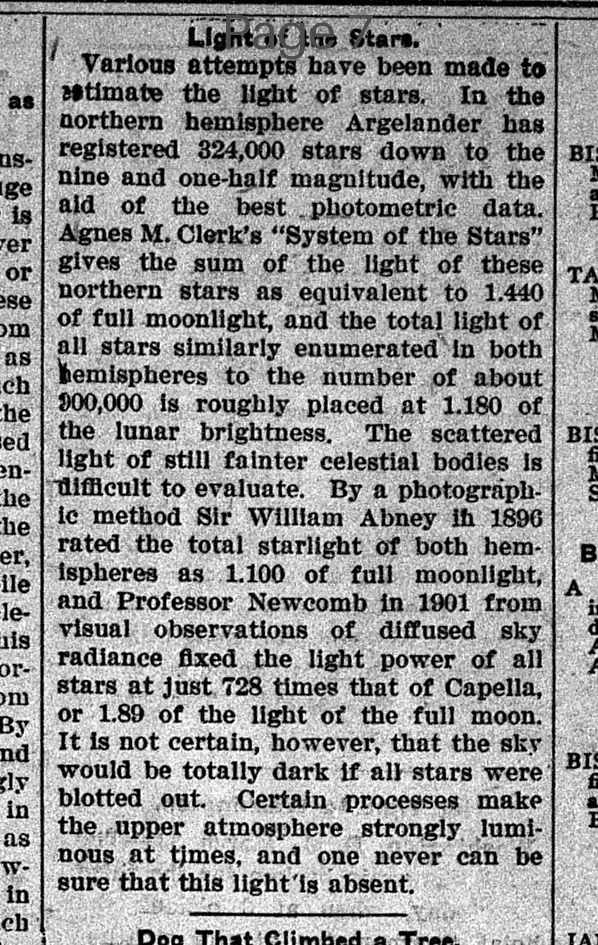
Astronomers like Argelander, Clerk, Abney, and Newcomb estimated total starlight from both hemispheres as equivalent to 1,100-1,180 full moons, with challenges in evaluating fainter stars and potential atmospheric glow preventing total darkness.
Clipping
OCR Quality
Full Text
It is not certain, however, that the sky would be totally dark if all stars were blotted out. Certain processes make the upper atmosphere strongly luminous at times, and one never can be sure that this light is absent.
What sub-type of article is it?
What themes does it cover?
What keywords are associated?
What entities or persons were involved?
Where did it happen?
Story Details
Key Persons
Location
Northern Hemisphere, Both Hemispheres
Event Date
1896, 1901
Story Details
Estimates of starlight include Argelander's registration of 324,000 northern stars equivalent to 1,440 full moons, total for 900,000 stars at 1,180 lunar brightness; Abney's 1896 photographic method at 1,100 full moons; Newcomb's 1901 visual observations at 1.89 full moon light. Uncertainty about sky darkness without stars due to atmospheric luminosity.