Thank you for visiting SNEWPapers!
Sign up free
Rhode Island Republican
Newport, Newport County, Rhode Island
What is this article about?
This editorial condemns John Rutledge for allegedly forging letters to Robert G. Harper, intended to deceive the U.S. President and incite disorder. It defends the publication of the forgery as patriotic, criticizes Rutledge's advocate, and urges vigilance to protect the republic from internal threats. (248 characters)
Merged-components note: Merged continuation of the 'SEVENTY-FIVE No. VII' editorial on Rutledge forgery across pages, relabeling the story component to editorial.
Clippings
1 of 2
OCR Quality
Full Text
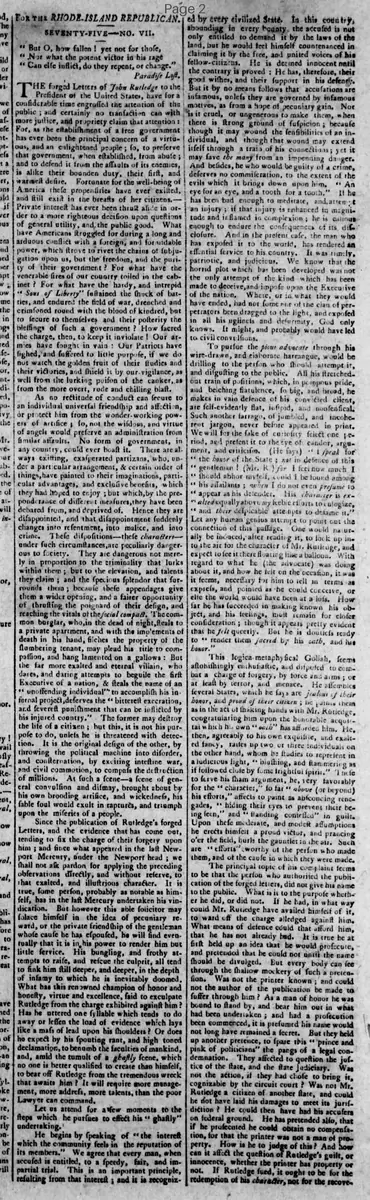
"But O, how fallen! yet not for thee,
Nor what the potent victor in his rage
Can else inflict, do they repent, or change."
THE forged Letters of Rutledge to Robert G. Harper, President of the United States, have for a considerable time engrossed the attention of the public; and certainly no transaction can with more justice, and propriety claim that attention: For, as the establishment of a free government has ever been the principal concern of a virtuous, and an enlightened people; so, to preserve that government, when established, from abuse; and to defend it from the assaults of its enemies, is alike their bounden duty, their pride, and warmest desire. Fortunate for the well-being of America these propensities have ever existed, and still exist in the breasts of her citizens.-- Private interest has ever been thrust aside in order to a more righteous decision upon questions of general utility, and, the public good. What have Americans struggled for during a long and arduous conflict with a foreign, and formidable power, which strove to rivet the chains of subjugation upon us, but the freedom, and the purity of their government? For what have the venerable sires of our country toiled in the cabinet? For what have the hardy, and intrepid "Sons of Liberty" sustained the shock of battles, and endured the field of war, drenched and crimsoned round with the blood of kindred, but to secure to themselves and their posterity the blessings of such a government? 'How sacred the charge, then, to keep it inviolate! Our armies have fought in vain: Our Patriots have sighed, and suffered to little purpose, if we do not watch the golden fruit of their toils and their victories, and shield it by our vigilance, as well from the lurking poison of the canker, as from the more overt, rude and chilling blast.
As no rectitude of conduct can secure to an individual universal friendship and affection, or protect him from the wonder-working powers of artifice; so, not the wisdom, and virtue of angels would preserve an administration from similar assaults. No form of government, in any country, could ever boast it. There are always existing, exasperated partizans, who, under a particular arrangement, & certain order of things, have painted to their imaginations, particular advantages, and exclusive benefits, which they had hoped to enjoy; but which, by the preponderance of different measures, they have been debarred from, and deprived of. Hence they are disappointed, and that disappointment suddenly changes into resentment, into malice, and into crime. These dispositions--these characters-- under such circumstances, are peculiarly dangerous to society. They are dangerous not merely in proportion to the criminality that lurks within them; but to the elevation, and talents they claim; and the precious splendor that surrounds them; because these appendages give them a wider opening, and a fairer opportunity of thrusting the poignard of their design, and reaching the vitals of the social compact. The common burglar, who, in the dead of night, steals to a private apartment, and with the instruments of death in his hand, filches the property of the slumbering tenant, may plead his title to compassion, and hang lamented on a gallows: But the far more exalted and eternal villain, who dares, and daring attempts to beguile the first Executive of a nation, & steals the name of an "unoffending individual" to accomplish his infernal project, deserves the "bitterest execration, and severest punishment that can be inflicted by his injured country." The former may destroy the life of a citizen; but this, it is not his purpose to do, unless he is threatened with detection. It is the original design of the other, by throwing the political machine into disorder, and consternation, by exciting intestine war, and civil commotion, to compass the destruction of millions. At such a scene--a scene of general convulsion and dismay, brought about by his own brooding artifice, and wickedness, his sable soul would exult in raptures, and triumph upon the miseries of a people.
Since the publication of Rutledge's forged Letters, and the evidence that has come out, tending to fix the charge of their forgery upon him; and since what appeared in the last Newport Mercury, under the Newport head; we shall not ask pardon for applying the preceding observations directly, and without reserve, to that exalted, and illustrious character. It is true, some person, probably as notable as himself, has in the last Mercury undertaken his vindication. But however this able solicitor may solace himself in the idea of pecuniary reward, or the private friendship of the gentleman whose cause he has espoused, he will find eventually that it is in his power to render him but little service. His bungling, and frothy attempts to raise, and rescue the culprit, all tend to sink him still deeper, and deeper, in the depth of infamy to which he is inevitably doomed.
What has this renowned champion of honor and honesty, virtue and excellence, aid to exculpate Rutledge from the charge exhibited against him? Has he uttered one syllable which tends to do away or lessen the load of evidence which lays like a mass of lead upon his shoulders? Or does he expect by his potuiting rant, and high toned declamation, to benumb the faculties of mankind, and, amid the tumult of a ghastly scene, which no one is better qualified to create than himself, to bear off Rutledge from the tremendous wreck that awaits him? It will require more management, more address, more talents, than the poor Lawyer can command.
Let us attend for a few moments to the steps which he pursues to effect his "ghastly" undertaking.'
He begins by speaking of "the interest which the community feels in the reputation of its members." We agree that every man, when accused is entitled, to a speedy, fair, and impartial trial. This is an important principle, resulting from that interest; and it is recognized by every civilized State. In this country abounding in every bounty, the accused is not only entitled to demand it by the laws of the land, but he would feel himself countenanced in claiming it by the free, and united voices of his fellow-citizens. He is deemed innocent until the contrary is proved: He has, therefore, their good wishes, and their support in his defense. But it by no means follows that accusations are infamous, unless they are governed by infamous motives, as from a hope of pecuniary gain. Nor is it cruel, or ungenerous to make them, when there is strong ground of suspicion; because though it may wound the sensibilities of an individual, and though that wound may extend itself through a train of his connections; yet it may save the many from an impending danger.
And besides, he who would be guilty of a crime, deserves no commiseration, to the extent of the evils which it brings down upon him. "An eye for an eye, and a tooth for a tooth." If he has been bad enough to meditate, and attempt an injury; if that injury is enhanced in magnitude and inflamed in complexion; he is callous enough to endure the consequences of its disclosure. And in the present case, the man who has exposed it to the world, has rendered an essential service to his country. It was manly, patriotic, and judicious. We know that the horrid plot which has been developed was not the only attempt of the kind which has been made to deceive, and impose upon the Executive of the nation. Where, or in what they would have ended, had not some one of the clan of perpetrators been dragged to the light, and exposed in all his ugliness and deformity, God only knows. It might, and probably would have led to civil convulsions.
To pursue the pious advocate through his wire-drawn, and elaborate harangue, would be irksome to the person who should attempt it, and disgusting to the public. All his stretched-out train of positions, which, in pompous pride, and belching flatulence, so big, and broad, he makes in vain defence of his convicted client, are self-evidently flat, insipid, and nonsensical. Such another farrago, of jumbled, and incoherent jargon, never before appeared in print.
We will for the sake of curiosity select one period, and present it to the eye of candor, argument, and criticism. (He says) "I speak for the honor of the State; not in defence of this gentleman! (Mr. R.) for I feel now much I should abhor myself, could I be found among his assailants; when I do not even presume to appear as his defender. His character is exalted equally above my feeble efforts to eulogize, and their despicable attempts to defame."
Let any human genius attempt to point out the connection of this passage. One would naturally be induced, after reading it, to look up into the air for the character of Mr. Rutledge, and expect to see it there lounging like a balloon." With regard to what he (the advocate) was doing about it, and how he felt on the occasion, it was it seems, necessary for him to tell in terms as express, and pointed as he could conceive, or else the world would have been at a loss. How far he has succeeded in making known his object, and his feelings, must remain for closer consideration; though it appears pretty evident that he felt queerly. But he is doubtless ready to "render them sacred by his oath, and his honor."
This logica-metaphysical Goliath, seems astonishingly enthusiastic, and disposed to combat a charge of forgery, by force and arms; or at least by terror, and menace. He assembles several States, which he says are jealous of their honor, and proud of their citizen; he paints them as in the act of shaking hands with Mr. Rutledge, congratulating him upon the honorable acquittal which his own "oath" has afforded him. He then, agreeably to his own exquisite, and exalted fancy, raises up two or three individuals on the other hand, whom he studies to represent in a ludicrous light, "blushing, and stammering as if followed close by some frightful spirit." In order to serve his sham argument, he, very favorably for the "character," so far "above (or beyond) his efforts," affects to paint as absconding renegades, "hiding their eyes to prevent their being seen," and "standing concealed" in guilt.
Upon these moderate, and modest assumptions he erects himself a proud victor, and prancing o'er the field, hurls the gauntlet in the air. Such are "efforts" worthy of the person who made them, and of the cause in which they were made.
The principal topic of his complaint seems to be that the person who authorized the publication of the forged letters, did not give his name to the public. What is it to the purpose whether he did, or did not. If he had, in what way could Mr. Rutledge have availed himself of it, to ward off the charge alledged against him. What means of defence could that afford him, that he has not already tried. It is true he at first held up an idea that he would prosecute, and pretended that he could not until the name should be divulged. But every body can see through the shallow mockery of such a pretension. Was not the printer known; and could not the author of the publication be made to suffer through him? As a man of honor he was bound to stand by, and bear him out in what had been undertaken; and had a prosecution been commenced, it is presumed his name would not long have remained a secret. But they held up another pretence, to spare this "prince and pink of politicians" the pangs of a legal condemnation. They affected to question the justice of the state, and the state Judiciary. Was not the action, if they had chose to bring it, cognizable by the circuit court? Was not Mr. Rutledge a citizen of another state, and could he not have laid his damages to meet its jurisdiction? He could then have had his accusers on federal ground. He has pretended also, that if he prosecuted he could obtain no compensation, for that the printer was not a man of property. How is he to judge of this? And how can it affect the question of Rutledge's guilt, or innocence, whether the printer has property or not. If Rutledge sued, it ought to be for the redemption of his character, not for the recovery of damages.
By way of money. It had become his duty to establish his innocence, if it was in his power to do it: It was a duty which he owed to himself, and to his fellow-citizens, of whose good opinions he must be so covetous. An action at law would have brought out all the evidence that could be adduced against him, and if it had not been sufficient to support the accusation, then he would have justly, and honorably triumphed. But he dare not prosecute: He shrunk with horror from a public trial, well aware of the testimony that lay against him, he knew that a judicial investigation would consign him to perdition. He, therefore, chose the worse method of committing himself to the force and credit of his party, and his friends.
What sub-type of article is it?
What keywords are associated?
What entities or persons were involved?
Editorial Details
Primary Topic
Accusation Of Forgery In Rutledge's Letters To Robert G. Harper
Stance / Tone
Strongly Condemnatory Of Rutledge And His Defender, Patriotic Exhortation To Vigilance
Key Figures
Key Arguments