Thank you for visiting SNEWPapers!
Sign up free
Salt Lake Evening Democrat
Salt Lake City, Salt Lake County, Utah
What is this article about?
At the Bay State Club's annual dinner in Boston on March 14, Hon. John G. Carlisle delivered a speech praising the club's role in advancing Democratic principles, defending state's rights, criticizing federal overreach, and affirming the current administration's success.
Merged-components note: Continuation of the same story on Carlisle's speech across columns on page 1.
Clipping
OCR Quality
Full Text
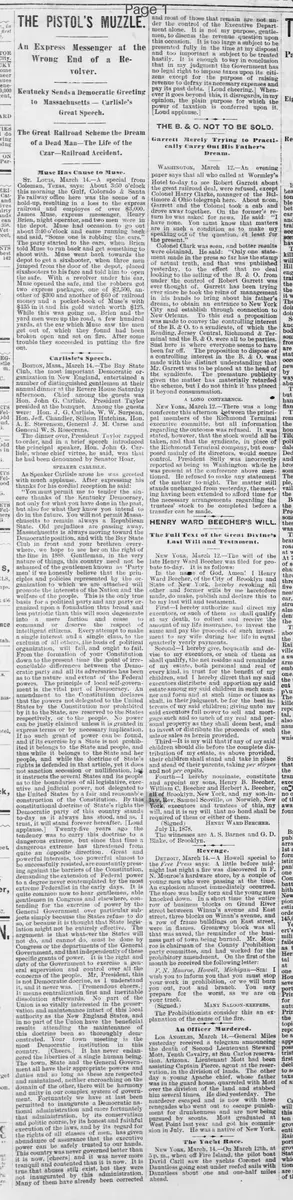
BOSTON, Mass., March 14.-The Bay State Club, the most important Democratic organization in New England, entertained a number of distinguished gentlemen at their annual dinner at the Revere House Saturday afternoon. Chief among the guests was Hon. John G. Carlisle. President Taylor presided at the banquet. Among the guests were: Hon. J. G. Carlisle, W. W. Crapo, Hon. Jeff. Chandler, Stilson Hutchins, Hon. A. E. Stevenson, General J. M. Corse and General W. S. Rosecrans.
The dinner over, President Taylor rapped to order, and in a brief speech introduced the principal speaker, Hon. John G. Carlisle, whose chief virtue, he said, was that he had been denounced by Senator Hoar.
SPEAKER CARLISLE.
As Speaker Carlisle arose he was greeted with much applause. After expressing his thanks for his cordial reception he said:
"You must permit me to tender the sincere thanks of the Kentucky Democracy, not only for what you have done in the past, but also for what they know you intend to do in the future. You will not permit Massachusetts to remain always a Republican State. Old prejudices are passing away. Massachusetts is always moving toward the Democratic position, and with the Bay State Club in front and your brethren everywhere, we hope to see her on the right of the line in 1888. Gentlemen, in the very nature of things, this country need not be ashamed of the gentlemen known as 'Party men' if we honestly believe that the principles and policies represented by the organization to which we are attached will promote the interests of the Nation and the welfare of the people. This is the only true basis for a political party and any party organized upon a foundation thus broad and less patriotic than this will soon degenerate into a mere faction and cease to command or deserve the respect of intelligent citizens. Every attempt to make a single interest and a single class, to the exclusion of all others, the basis of political organization, will fail, and ought to fail. From the formation of your Constitution down to the present time the point of irreconcilable differences between the Democratic party and all its adversaries has been as to the nature and extent of the Federal powers. The principle of local self-government is the vital part of Democracy. An amendment to the Constitution declares that the powers not delegated to the United States by the Constitution nor prohibited by it to the State, are reserved to the States respectively, or to the people. No power can be justly claimed unless it is granted in express terms or by necessary implication. If no such grant of power can be found, and if its exercise by a State is not prohibited it belongs to the State and people, and thus while it belongs to the State and her people, and while the doctrine of State's rights is defended in that article, yet it does not sanction secession or nullification, but it instructs the several States and its people as to the boundaries of all legislative, executive and judicial power, not delegated to the United States by a fair and reasonable construction of the Constitution. By this constitutional doctrine of State's rights the Democratic party of this country stands to-day as it always has stood, and as, I trust, it will stand forever hereafter. [Loud applause.] Twenty-five years ago the tendency was to carry this doctrine to a dangerous extreme, but since that time a dangerous extreme has threatened from quite an opposite direction. Great and powerful interests, too powerful almost to be successfully resisted, are constantly pressing against the barriers of the Constitution, demanding the extension of Federal power to a degree never contemplated by the most extreme Federalist in the early days. It is quite common now to hear gentlemen, able gentlemen in Congress and elsewhere, contending for the exercise of power by the General Government over particular subjects simply because the States refuse to do so, or because it is thought that State legislation might not be entirely effective. The argument is that whatever the States will not do, and cannot do, must be done by Congress or the departments of the General Government, and that independently of these specific grants of power. It is the right and duty of the Government to exercise a general supervision and control over all the concerns of the people. Mr. President, this is not Democratic doctrine, as I understand it, and it never was. [Tremendous cheers.] It means centralization first and inevitable dissolution afterwards. No part of the Union is so vitally interested in the preservation and maintenance intact of this local authority as the New England States, and in no part of the Union have the beneficial results attending the maintenance of this doctrine been so thoroughly demonstrated. Your town meeting is the most Democratic institution in this country. [Cheers.] It has never endangered the liberties of a single human being. The town, State and the General Government all have their appropriate powers and duties and so long as these are respected and maintained, neither encroaching on the domain of the other, there will be harmony and unity in our complex system of government.
When the Democratic party is permitted to inaugurate a Democratic national administration. Fortunately we have at last been blessed with such an administration and more fortunately that administration, by its conservatism and politic course, by its honest and faithful execution of the laws, and by its regard for the rights of all classes of men, has given abundance of assurance that the executive power can be safely trusted to our hands [cheers] and it was never more tranquil and contented than it is now. This country was never governed better than it is now. It is true that abuses still exist, but they were not inaugurated by this administration. Many of them have already been corrected
and most of those that remain are not under the control of the Executive Department alone. It is not my purpose, gentlemen, to discuss the revenue question upon this occasion. It is too large a subject to be presented fully in the time at my disposal and too important a subject to be treated hastily. It is enough to say in conclusion that in my judgment the Government has no legal right to impose taxes upon its citizens except for the purpose of raising revenue to defray its necessary expenses and pay its past debts. [Loud cheering.] Whenever it goes beyond this, it disregards, in my opinion, the plain purpose for which the power of taxation is conferred upon it. [Loud applause.]
What sub-type of article is it?
What themes does it cover?
What keywords are associated?
What entities or persons were involved?
Where did it happen?
Story Details
Key Persons
Location
Boston, Mass., Revere House
Event Date
March 14
Story Details
The Bay State Club hosted its annual dinner with distinguished guests including Hon. John G. Carlisle. After dinner, President Taylor introduced Carlisle, who spoke on Democratic principles, the importance of state's rights, criticism of federal overreach, praise for the current administration, and limitations on taxation.