Thank you for visiting SNEWPapers!
Sign up free
The Charlotte Democrat
Charlotte, Mecklenburg County, North Carolina
What is this article about?
Narrator Crumple describes how lazy, unprofitable farmer Sam Simpson sells his exhausted 100-acre farm to industrious German immigrant Hans Leibenstein for $30 per acre in cash, including stock and implements. Crumple bluntly criticizes Simpson's poor farming and advises him to pursue horse trading instead, while praising Hans's success through hard work.
Merged-components note: Continuation of the story 'Why Sam. Simpson Sold his Farm' across three components due to sequential reading order and coherent narrative flow on the same topic.
Clipping
OCR Quality
Full Text
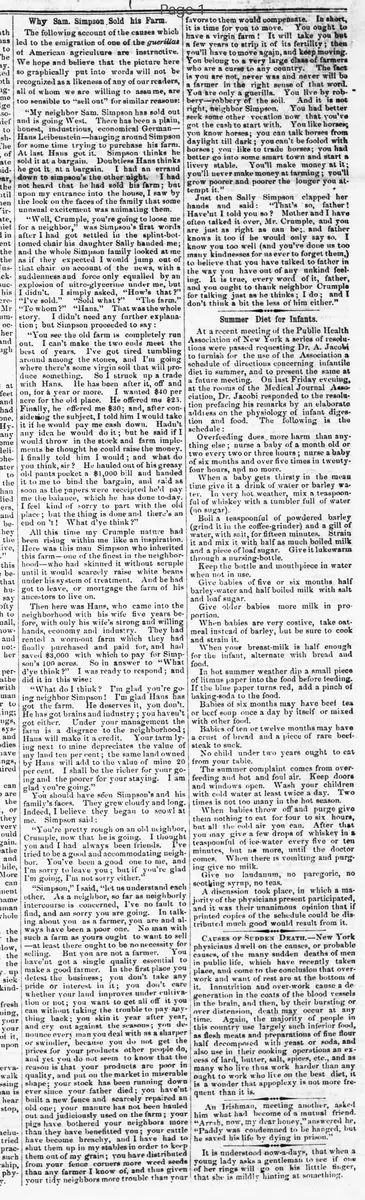
The following account of the causes which led to the emigration of one of the guerrillas of American agriculture are instructive. We hope and believe that the picture here so graphically put into words will not be recognized as a likeness of any of our readers, all of whom we are willing to assume, are too sensible to "sell out" for similar reasons:
"My neighbor Sam. Simpson has sold out and is going West. There has been a plain, honest, industrious, economical German—Hans Leibenstein—hanging around Simpson for some time trying to purchase his farm. At last Hans got it. Simpson thinks he sold it at a bargain. Doubtless Hans thinks he got it at a bargain. I had an errand down to Simpson's the other night. I had not heard that he had sold his farm; but upon my entrance into the house, I saw by the look on the faces of the family that some unusual excitement was animating them.
"Well, Crumple, you're going to lose me for a neighbor," was Simpson's first words after I had got settled in the splint-bottomed chair his daughter Sally handed me; and the whole Simpson family looked at me as if they expected I would jump out of that chair on account of the news, with a suddenness and force only equalled by an explosion of nitro-glycerine under me, but I didn't. I simply asked, "How's that?"
"I've sold."
"Sold what?"
"The farm."
"To whom?"
"Hans."
That was the whole story. I didn't need any further explanation; but Simpson proceeded to say:
"You see the old farm is completely run out. I can't make the two ends meet the best of years. I've got tired tumbling around among the stones, and I'm going where there's some virgin soil that will produce something. So I struck up a trade with Hans. He has been after it, off and on, for a year or more. I wanted $40 per acre for the old place. He offered me $25. Finally, he offered me $30; and, after considering the subject, I told him I would take it if he would pay me cash down. Hadn't any idea he would do it; but he said if I would throw in the stock and farm implements he thought he could raise the money. I finally told him I would; and what do you think, sir? He hauled out of his greasy old pants pocket a $1,000 bill and handed it to me to bind the bargain, and said as soon as the papers were receipted he'd pay me the balance, which he has done to-day. I feel kind of sorry to part with the old place; but the thing is done and there's an end on 't! What d'ye think?"
All this time my Crumple nature had been rising within me like an inspiration. Here was this man Simpson who inherited this farm—one of the finest in the neighborhood—who had skinned it without scruple until it would scarcely raise white beans under his system of treatment. And he had got to leave, or mortgage the farm of his ancestors to live on.
Then here was Hans, who came into the neighborhood with his wife five years before, with only his wife's strong and willing hands, economy and industry. They had rented a worn-out farm which they had finally purchased and paid for, and had saved $3,000 with which to pay for Simpson's 100 acres.
So in answer to "What d'ye think?" I was ready to respond; and did it in this wise:
"What do I think? I'm glad you're going neighbor Simpson! I'm glad Hans has got the farm. He deserves it, you don't. He has got brains and industry; you haven't got either. Under your management the farm is a disgrace to the neighborhood; Hans will make it a credit. Your farm lying next to mine depreciates the value of my land ten per cent; the same land owned by Hans will add to the value of mine 20 per cent. I shall be the richer for your going and the poorer for your staying. I am glad you're going."
You should have seen Simpson's and his family's faces. They grew cloudy and long. Indeed, I believe they began to scowl at me. Simpson said:
"You're pretty rough on an old neighbor, Crumple, now that he is going. I thought you and I had always been friends. I've tried to be a good and accommodating neighbor. You've been a good one to me, and I'm sorry to leave you; but if you're glad I'm going, I'm not sorry either."
"Simpson," I said, "let us understand each other. As a neighbor, so far as neighborly intercourse is concerned, I've no fault to find, and am sorry you are going. In talking about you as a farmer, you are and always have been a poor one. No man with such a farm as yours ought to want to sell—at least there ought to be no necessity for selling. But you are not a farmer. You haven't got a single quality essential to make a good farmer. In the first place you detest the business; you don't take any pride or interest in it; you don't care whether your land improves under cultivation or not; you want to get all off it you can without taking the trouble to pay anything back; you skin it year after year, and cry out against the seasons; you denounce every man you deal with as a sharper or swindler, because you do not get the prices for your products other people do, and yet you do not seem to know that the reason is that your products are poor in quality, and put on the market in miserable shape; your stock has been running down ever since your father died; you haven't built a new fence and scarcely repaired an old one; your manure has not been hauled out and judiciously used on the farm; your pigs have bothered your neighbors more than they have benefitted you; your cattle have become breachy, and I have had to shut them up in my stables in order to keep them out of my grain; you have distributed from your fence corners more weed seeds than any farmer I know of, and thus given your tidy neighbors more trouble than your favors to them would compensate. In short, it is time for you to move. You ought to have a virgin farm! It will take you but a few years to strip it of its fertility; then you'll have to move again, and keep moving. You belong to a very large class of farmers who are a curse to any country. The fact is you are not, never was and never will be a farmer in the right sense of that word. You are only a guerrilla. You live by robbery—robbery of the soil. And it is not right, neighbor Simpson. You had better seek some other vocation now that you've got the cash to start with. You like horses; you know horses; you can talk horses from daylight till dark; you can't be fooled with horses; you like to trade horses; you had better go into some smart town and start a livery stable. You'll make money at it; you'll never make money at farming; you'll grow poorer and poorer the longer you attempt it."
Just then Sally Simpson clapped her hands and said: "That's so, father! Haven't I told you so? Mother and I have often talked it over, Mr. Crumple, and you are just as right as can be; and father knows it too if he would only say so. I know you too well (and you've done us too many kindnesses for us ever to forget them,) to believe that you have talked to father in the way you have out of any unkind feeling. It is true, every word of it, father, and you ought to thank neighbor Crumple for talking just as he thinks; I do; and I don't think a bit the less of him either."
What sub-type of article is it?
What themes does it cover?
What keywords are associated?
What entities or persons were involved?
Where did it happen?
Story Details
Key Persons
Location
Neighborhood Farm
Story Details
Lazy farmer Sam Simpson sells his depleted inherited farm to hardworking German immigrant Hans Leibenstein for $3,000 cash. Narrator Crumple criticizes Simpson's poor practices that exhausted the soil and advises him to switch to horse trading, while praising Hans's industry that enabled him to buy the property.