Thank you for visiting SNEWPapers!
Sign up free
The Nashville Daily Union
Nashville, Davidson County, Tennessee
What is this article about?
On February 13, 1863, the U.S. War Department orders a court of inquiry at Cairo into military officers' involvement in cotton and other traffic on the Mississippi River, permits for trade, and misuse of government property. The article suspects corruption among officers and notes the Emancipation Proclamation's positive effect on European sympathies, countering Southern propaganda in the London Times.
Clipping
OCR Quality
Full Text
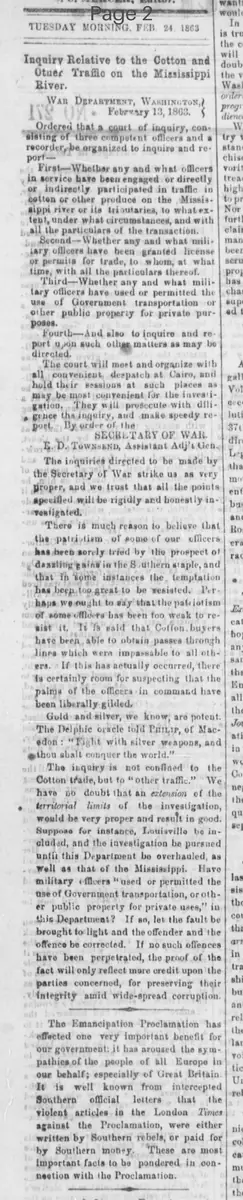
Inquiry Relative to the Cotton and Other Traffic on the Mississippi River.
WAR DEPARTMENT, WASHINGTON, Feb. 13, 1863.
Ordered, that a court of inquiry, consisting of three competent officers and a recorder, be organized to inquire and report:
First—Whether any and what officers in service have been engaged or directly or indirectly participated in traffic in cotton or other produce on the Mississippi river or its tributaries, to what extent, under what circumstances, and with all the particulars of the transaction.
Second—Whether any and what military officers have been granted license or permits for trade, to whom, at what time, with all the particulars thereof.
Third—Whether any and what military officers have used or permitted the use of Government transportation or other public property for private purposes.
Fourth—And also to inquire and report upon such other matters as may be directed.
The court will meet and organize with all convenient despatch at Cairo, and hold their sessions at such places as may be most convenient for the investigation. They will prosecute with diligence this inquiry, and make speedy report.
By order of the
SECRETARY OF WAR.
E. D. TOWNSEND, Assistant Adj't Gen.
The inquiries directed to be made by the Secretary of War strike us as very proper, and we trust that all the points specified will be rigidly and honestly investigated.
There is much reason to believe that the patriotism of some of our officers has been sorely tried by the prospect of dazzling gains in the Southern staple, and that in some instances the temptation has been too great to be resisted. Perhaps we ought to say that the patriotism of some officers has been too weak to resist it. It is said that cotton-buyers have been able to obtain passes through lines which were impassable to all others. If this has actually occurred, there is certainly room for suspecting that the palms of the officers in command have been liberally gilded.
Gold and silver, we know, are potent. The Delphic oracle told Philip, of Macedon: "Fight with silver weapons, and thou shalt conquer the world."
The inquiry is not confined to the cotton trade, but to "other traffic." We have no doubt that an extension of the territorial limits of the investigation, would be very proper and result in good. Suppose, for instance, Louisville be included, and the investigation be pursued until this Department be overhauled, as well as that of the Mississippi. Have "military officers" used or permitted the use of Government transportation, or other public property for private uses," in this Department? If so, let the fault be brought to light and the offender and the offence be corrected. If no such offences have been perpetrated, the proof of the fact will only reflect more credit upon the parties concerned, for preserving their integrity amid wide-spread corruption.
The Emancipation Proclamation has effected one very important benefit for our government: it has aroused the sympathies of the people of all Europe in our behalf; especially of Great Britain. It is well known from intercepted Southern official letters that the violent articles in the London Times against the Proclamation, were either written by Southern rebels, or paid for by Southern money. These are most important facts to be pondered in connection with the Proclamation.
What sub-type of article is it?
What themes does it cover?
What keywords are associated?
What entities or persons were involved?
Where did it happen?
Story Details
Key Persons
Location
Mississippi River, Cairo, Washington, Louisville
Event Date
Feb. 13, 1863
Story Details
The War Department orders a court of inquiry into military officers' participation in cotton trade, trade permits, and misuse of government property on the Mississippi River. Commentary suspects corruption via bribes and suggests extending the probe. Notes the Emancipation Proclamation's role in gaining European support against Southern propaganda.