Thank you for visiting SNEWPapers!
Sign up free
Alpena Weekly Argus
Alpena, Alpena County, Michigan
What is this article about?
Young Baron Paul de Brantel faces financial ruin from dissipation, but discovers his servant Pierre, friend M. de Rosel, and love Jeanne de Rosel schemed as 'usurers' to protect his fortune. Jeanne, using her inheritance, lent money at high rates to curb his spending, leaving him with 250,000 francs. They marry, resolving his crisis.
Clipping
OCR Quality
Full Text
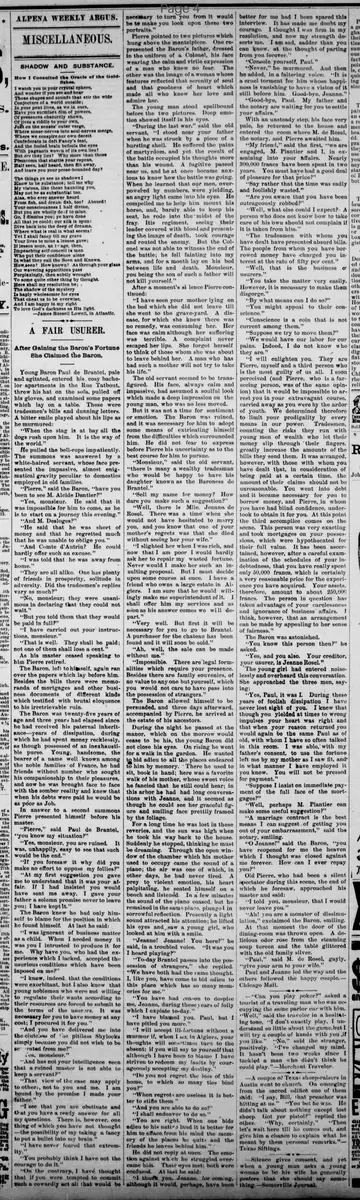
After Gaining the Baron's Fortune She Claimed the Baron.
Young Baron Paul de Brantel, pale and agitated, entered his cosy bachelor apartments in the Rue Taitbout, threw his hat on the sofa, pulled off his gloves, and examined some papers which lay on a table. These were tradesmen's bills and dunning letters.
A bitter smile played about his lips as he murmured:
"When the stag is at bay all the dogs rush upon him. It is the way of the world."
He pulled the bell-rope impatiently. The summons was answered by a white-haired servant, whose face presented the impassive, almost enigmatical gravity peculiar to domestics employed in old families.
"Pierre," said the Baron, "have you been to see M. Alcide Dantier?"
"Yes, monsieur. He said that it was impossible for him to come, as he is to start on a journey this evening."
"And M. Desloges?"
"He said that he was short of money and that he regretted much that he was unable to oblige you."
"And Comte d'Autrin? He could hardly offer such an excuse."
"I was told that he was away from home."
They are all alike. One has plenty of friends in prosperity, solitude in adversity. Did the tradesmen's replies vary as much?"
"No, monsieur; they were unanimous in declaring that they could not wait."
"But you told them that they would be paid in full?"
"I have carried out your instructions, monsieur."
"That is well. They shall be paid: not one of them shall lose a cent."
As his master ceased speaking to him Pierre retired.
The Baron, left to himself, again ran over the papers which lay before him. Besides the bills there were memoranda of mortgages and other business documents of different kinds which testified with brutal eloquence to his irretrievable ruin.
The Baron was twenty-five years of age and three years had elapsed since he had received his paternal inheritance-years of dissipation, during which he had spent money recklessly, as though possessed of an inexhaustible purse. Young, handsome, the bearer of a name well known among the noble families of France, he had friends without number who sought his companionship in their pleasures, and now he was brought face to face with the somber reality and knew that when his debts were paid he would be as poor as Job.
In answer to a second summons Pierre presented himself before his master.
"Pierre," said Paul de Brantel "you know my situation?"
"Yes, monsieur, you are ruined. It was, unhappily, easy to see that such would be the end."
"If you foresaw it why did you make no effort to oppose my follies?"
"At my first suggestion you gave me to understand that it was your affair. If I had insisted you would have sent me away. I gave your father a solemn promise never to leave you; I have kept it."
The Baron knew he had only himself to blame for the position in which he found himself. At last he said:
"I was ignorant of business matters as a child. When I needed money it was you I intrusted to procure it for me. Why have you, who had the experience which I lacked, accepted the usurious conditions which have been imposed on me?"
"I know, indeed, that the conditions were exorbitant, but I also knew that young noblemen who were not willing to regulate their wants according to their resources are forced to submit to the terms of the usurers. It was necessary for you to have money at any cost; I procured it for you."
"And you have delivered me into the clutches of the pitiless Shylocks simply because you did not wish to be separated from me?"
"Yes, monsieur."
"And has not your intelligence seen that a ruined master is not able to keep a servant?"
"That view of the case may apply to others, not to you and me. I am bound by the promise I made your father."
"I see that you are obstinate and that you have a ready answer for all my questions. There is, however, one thing of which you have not thought—the possibility of my taking a fancy to put a bullet into my brain."
"I have never feared that extremity."
"You probably think I have not the courage to do it."
"On the contrary, I have thought that if you were tempted to commit such a cowardly act all that would be necessary to turn you from it would be to make you look upon these two portraits."
Pierre pointed to two pictures which hung above the mantelpiece. One represented the Baron's father, dressed in the uniform of a Colonel, his face wearing the calm and virile expression of a man who knew no fear. The other was the image of a woman whose features reflected that serenity of soul and that goodness of heart which made all who knew her love and admire her.
The young man stood spellbound before the two pictures. Deep emotion showed itself in his eyes.
"During the last war," said the old servant, "I stood near your father when he was struck by a piece of a bursting shell. He suffered the pains of martyrdom, and yet the result of the battle occupied his thoughts more than his wound. A fugitive passed near us, and he at once became anxious to know how the battle was going. When he learned that our men, overpowered by numbers, were yielding, an angry light came into his eyes. He compelled me to help him mount his horse, and, barely able to keep his seat, he rode into the midst of the fray. His regiment, seeing their leader covered with blood and presenting the image of death, took courage and routed the enemy. But the Colonel was not able to witness the end of the battle; he fell fainting into my arms, and for a month lay on his bed between life and death. Monsieur, you being the son of such a father will not kill yourself."
After a moment's silence Pierre continued:
"I have seen your mother lying on the bed which she did not leave till she went to the graveyard. A disease, for which she knew there was no remedy, was consuming her. Her face was calm although her suffering was terrible. A complaint never escaped her lips. She forgot herself to think of those whom she was about to leave behind her. A man who has had such a mother will not try to take his life."
The old servant seemed to be transfigured. His face, always calm and impassive, had assumed a soulful look which made a deep impression on the young man, who was no less moved.
But it was not a time for sentiment or emotion. The Baron was ruined, and it was necessary for him to adopt some means of extricating himself from the difficulties which surrounded him. He did not fear to express before Pierre his uncertainty as to the best course for him to pursue.
"Monsieur," said the old servant "there is many a wealthy tradesman who would be happy to have his daughter known as the Baroness de Brantel."
"Sell my name for money? How dare you make such a suggestion?"
"Well, there is Mlle. Jeanne de Rosel. There was a time when she would not have hesitated to marry you, and you know that one of your mother's regrets was that she died without seeing her your wife."
"I slighted her when I was rich, and now that I am poor I would hardly ask her to repair my wasted fortune. Never would I make her such an insulting proposal. But I must decide upon some course at once. I have a friend who owns a large estate in Algiers. I am sure that he would willingly make me superintendent of it. I shall offer him my services and as soon as his answer comes we will depart."
"Very well. But first it will be necessary for you to go to Brantel. A purchaser for the chateau has been found and it will soon be sold."
"Ah, well, the sale can be made without me."
"Impossible. There are legal formalities which require your presence. Besides there are family souvenirs, of no value to any one but yourself, which you would not care to have pass into the possession of strangers."
The Baron allowed himself to be persuaded, and three days afterward, accompanied by Pierre, he arrived at the estate of his ancestors.
During the night he passed at the manor, which on the morrow would cease to be his, the young Baron did not close his eyes. On rising he went for a walk in the garden. He wanted to bid adieu to all the places endeared to him by memory. There he used to sit, book in hand; here was a favorite walk of his mother, whose sweet voice he fancied that he still could hear; in this arbor he had had long conversations with Jeanne, and it seemed as though he could see her graceful figure and smiling face prettily framed by the foliage.
For a long time he was lost in these reveries, and the sun was high when he took his way back to the house. Suddenly he stopped, thinking he must be dreaming. Through the open window of the chamber which his mother used to occupy came the sound of a piano; the air was one of which, in other days, he had never tired. A prey to violent emotion, his heart palpitating, he seated himself on a bench and listened. In a few minutes the sound of the piano ceased, but he remained in the same place, plunged in sorrowful reflection. Presently a light sound attracted his attention; he lifted his eyes and saw a young girl, who looked at him with a smile.
"Jeanne! Jeanne! You here?" he said, in a troubled voice. "It was you I heard playing?"
"To-day Brantel passes into the possession of strangers," she replied. "We have both had the same thought. I, like you, have come to bid adieu to this place which has so many memories for me."
"You have had reason to despise me, Jeanne, during these years of folly which I expiate to-day."
"I have blamed you, Paul, but I have pitied you more."
"I will accept ill-fortune without a murmur if, when I am in Algiers, your thoughts will sometimes turn to the absent; if you will say to yourself that although I have been to blame I have striven to redeem my faults by courageously accepting my destiny."
"Do you not regret the loss of this home, to which so many ties bind you?"
"When regrets are useless it is better to stifle them."
"And you are able to do so?"
"I shall endeavor to do so."
"You are right. When one bids adieu to his native land it is better for him to efface from his mind the memory of the places he quits and the friends he leaves behind him."
He did not reply at once. The emotion against which he struggled overcame him. Their eyes met; both were confused. At last he said:
"I thank you, Jeanne, for coming, although it would, perhaps, have been better for me had I been spared this interview. It has made me doubt my courage. I thought I was firm in my resolution, and now my strength deserts me. I am sad, sadder than you can know, at the thought of parting from you forever."
"Console yourself, Paul."
"Never," he murmured. And then he added, in a faltering voice: "It is a cruel torment for him whose happiness is vanishing to have a vision of it still before him. Good-bye, Jeanne."
"Good-bye, Paul. My father and the notary are waiting for you to settle your affairs."
With an unsteady step, his face very pale, he returned to the house and entered the room where M. de Rosel, the notary, and Pierre awaited him.
"My friend," said the first, "we are engaged, M. Plantier and I, in examining into your affairs. Nearly 300,000 francs have been spent in two years. You must have had a good deal of pleasure for that price?"
"Say rather that the time was sadly and foolishly wasted."
"Are you aware that you have been outrageously robbed?"
"Well, what else could I expect? A person who does not know how to take care of his own should not complain if it is taken from him."
"The tradesmen with whom you have dealt have presented absurd bills. The people from whom you have borrowed money have charged you interest at the rate of fifty per cent."
"Well, that is the business of usurers."
"You take the matter very easily. However, it is necessary to make them disgorge."
"By what means can I do so?"
"You might appeal to their conscience."
"Conscience is a coin that is not current among them."
"Suppose we try to move them?"
"We would have our labor for our pains. Indeed, I do not know who they are."
"I will enlighten you. They are Pierre, myself and a third person who is the most guilty of us all. I soon perceived (and Pierre, who is a far-seeing person, was of the same opinion) that it would be impossible to arrest you in your extravagant course, carried away as you were by the ardor of youth. We determined therefore to limit your prodigality by every means in our power. Tradesmen, counting the risks they run with young men of wealth who let their money slip through their fingers, greatly increase the amounts of the bills they send them. It was arranged, however, with those with whom you have dealt that, in consideration of being paid at a certain time, the amount of their claims should not be unreasonable. You went into debt and it became necessary for you to borrow money, and Pierre, in whom you have had blind confidence, undertook to obtain it for you. At this point the third accomplice comes on the scene. This person was very exacting and took mortgages on your possessions, which were hypothecated for their full value. It has been ascertained, however, after a careful examination of the schedules of your indebtedness, that you have really spent only 50,000 francs, which is certainly a very reasonable price for the experience you have acquired. Your assets, therefore, amount to about 250,000 francs. The person in question has taken advantage of your carelessness and ignorance of business affairs. I think, however, that an arrangement can be made by appealing to her sense of fairness."
The Baron was astonished.
"You know this person then?" he asked.
"Yes, and you also. Your creditor your usurer, is Jeanne de Rosel."
The young girl had entered noiselessly and overheard this conversation. She approached the three men, saying:
"Yes, Paul, it was I. During these years of foolish dissipation I have never lost sight of you. I knew that though you yielded at times to wrong impulses your heart was right and that when your reason returned you would again be the same Paul as of old, with whom I have so often talked in this room. I was able, with my father's consent, to use the fortune left me by my mother as I saw fit, and in what manner I have employed it you know. You will not be pressed for payment."
"Suppose I insist on immediate payment of the full face of the mortgages?"
"Well, perhaps M. Plantier can make some useful suggestion?"
"A marriage contract is the best means I can suggest of getting you out of your embarrassment," said the notary, smiling.
"O Jeanne!" said the Baron, "you have reopened for me the heaven which I thought was closed against me forever. How can I ever repay you?"
Old Pierre, who had been a silent spectator during this scene, the end of which he foresaw, approached his master and said:
"I told you, monsieur, that I would never leave you."
"Ah! you are a monster of dissimulation," exclaimed the Baron, smiling.
At that moment the door of the dining-room was thrown open. A delicious odor rose from the steaming soup tureen and the table glittered with the old family silver.
"Paul," said M. de Rosel, gayly. "give your arm to your wife."
Paul and Jeanne led the way and the others followed the happy couple.
-Chicago Mail.
What sub-type of article is it?
What themes does it cover?
What keywords are associated?
What entities or persons were involved?
Where did it happen?
Story Details
Key Persons
Location
Rue Taitbout, Brantel Estate, France
Story Details
Baron Paul de Brantel believes himself ruined by dissipation and debts, but discovers that Pierre, M. de Rosel, and Jeanne de Rosel inflated bills and lent money at high rates to limit his spending, preserving most of his fortune. Jeanne, his former love, reveals her role as the main 'usurer' using her inheritance. They reconcile and marry.