Thank you for visiting SNEWPapers!
Sign up free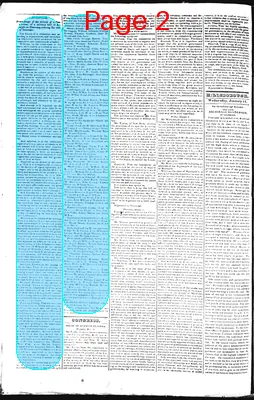
The Hillsborough Recorder
Hillsboro, Orange County, North Carolina
What is this article about?
On December 26, friends of a constitutional convention met in Raleigh, NC, adopting resolutions criticizing unequal representation, annual assemblies, and calling for a convention to amend the state constitution. Committees of correspondence were appointed statewide.
Clipping
OCR Quality
Full Text
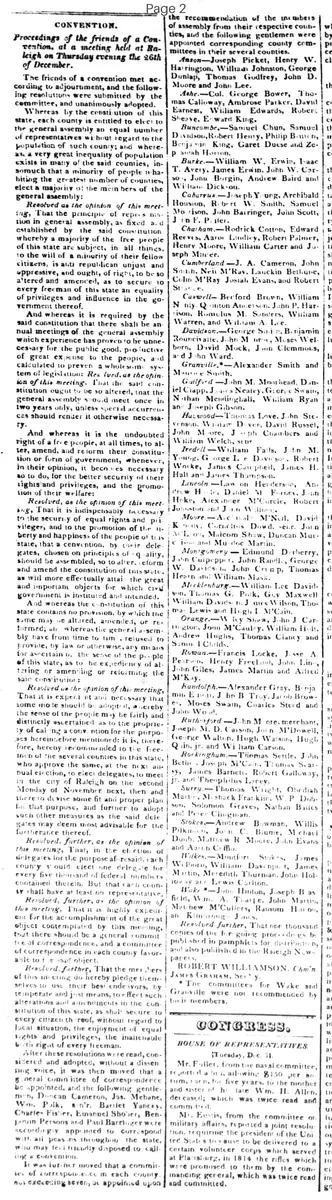
Proceedings of the friends of a Convention, at a meeting held at Raleigh on Thursday evening the 26th of December.
The friends of a convention met according to adjournment, and the following resolutions were submitted by the committee, and unanimously adopted.
Whereas by the constitution of this state, each county is entitled to elect to the general assembly an equal number of representatives without regard to the population of such county; and whereas, a very great inequality of population exists in many of the said counties, insomuch that a minority of people inhabiting the greatest number of counties, elect a majority of the members of the general assembly:
Resolved as the opinion of this meeting, That the principle of representation in general assembly, as fixed and established by the said constitution whereby a majority of the free people of this state are subject, in all things, to the will of a minority of their fellow citizens, is anti-republican unjust and oppressive, and ought, of right, to be so altered and amended, as to secure to every freeman of this state an equality of privileges and influence in the government thereof.
And whereas it is required by the said constitution that there shall be annual meetings of the general assembly which experience has proven to be unnecessary for the public good, productive of great expense to the people, and calculated to prevent a wholesome system of legislation: Resolved, as the opinion of this meeting, That the said constitution ought to be so altered, that the general assembly should meet once in two years only, unless special occurrences should render it otherwise necessary.
And whereas it is the undoubted right of a free people, at all times, to alter, amend, and reform their constitution or form of government, whenever, in their opinion, it becomes necessary so to do, for the better security of their rights and privileges, and the promotion of their welfare:
Resolved, as the opinion of this meeting, That it is indispensably necessary to the security of equal rights and privileges, and to the promotion of the liberty and happiness of the people of this state, that a convention, by their delegates, chosen on principles of equality, should be assembled, so to alter, reform and amend the constitution of this state, as will more effectually attain the great and important objects for which civil government is instituted and intended.
And whereas the constitution of this state contains no provision, by which the same may be altered, amended, or reformed: and whereas the general assembly have from time to time, refused to provide, by law or otherwise, any means for ascertaining the sense of the people of this state, as to the expediency of altering or amending or reforming the said constitution :
Resolved as the opinion of this meeting, That it is expedient and necessary that some mode should be adopted, whereby the sense of the people may be fairly and distinctly ascertained as to the propriety of calling a convention for the purposes hereinbefore mentioned: it is, therefore, hereby recommended to the free men of the several counties in this state, who approve the same, at the next annual election, to elect delegates, to meet in the city of Raleigh on the second Monday of November next, then and there to devise some fit and proper plan for that purpose, and further to adopt such other measures as the said delegates may deem most advisable for the furtherance thereof.
Resolved, further, as the opinion of this meeting, That, in the election of delegates for the purpose aforesaid, each county should elect one delegate for every five thousand of federal number contained therein. But that each county shall have at least one representative.
Resolved, further, as the opinion of this meeting, That it is highly expedient for the accomplishment of the great object contemplated by this meeting, that there should be a general committee of correspondence, and a committee of correspondence in each county favorable to the said object.
Resolved, further, That the members of this meeting do hereby pledge themselves to use their best endeavors, by temperate and just means, to effect such alterations and amendments in the constitution of this state, as shall secure to every citizen thereof, without regard to local situation, the enjoyment of equal rights and privileges, the inalienable birth right of every freeman.
After these resolutions were read, considered and adopted, without a dissenting voice, it was then moved that a general committee of correspondence be appointed, and the following gentlemen, Duncan Cameron, Jas. Mebane, Wm. Polk, Bartlett Yancey, Charles Fisher, Emanuel Shober, Benjamin Persons and Paul Barringer were accordingly appointed to correspond with all persons throughout the state, who may feel friendly disposed to calling a convention.
It was further moved that a committee of correspondence in each county not exceeding seven, be appointed upon the recommendation of the members of assembly from their respective counties, and the following gentlemen were appointed corresponding county committees in their several counties.
Anson—Joseph Picket, Henry W. Harrington, William Johnston, George Dunlap, Thomas Godfrey, John D. Moore and John Lee.
Ashe—Col. George Bower, Thomas Calloway, Ambrose Parker, David Earnest, William Edwards, Robert Sheave, Edward King.
Buncombe—Samuel Chunn, Samuel Davidson, Robert Henry, Philip Burton, Benjamin King, Garrett Deweese and Zephaniah Horton.
Burke—William W. Erwin, Isaac T. Avery, James Erwin, John W. Carson, John Burgin, Andrew Baird and William Dickson.
Cabarrus—Joseph Young, Archibald Houston, Robert W. Smith, Samuel Morrison, John Barringer, John Scott, John F. Phifer.
Chatham—Rodrick Cotton, Edward Reeves, Aaron Lindley, Robert Palmer, Henry Moore, William Carter and Joseph Minor.
Cumberland—J. A. Cameron, John Sallib, Neil M'Rae, Lauchlin Bethune, Colin M'Rae, Josiah Evans, and Robert Strange.
Caswell—Bedford Brown, William N. Niny, Clinton Anderson, John P. Harris, Romulus M. Saunders, William Warren, and William A. Little.
Davidson—George Snider, Benjamin Roundtree, John Mart, Moses Welborn, David Mock, Jun. Clemmons, and John Ward.
Granville—Alexander Smith and Murphey Smith.
Guilford—John M. Moorehead, Daniel Clapp, James Needham, George Swain, Nathan Mendinghall, William Ryan and Joseph Gibson.
Haywood—Thomas Love, John Stevenson, William Dover, David Russel, John Moore, Joseph Chambers and William Welch, senr.
Iredell—William Falls, John M. Young, George E. Davis, Robert Worke, James Campbell, James H. Hall and James Thomson.
Lincoln—Lawson Henderson, Andrew Hoke, Daniel Forney, John Hoke, Alexander McCorkle, Robert Johnston and John Wilson.
Moore—Archibald McNul, David Kennedy, Cornelius Doud, senr. John Lott, Malcolm Shaw, Duncan Murphy and Murdock Martin.
Montgomery—Edmund Derberry, John Cuppiddle, John Randle, George W. Davis, John Craig, Thomas Hearn and William Meask.
Mecklenburg—William Lee Davidson, Thomas G. Polk, Ely Maxwell, William Davidson, James Wilson, Thomas Lewis and Hugh M'Cain.
Orange—William Shaw, John J. Carrington, John M'Cauley, William Hill, Andrew Hughes, Thomas Clancy and Samuel Childs.
Rowan—Francis Locke, Jesse A. Pearson, Henry Freeland, John Lin, John Giles, James Martin and Alfred M'Kay.
Randolph—Alexander Gray, Benjamin Elliott, John B. Troy, Jacob Brower, Moses Swain, Charles Sted and John Wood.
Rutherford—John Moore, merchant, Joseph M. Davidson, John M'Dowell, George Walton, Hugh Watson, Hugh Quinn, jr. and William Carson.
Rockingham—Thomas Settle, John Bethe, Joseph M'Call, Thomas Star, James Barnett, Robert Galloway, jr. and Theophilus Lacey.
Surry—Thomas Wright, Obediah Martin, Shack Franklin, W. P. Dobson, Solomon Graves, Nathan Bullis and Peter Clingman.
Stokes—Andrew Bowman, Willis Pickens, John C. Blunt, Michael Dobb, Matthew R. Moore, John Evans and Aaron C. McD.
Wilkes—Mountfort Stokes, James Welborn, William Davenport, James Martin, Meredith Thurman, John Holloway and Lewis Carlton.
Wake—John Hinton, Joseph Bassfield, Wm. A. Turner, John Martin, Mathew M'Cullers, Ransom Hinton, and Kimborough Jones.
Resolved further, That one thousand copies of the foregoing proceedings be published in pamphlets for distribution, and also published in the Raleigh Newspapers.
ROBERT WILLIAMSON, Chm'n
JAMES GRAHAM, Sec'y
* The committees for Wake and Granville were not recommended by their members.
What sub-type of article is it?
What keywords are associated?
What entities or persons were involved?
Where did it happen?
Domestic News Details
Primary Location
Raleigh
Event Date
Thursday Evening The 26th Of December
Key Persons
Outcome
resolutions unanimously adopted; general and county committees of correspondence appointed; proceedings to be published in 1000 pamphlets and raleigh newspapers.
Event Details
Friends of a convention met in Raleigh and adopted resolutions criticizing unequal county representation in the general assembly, annual meetings, and lack of constitutional amendment provisions. They called for electing delegates at the next annual election to meet in Raleigh on the second Monday of November to plan a convention for reforms ensuring equal rights and biennial assemblies. Committees of correspondence were appointed for the state and various counties.