Thank you for visiting SNEWPapers!
Sign up free
The Virginia Gazette
Williamsburg, Virginia
What is this article about?
Private letters from Boston dated July 4 describe economic distress and political divisions among merchants and factions opposing British policies, including failed non-importation efforts and internal distrust among colonists, leading to delayed shipments and port blockade impacts.
Clipping
OCR Quality
Full Text
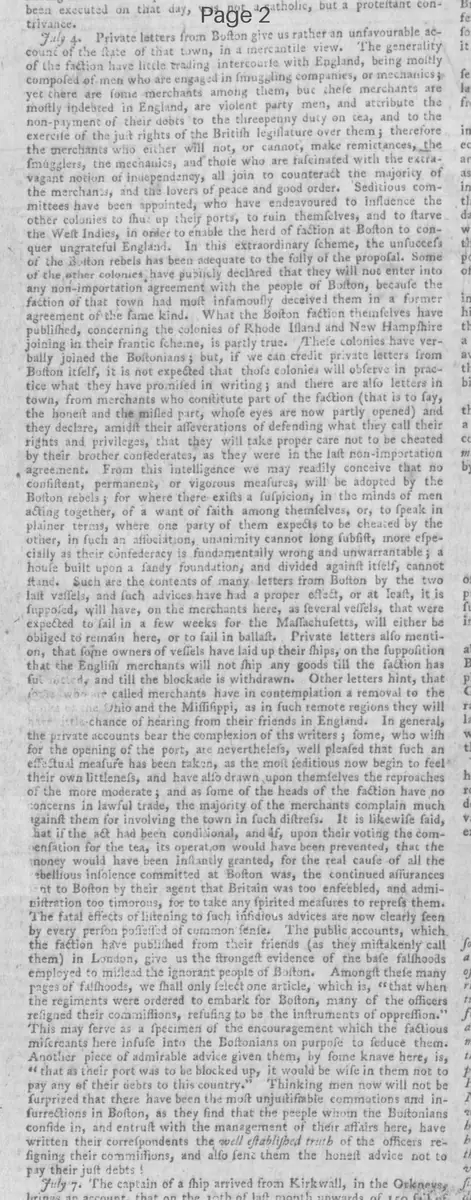
Seditious committees have been appointed, who have endeavoured to influence the other colonies to shut up their ports, to ruin themselves, and to starve the West Indies, in order to enable the herd of faction at Boston to conquer ungrateful England. In this extraordinary scheme, the unsuccess of the Boston rebels has been adequate to the folly of the proposal. Some of the other colonies have publicly declared that they will not enter into any non-importation agreement with the people of Boston, because the faction of that town had most infamously deceived them in a former agreement of the same kind.
What the Boston faction themselves have published, concerning the colonies of Rhode Island and New Hampshire joining in their frantic scheme, is partly true. These colonies have verbally joined the Bostonians; but, if we can credit private letters from Boston itself, it is not expected that those colonies will observe in practice what they have promised in writing; and there are also letters in town, from merchants who constitute part of the faction (that is to say, the honest and the misled part, whose eyes are now partly opened) and they declare, amidst their asseverations of defending what they call their rights and privileges, that they will take proper care not to be cheated by their brother confederates, as they were in the last non-importation agreement.
From this intelligence we may readily conceive that no consistent, permanent, or vigorous measures, will be adopted by the Boston rebels; for where there exists a suspicion, in the minds of men acting together, of a want of faith among themselves, or, to speak in plainer terms, where one party of them expects to be cheated by the other, in such an association, unanimity cannot long subsist, more especially as their confederacy is fundamentally wrong and unwarrantable; a house built upon a sandy foundation, and divided against itself, cannot stand.
Such are the contents of many letters from Boston by the two last weeks, and such advices have had a proper effect, or at least, it is supposed, will have, on the merchants here, as several vessels, that were expected to sail in a few weeks for the Massachusetts, will either be obliged to remain here, or to sail in ballast. Private letters also mention, that some owners of vessels have laid up their ships, on the supposition that the English merchants will not ship any goods till the faction has subsided, and till the blockade is withdrawn.
Other letters hint, that some so called merchants have in contemplation a removal to the Ohio and the Mississippi, as in such remote regions they will be at chance of hearing from their friends in England. In general, the private accounts bear the complexion of the writers; some, who wish for the opening of the port, are nevertheless, well pleased that such an effectual measure has been taken, as the most seditious now begin to feel their own littleness, and have also drawn upon themselves the reproaches of the more moderate; and as some of the heads of the faction have no concerns in lawful trade, the majority of the merchants complain much against them for involving the town in such distress.
It is likewise said, that if the act had been conditional, and if, upon their voting the compensation for the tea, its operation would have been prevented, that the money would have been instantly granted, for the real cause of all the rebellious insolence committed at Boston was, the continued asseverations to Boston by their agent that Britain was too enfeebled, and administration too timorous, to take any spirited measures to repress them. The fatal effects of listening to such insidious advices are now clearly seen by every person possessed of common sense.
The public accounts, which the faction have published from their friends (as they mistakenly call them) in London, give us the strongest evidence of the base falsehoods employed to mislead the ignorant people of Boston. Amongst these many pages of falsehoods, we shall only select one article, which is, 'that when the regiments were ordered to embark for Boston, many of the officers resigned their commissions, refusing to be the instruments of oppression.' This may serve as a specimen of the encouragement which the factious miscreants here infuse into the Bostonians on purpose to seduce them.
Another piece of admirable advice given them, by some knave here, is, that as their port was to be blocked up, it would be wise in them not to pay any of their debts to this country. Thinking men now will not be surprised that there have been the most unjustifiable commotions and insurrections in Boston, as they find that the people in whom the Bostonians confide in, and entrust with the management of their affairs here, have written their correspondents the well established truth of the officers resigning their commissions, and also sent them the honest advice not to pay their just debts!
What sub-type of article is it?
What keywords are associated?
Where did it happen?
Domestic News Details
Primary Location
Boston
Event Date
July 4
Outcome
failed non-importation agreements due to distrust among colonies; vessels delayed or laid up; internal divisions among merchants and factions; no physical casualties mentioned.
Event Details
Private letters report unfavorable mercantile conditions in Boston due to factions of smugglers, mechanics, and indebted merchants opposing British policies; seditious committees push for port closures and non-importation, but face resistance and deceit accusations from other colonies like Rhode Island and New Hampshire; overall scheme deemed folly leading to disunity.