Thank you for visiting SNEWPapers!
Sign up free
Plentywood Herald
Plentywood, Sheridan County, Montana
What is this article about?
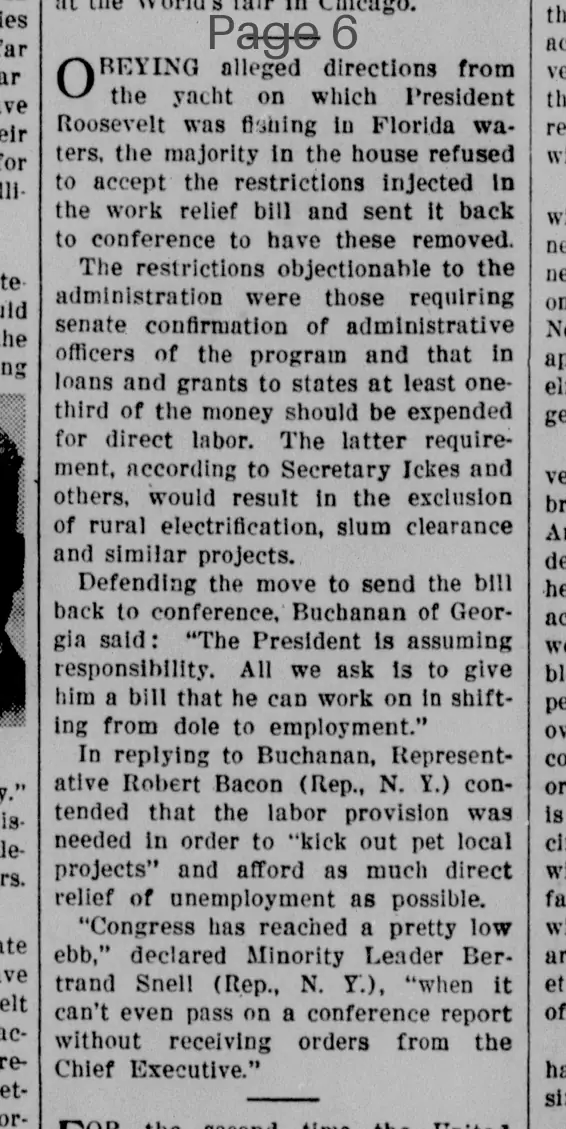
The U.S. House of Representatives, defying President Roosevelt's alleged directions, refused restrictions in the work relief bill requiring Senate confirmation of officers and one-third direct labor expenditure, sending it back to conference for removal. Objections centered on excluding rural electrification and slum clearance projects. Debates featured Rep. Buchanan defending the move and Reps. Bacon and Snell criticizing it.
Clipping
OCR Quality
Full Text
The restrictions objectionable to the administration were those requiring senate confirmation of administrative officers of the program and that in loans and grants to states at least one third of the money should be expended for direct labor. The latter requirement, according to Secretary Ickes and others, would result in the exclusion of rural electrification, slum clearance and similar projects.
Defending the move to send the bill back to conference, Buchanan of Georgia said: "The President is assuming responsibility. All we ask is to give him a bill that he can work on in shifting from dole to employment."
In replying to Buchanan, Representative Robert Bacon (Rep., N. Y.) contended that the labor provision was needed in order to "kick out pet local projects" and afford as much direct relief of unemployment as possible.
"Congress has reached a pretty low ebb," declared Minority Leader Bertrand Snell (Rep., N. Y.), "when it can't even pass on a conference report without receiving orders from the Chief Executive."
What sub-type of article is it?
What keywords are associated?
What entities or persons were involved?
Domestic News Details
Key Persons
Outcome
bill sent back to conference to remove objectionable restrictions on administrative officers and direct labor expenditure.
Event Details
Majority in the House refused to accept restrictions in the work relief bill, including Senate confirmation of officers and one-third money for direct labor in loans and grants to states, defying directions from the yacht where President Roosevelt was fishing. These would exclude rural electrification, slum clearance, and similar projects. Buchanan defended sending it back to conference to give the President a workable bill shifting from dole to employment. Bacon argued the labor provision was needed to eliminate pet local projects and maximize direct unemployment relief. Snell criticized Congress for taking orders from the Chief Executive.