Thank you for visiting SNEWPapers!
Sign up free
Story
November 4, 1897
Alexandria Gazette
Alexandria, Alexandria County, District Of Columbia
What is this article about?
Anticipated November meteor showers: Leonids on 13-14th with historical brilliance in 1833/1866, due in 1899 but visible now; Andromedes on 27th. Astronomers prepare photography despite moonlight interference.
Clipping
OCR Quality
98%
Excellent
Full Text
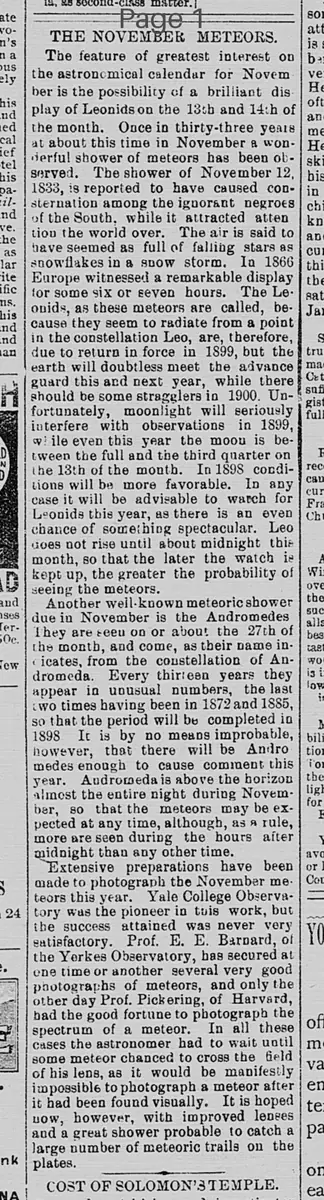
THE NOVEMBER METEORS
The feature of greatest interest on the astronomical calendar for November is the possibility of a brilliant display of Leonids on the 13th and 14th of the month. Once in thirty-three years at about this time in November a wonderful shower of meteors has been observed. The shower of November 12, 1833, is reported to have caused consternation among the ignorant negroes of the South, while it attracted attention the world over. The air is said to have seemed as full of falling stars as snowflakes in a snow storm. In 1866 Europe witnessed a remarkable display for some six or seven hours. The Leonids, as these meteors are called, because they seem to radiate from a point in the constellation Leo, are, therefore, due to return in force in 1899, but the earth will doubtless meet the advance guard this and next year, while there should be some stragglers in 1900. Unfortunately, moonlight will seriously interfere with observations in 1899, while even this year the moon is between the full and the third quarter on the 13th of the month. In 1898 conditions will be more favorable. In any case it will be advisable to watch for Leonids this year, as there is an even chance of something spectacular. Leo does not rise until about midnight this month, so that the later the watch is kept up, the greater the probability of seeing the meteors.
Another well-known meteoric shower due in November is the Andromedes. They are seen on or about the 27th of the month, and come, as their name indicates, from the constellation of Andromeda. Every thirteen years they appear in unusual numbers, the last two times having been in 1872 and 1885, so that the period will be completed in 1898. It is by no means improbable, however, that there will be Andromedes enough to cause comment this year. Andromeda is above the horizon almost the entire night during November, so that the meteors may be expected at any time, although, as a rule, more are seen during the hours after midnight than any other time.
Extensive preparations have been made to photograph the November meteors this year. Yale College Observatory was the pioneer in this work, but the success attained was never very satisfactory. Prof. E. E. Barnard, of the Yerkes Observatory, has secured at one time or another several very good photographs of meteors, and only the other day Prof. Pickering, of Harvard, had the good fortune to photograph the spectrum of a meteor. In all these cases the astronomer had to wait until some meteor chanced to cross the field of his lens, as it would be manifestly impossible to photograph a meteor after it had been found visually. It is hoped now, however, with improved lenses and a great shower probable to catch a large number of meteoric trails on the plates.
The feature of greatest interest on the astronomical calendar for November is the possibility of a brilliant display of Leonids on the 13th and 14th of the month. Once in thirty-three years at about this time in November a wonderful shower of meteors has been observed. The shower of November 12, 1833, is reported to have caused consternation among the ignorant negroes of the South, while it attracted attention the world over. The air is said to have seemed as full of falling stars as snowflakes in a snow storm. In 1866 Europe witnessed a remarkable display for some six or seven hours. The Leonids, as these meteors are called, because they seem to radiate from a point in the constellation Leo, are, therefore, due to return in force in 1899, but the earth will doubtless meet the advance guard this and next year, while there should be some stragglers in 1900. Unfortunately, moonlight will seriously interfere with observations in 1899, while even this year the moon is between the full and the third quarter on the 13th of the month. In 1898 conditions will be more favorable. In any case it will be advisable to watch for Leonids this year, as there is an even chance of something spectacular. Leo does not rise until about midnight this month, so that the later the watch is kept up, the greater the probability of seeing the meteors.
Another well-known meteoric shower due in November is the Andromedes. They are seen on or about the 27th of the month, and come, as their name indicates, from the constellation of Andromeda. Every thirteen years they appear in unusual numbers, the last two times having been in 1872 and 1885, so that the period will be completed in 1898. It is by no means improbable, however, that there will be Andromedes enough to cause comment this year. Andromeda is above the horizon almost the entire night during November, so that the meteors may be expected at any time, although, as a rule, more are seen during the hours after midnight than any other time.
Extensive preparations have been made to photograph the November meteors this year. Yale College Observatory was the pioneer in this work, but the success attained was never very satisfactory. Prof. E. E. Barnard, of the Yerkes Observatory, has secured at one time or another several very good photographs of meteors, and only the other day Prof. Pickering, of Harvard, had the good fortune to photograph the spectrum of a meteor. In all these cases the astronomer had to wait until some meteor chanced to cross the field of his lens, as it would be manifestly impossible to photograph a meteor after it had been found visually. It is hoped now, however, with improved lenses and a great shower probable to catch a large number of meteoric trails on the plates.
What sub-type of article is it?
Curiosity
Extraordinary Event
Historical Event
What themes does it cover?
Nature
What keywords are associated?
Leonids
Meteors
Andromedes
Astronomical Display
Meteor Photography
What entities or persons were involved?
Prof. E. E. Barnard
Prof. Pickering
Story Details
Key Persons
Prof. E. E. Barnard
Prof. Pickering
Event Date
November 13th And 14th, 1899; November 27th, 1898
Story Details
Description of the Leonid meteor shower expected in November, with historical displays in 1833 and 1866, anticipated return in 1899 but visible this year and next; Andromedes on the 27th; preparations to photograph meteors by Yale, Yerkes, and Harvard observatories.