Thank you for visiting SNEWPapers!
Sign up free
Phenix Gazette
Alexandria, Virginia
What is this article about?
In this letter, B.C. defends Catholicism as a divine system originating from adoration of the Creator, critiques Blanco White's 'Evidence' for fabricating experiences as a confessor in Spanish convents, citing church laws making such roles impossible for him, and condemns his critics like Bishop Kemp for ignorance. Charleston, S.C., Oct. 2, 1826.
Clipping
OCR Quality
Full Text
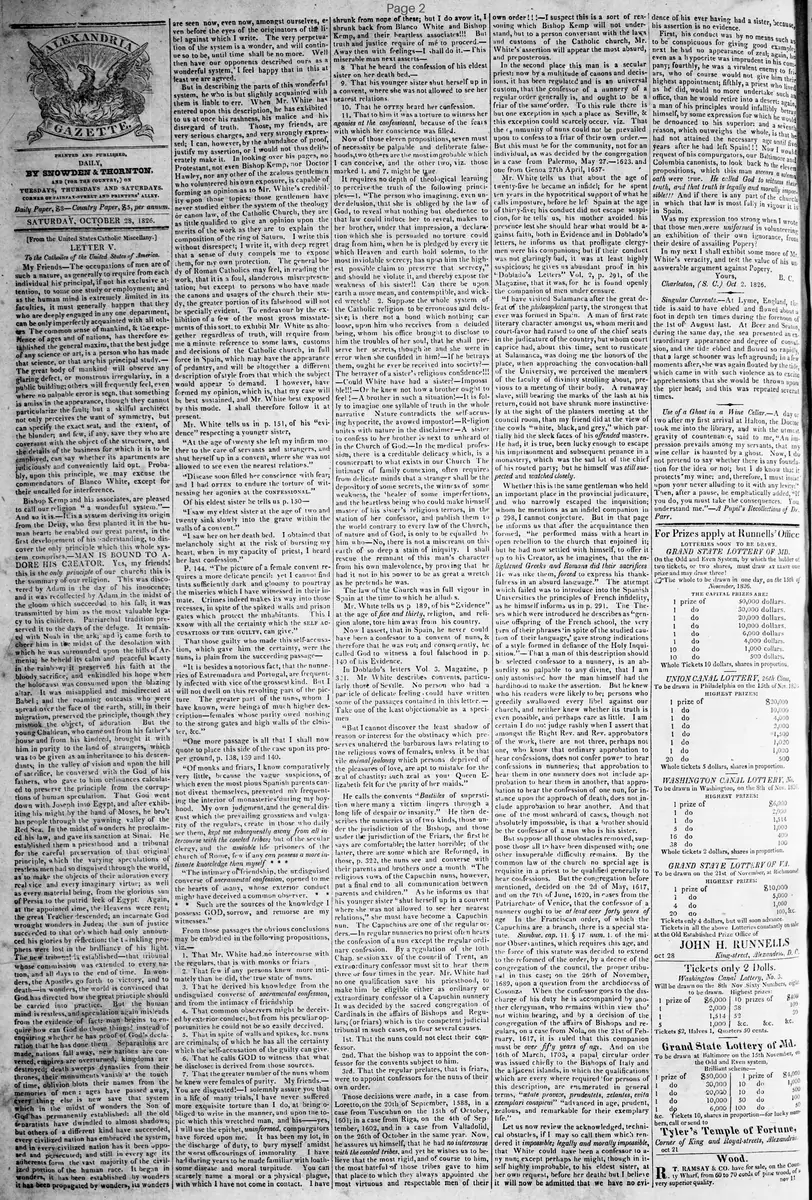
LETTER V.
To the Catholics of the United States of America.
My Friends—The occupations of men are of such a nature, as generally to require from each individual his principal, if not his exclusive attention, to some one study or employment; and as the human mind is extremely limited in its faculties, it must generally happen that they who are deeply engaged in any one department, can be only imperfectly acquainted with all others. The common sense of mankind, & the experience of ages and of nations, has therefore established the general maxim, that the best judge of any science or art, is a person who has made that science, or that art his principal study.—The great body of mankind will observe any glaring defect, or monstrous irregularity, in a public building; others will frequently feel, even where no palpable error is seen, that something is amiss in the appearance, though they cannot particularize the fault; but a skilful architect not only perceives the want of symmetry, but can specify the exact seat, and the extent, of the blunder; and few, if any, save they who are conversant with the object of the structure, and the details of the business for which it is to be employed, can say whether its apartments are judiciously and conveniently laid out. Probably, upon this principle, we may excuse the commentators of Blanco White, except for their uncalled for interference. Bishop Kemp and his associates, are pleased to call our religion
a wonderful system.
And so it is.—It is a system deriving its origin from the Deity, who first planted it in the human heart: he enabled our great parent, in the first development of his understanding, to discover the only principle which this whole system comprises,—MAN IS BOUND TO ADORE HIS CREATOR. Yes, my friends! this is the only principle of our church: this is the summary of our religion. This was discovered by Adam in the day of his innocence; and it was recollected by Adam in the midst of the gloom which succeeded to his fall; it was transmitted by him as the most valuable legacy to his children. Patriarchal tradition preserved it to the days of the deluge. It remained with Noah in the ark; and it came forth to cheer him in the midst of the desolation with which he was surrounded upon the hills of Armenia; he beheld its calm and peaceful beauty in the rainbow; it preserved his faith at the bloody sacrifice, and enkindled his hope when the holocaust was consumed upon the blazing altar. It was misapplied and misdirected at Babel; and the roaming outcasts who were spread over the face of the earth, still, in their migration, preserved the principle, though they mistook the object, of adoration. But the young Chaldean, who came out from his father's house and from his kindred, brought it with him in purity to the land of strangers, which was to be given as an inheritance to his descendants; in the valley of vision and upon the hill of sacrifice, he conversed with the God of his fathers, who gave to him ordinances calculated to preserve the principle from the corruptions of human speculation. That God went down with Joseph into Egypt, and after exhibiting his might by the hand of Moses, he brought his people through the yawning valley of the Red Sea. In the midst of wonders he proclaimed his law, and gave its sanction at Sinai. He established them a priesthood and a tribunal for the careful preservation of that original principle, which the varying speculations of restless men had so disguised through the world, as to make the objects of their adoration every real vice and every imaginary virtue; as well as every material being, from the glorious sun of Persia to the putrid leek of Egypt. Again, at the appointed time, the Heavens were rent; the great Teacher descended; an incarnate God wrought wonders in Judea; the sun of justice succeeded to that orb which had only announced his glories by reflection: the twinkling prophets were lost in the brilliancy of his light. The new tribunal is established—that tribunal whose commission was extended to every nation, and all days to the end of time. In wonders, the Apostles go forth to victory, and to death—in wonders, the world is convinced that God has directed how the great principle should be carried into practice. But the human mind is restless, and speculation again misleads from the evidence of fact: man begins to enquire how can God do those things? instead of enquiring whether he has proof of God's declaration that he has done them. Separations are made, nations fall away, new nations are converted, empires are overturned, kingdoms are destroyed; death sweeps dynasties from their thrones, their monuments vanish at the touch of time, oblivion blots their names from the memories of men: ages have passed away, every thing else is new save that system which in the midst of wonders the Son of God has permanently established: all the old separatists have dwindled to almost shadows; but others of a different kind have succeeded, every civilized nation has embraced the system, and in every civilized nation has it been opposed and persecuted; and still in every age its adherents form the vast majority of the civilized portion of the human race. It began in wonders, it has been established by wonders it has been propagated by wonders. Its wonders are seen now, even now, amongst ourselves, even before the eyes of the originators of the libel against which I write. The very perpetuation of the system is a wonder, and will continue so to be, until time shall be no more. Well then have our opponents described ours as a wonderful system, I feel happy that in this at least we are agreed.
But in describing the parts of this wonderful system, he who is but slightly acquainted with them is liable to err. When Mr. White has entered upon this description, he has exhibited to us at once his rashness, his malice and his disregard of truth. Those, my friends, are very serious charges, and very strongly expressed; I can, however, by the abundance of proof, justify my assertion, or I would not thus deliberately make it. In looking over his pages, no Protestant, not even Bishop Kemp, nor Doctor Hawley, nor any other of the zealous gentlemen who volunteered his own exposure, is capable of forming an opinion as to Mr. White's credibility upon those topics: those gentlemen have never studied either the system of the theology or canon law, of the Catholic Church, they are as little qualified to give an opinion upon the merits of the work as they are to explain the composition of the ring of Saturn. I write this without disrespect; I write it, with deep regret that a sense of duty compels me to expose them, for my own protection. The general body of Roman Catholics may feel, in reading the work, that it is a foul, slanderous misrepresentation; but except to persons who have made the canons and usages of the church their study, the greater portion of its falsehood will not be specially evident. To endeavour by the exhibition of a few of the most gross misstatements of this sort, to exhibit Mr. White as altogether regardless of truth, will require from me a minute reference to some laws, customs and decisions of the Catholic church, in full force in Spain, which may have the appearance of pedantry, and will be altogether a different description of style from that which the subject would appear to demand. I however, have formed my opinion, which is, that my case will be best sustained, and Mr. White best exposed by this mode. I shall therefore follow it at present.
Mr. White tells us in p. 151, of his "evidence" respecting a younger sister,
"At the age of twenty she left my infirm mother to the care of servants and strangers, and shut herself up in a convent, where she was not allowed to see even the nearest relations."
"Disease soon filled her conscience with fear; and I had often to endure the torture of witnessing her agonies at the confessional."
Of his eldest sister he tells us p. 150—
"I saw my eldest sister at the age of two and twenty sink slowly into the grave within the walls of a convent
I saw her on her death bed. I obtained that melancholy sight at the risk of bursting my heart, when in my capacity of priest, I heard her last confession."
P. 144. "The picture of a female convent requires a more delicate pencil: yet I cannot find tints sufficiently dark and gloomy to pourtray the miseries which I have witnessed in their intimate. Crimes indeed makes its way into those recesses, in spite of the spiked walls and prison gates which protect the inhabitants. This I know with all the certainty which the SELF ACCUSATIONS OF THE GUILTY, can give."
That those guilty who made this self-accusation, which gave him the certainty, were the nuns, is plain from the succeeding passage—
"It is besides a notorious fact, that the nunneries of Estremadura and Portugal, are frequently infected with vice of the grossest kind. But I will not dwell on this revolting part of the picture. The greater part of the nuns, whom I have known, were beings of much higher description—females whose purity owed nothing to the strong gates and high walls of the cloister, &c."
"One more passage is all that I shall now quote to place this side of the case upon its proper ground, p. 138, 139 and 140.
"Of monks and friars, I know comparatively very little, because the vague suspicions, of which even the most pious Spanish parents cannot divest themselves, prevented my frequenting the interior of monasteries during my boyhood. My own judgment, and the general disgust which the prevailing grossness and vulgarity of the regulars, create in those who daily see them, kept me subsequently away from all intercourse with the cowled tribes; but of the secular clergy, and the amiable life prisoners of the church of Rome, few if any can possess a more intimate knowledge than myself * * *
"The intimacy of friendship, the undisguised converse of sacramental confession, opened to me the hearts of many, whose exterior conduct might have deceived a common observer.
Such are the sources of the knowledge I possess: GOD, sorrow, and remorse are my witnesses."
From those passages the obvious conclusions may be embodied in the following propositions, viz.—
1. That Mr. White had no intercourse with the regulars, that is with monks or friars
2. That few if any persons knew more intimately than he did, the true state of nuns.
3. That he derived his knowledge from the undisguised converse of sacramental confession, and from the intimacy of friendship
4. That common observers might be deceived by exterior conduct, but from his peculiar opportunities he could not be so easily deceived.
5. That in spite of walls and spikes, &c. nuns are criminals; of which he has all the certainty which the self-accusation of the guilty can give.
6. That he calls GOD to witness that what he discloses is derived from those sources.
7. That the greater number of the nuns whom he knew were females of purity. My friends.—You are disgusted!—I solemnly assure you that in a life of many trials, I have never suffered more exquisite torture than I do, at being obliged to write in the manner, and upon the topic which this wretched man, and his—yes, I will use the epithet, uninformed, compurgators have forced upon me. It has been my lot, in the discharge of duty, to bury myself amidst the worst offscourings of immorality. I have had during years to be made familiar with loathsome disease and moral turpitude. You can scarcely name a moral or a physical plague, with which I have not come in contact. I have shrunk from none of these: but I do avow it, I shrunk back from Blanco White and Bishop Kemp, and their heartless associates!!! But truth and justice require of me to proceed.—Away then with feelings—I shall do it.—This miserable man next asserts—
8 That he heard the confession of his eldest sister on her death bed.—
9. That his younger sister shut herself up in a convent, where she was not allowed to see her nearest relations.
10. That he often heard her confession.
11. That to him it was a torture to witness her agonies at the confessional, because of the fears with which her conscience was filled.
Now of those eleven propositions, seven must of necessity be palpable and deliberate falsehoods, two others are the most improbable which I can conceive, and the other two, viz. those marked 1. and 7. might be true.
It requires no depth of theological learning to perceive the truth of the following principles—1. "The person who imagining, even under delusion, that she is obliged by the law of God, to reveal what nothing but obedience to that law could induce her to reveal, makes to her brother, under that impression, a declaration which she is persuaded no torture could drag from him, when he is pledged by every tie which Heaven and earth hold solemn, to the most inviolable secrecy; has upon him the highest possible claim to preserve that secrecy," and should he violate it, and thereby expose the weakness of his sister!! Can there be upon earth a more mean, and contemptible, and wicked wretch? 2. Suppose the whole system of the Catholic religion to be erroneous and delusive; is there not a bond which nothing can loose, upon him who receives from a deluded being, whom his office brought to disclose to him the troubles of her soul, that he shall preserve her secrets, though he and she were in error when she confided in him?—If he betrays them, ought he ever be received into society?— The betrayer of a sister's religious confidence!!! Could White have had a sister?—Impossible!!!—Or he knew not how a brother ought to feel!—A brother in such a situation!—It is folly to imagine one syllable of truth in the whole narrative Nature contradicts the self-accusing hypocrite, the avowed impostor!—Religion unites with nature in the disclaimer—A sister to confess to her brother is next to unheard of in the Church of God.—In the medical profession, there is a creditable delicacy which, is a counterpart to what exists in our Church The intimacy of family connexion, often requires from delicate minds that a stranger shall be the depository of some secrets, the witness of some weakness, the healer of some imperfections, and the heartless being who could make himself master of his sister's religious terrors, in the station of her confessor, and publish them to the world contrary to every law of the Church, of nature and of God, is only to be equalled by him who—No, there is not a miscreant on this earth of so deep a stain of iniquity. I shall rescue the remnant of this man's character from his own malevolence, by proving that he had it not in his power to be as great a wretch as he pretends he was.
The law of the Church was in full vigour in Spain at the time to which he alludes.
Mr. White tells us p. 189, of his "Evidence" at the age of five and thirty, religion, and religion alone, tore him away from his country.
Now I assert, that in Spain, he never could have been a confessor to a convent of nuns, & therefore that he was not; and consequently, he called God to witness a foul falsehood in p. 140 of his Evidence.
In Doblado's letters Vol 3. Magazine, P. 301. Mr White describes convents, particularly those of Seville. No person who had a particle of delicate feeling could have written some of the passages contained in this letter.—Take one of the least objectionable as a specimen
"But I cannot discover the least shadow of reason or interest for the obstinacy which preserves unaltered the barbarous laws relating to the religious vows of females, unless it be that vile animal jealousy which persons deprived of the pleasures of love, are apt to mistake for the zeal of chastity: such zeal as your Queen Elizabeth felt for the purity of her maids."
He calls the convents "Bastiles of superstition where many a victim lingers through a long life of despair or insanity." He then describes the nunneries as of two kinds, those under the jurisdiction of the Bishop, and those under the jurisdiction of the Friars, the first he says are comfortable; the latter horrible; of the latter, there are some which are Reformed, in those, p. 322, the nuns see and converse with their parents and brothers once a month "The religious vows of the Capuchin nuns, however, put a final end to all communication between parents and children." As he informs us that his younger sister "shut herself up in a convent where she was not allowed to see her nearest relations," she must have become a Capuchin nun.
The Capuchins are one of the regular orders.—In regular nunneries no priest often hears the confession of a nun except the regular ordinary confession. By a regulation of the 10th Chap. session xxv of the council of Trent, an extraordinary confessor must sit to hear them three or four times in the year. Mr. White had no one qualification save his priesthood, to make him be eligible either as ordinary or extraordinary confessor of a Capuchin nunnery It was decided by the sacred congregation of Cardinals in the affairs of Bishops and Regulars; (or friars) which is the competent judicial tribunal in such cases, on four several causes.
1st. That the nuns could not elect their confessor.
2nd. That the bishop was to appoint the confessor for the convents subject to him.
3rd. That the regular prelates, that is friars, were to appoint confessors for the nuns of their own order.
Those decisions were made, in a case from Loretto, on the 20th of September, 1588, in a case from Tuscuhun on the 15th of October, 1601; in a case from Riga, on the 4th of September, 1602, and in a case from Valladolid, on the 26th of October in the same year. Now. he assures us himself, that he had no intercourse with the cowled tribes, and yet he wishes us to believe that the most rigid, and of course to him, the most hateful of those tribes gave to him that place to which they always appointed the most virtuous and respectable men of their own order!!! I suspect this is a sort of reasoning which Bishop Kemp will not understand, but to a person conversant with the laws and customs of the Catholic church, Mr. White's assertion will appear the most absurd, and preposterous.
In the second place this man is a secular priest: now by a multitude of canons and decisions, it has been regulated and is an universal custom, that the confessor of a nunnery of a regular order generally is, and ought to be a friar of the same order. To this rule there is but one exception in such a place as Seville, & this exception could scarcely occur. viz. That the community of nuns could not be prevailed upon to confess to a friar of their own order.— But this must be for the community, not for an individual, as was decided by the congregation in a case from Palermo, May 27.1623.and one from Genoa 27th April, 1657—
Mr. White tells us that about the age of twenty-five he became an infidel; for he spent ten years in the hypocritical support of what he calls imposture, before he left Spain at the age of thirty-five; his conduct did not escape suspicion, for he tells us, his mother avoided his presence lest she should hear what would be against faith, both in Evidence and in Doblado's letters, he informs us that profligate clergymen were his companions; but if their conduct was not glaringly bad, it was at least highly suspicious; he gives us abundant proof in his "Doblado's Letters" Vol. 2, p. 291, of the Magazine, that it was, for he is found openly the companion of men under censure.
"I have visited Salamanca after the great defeat of the philosophical party, the strongest that ever was formed in Spain. A man of first rate literary character amongst us, whom merit and court-favor had raised to one of the chief seats in the judicature of the country, but whom court caprice had, about this time, sent to rusticate at Salamanca, was doing me the honors of the place, when approaching the convocation-hall of the University, we perceived the members of the faculty of divinity strolling about, previous to a meeting of their body. A runaway slave, still bearing the marks of the lash at his return, could not have shrunk more instinctively at the sight of the planters meeting at the council room, than my friend did at the view of the cowls "white, black, and grey," which partially hid the sleek faces of his offended masters. He had, it is true, been lucky enough to escape his imprisonment and subsequent penance in a monastery, which was the sad lot of the chief of his routed party; but he himself was still suspected and watched closely.
Whether this is the same gentleman who held an important place in the provincial judicature, and who narrowly escaped the inquisition; whom he mentions as an infidel companion in p 298, I cannot conjecture. But in that page he informs us that after the acquaintance then formed, "he performed mass with a heart in open rebellion to the church that enjoined it; but he had now settled with himself, to offer it up to his Creator, as he imagines, that the enlightened Greeks and Romans did their sacrifices Hie was like them, forced to express his thankfulness in an absurd language." The attempt which failed was to introduce into the Spanish Universities the principles of French infidelity, as he himself informs us in p. 291. The Theses which were introduced he describes as "genuine offspring of the French school, the very turn of their phrases 'in spite of the studied caution of their language,' gave strong indications of a style formed in defiance of the Holy Inquisition."—That a man of this description should be selected confessor to a nunnery, is an absurdity so palpable to any divine, that I am only astonished how the man himself had the hardihood to make the assertion. But he knew who his readers were likely to be; persons who greedily swallowed every libel against our church, and neither knew whether its truth is even possible, and perhaps care as little. I am certain I do not judge rashly when I assert that amongst the Right Rev. and Rev. approbators of the work, there are not three, perhaps not one, who know that ordinary approbation to hear confessions, does not confer power to hear confessions in nunneries; that approbation to hear them in one nunnery does not include approbation to hear them in another, that approbation to hear the confession of one nun, for instance upon the approach of death, does not include approbation to hear another. And that one of the most unheard of cases, though not absolutely impossible, is that a brother should be the confessor of a nun who is his sister.
But suppose all those obstacles removed, suppose those all to have been dispensed with; one other insuperable difficulty remains. By the common law of the church no special age is requisite in a priest to be qualified generally to hear confessions. But the congregation before mentioned, decided on the 2d of May, 1617, and on the 7th of June, 1620, in cases from the Patriarchate of Venice, that the confessor of a nunnery ought to be at least over forty years of age In the Franciscan order, of which the Capuchins are a branch, there is a special statute. Sambuc. cap. 11. § 17 num. 1. of the minor Observantines, which requires this age, and the force of this statute was decided to extend to the reformed of the order, by a decree of the congregation of the council, the proper tribunal in this case; on the 26th of November, 1689, upon a question from the archdiocese of Cosenza When the confessor goes to the discharge of his duty he is accompanied by another clergyman, who remains within view though not within hearing, and by a decision of the congregation of the affairs of Bishops and regulars, on a case from Nola, on the 21st of February, 1617, it is ruled that this companion must be over fifty years of age. And on the 16th of March, 1703, a papal circular order was issued chiefly to the Bishops of Italy and the adjacent islands, in which the qualifications which are every where required for persons of this description, are enumerated in general terms, "ætate provectæ, prudentia, zelantes, et vita exemplari conspicui" "advanced in age, prudent, zealous, and remarkable for their exemplary life."
Let us now review the acknowledged, technical obstacles, if I may so call them which rendered it impossible; legally and morally impossible, that White could have been a confessor to any nun; except perhaps he might, though in itself highly improbable, to his eldest sister, at her own request, before her death: but I believe it will now be admitted that we have no evidence of his ever having had a sister, because his assertion is no evidence.
First, his conduct was by no means such as to be conspicuous for giving good example; next he had no appearance of zeal; again, he even as a hypocrite was imprudent in his company; fourthly, he was a virulent enemy to friars, who of course would not give him their highest appointment; fifthly, a priest who lived as he did, would no more undertake such an office, than he would retire into a desert: again, a man of his principles would infallibly himself, by some expression for which he would be denounced to his superior: and a seventh reason, which outweighs the whole, is that he had not attained the necessary age until five years after he had left Spain!!!
Now I would request of his compurgators, our Baltimore and Columbia canonists, to look back to the eleven propositions, which this man swears a solemn oath were true. He called God to witness their truth, and that truth is legally and morally impossible!!! And if there is any part of the church in which that law is most fully in vigour it is in Spain.
Was my expression too strong when I wrote that those men were uniformed in volunteering an exhibition of their own ignorance, from their desire of assailing Popery?
In my next I shall exhibit some more of Mr. White's veracity, and test the value of his unanswerable argument against Popery.
Yours,
B. C.
Charleston, (S. C.) Oct 2. 1826.
What sub-type of article is it?
What themes does it cover?
What keywords are associated?
What entities or persons were involved?
Letter to Editor Details
Author
B. C.
Recipient
To The Catholics Of The United States Of America
Main Argument
catholicism is a divine system centered on adoring the creator, preserved through history; blanco white's claims of hearing his sisters' confessions in spanish convents are impossible under church laws on confessors' qualifications, making his account false and slanderous.
Notable Details