Thank you for visiting SNEWPapers!
Sign up free
The New Hampshire Gazette
Portsmouth, Rockingham County, New Hampshire
What is this article about?
In 1801, Jason Fairbanks was tried and convicted in Dedham, Massachusetts, for the willful murder of 18-year-old Elizabeth Fales, whom he stabbed multiple times after she rejected his advances. Evidence included witness testimonies, a bloody knife, and his threats. He was sentenced to death.
Merged-components note: Continuation of the 'Trial of Fairbanks' story across multiple columns on page 1.
Clipping
OCR Quality
Full Text
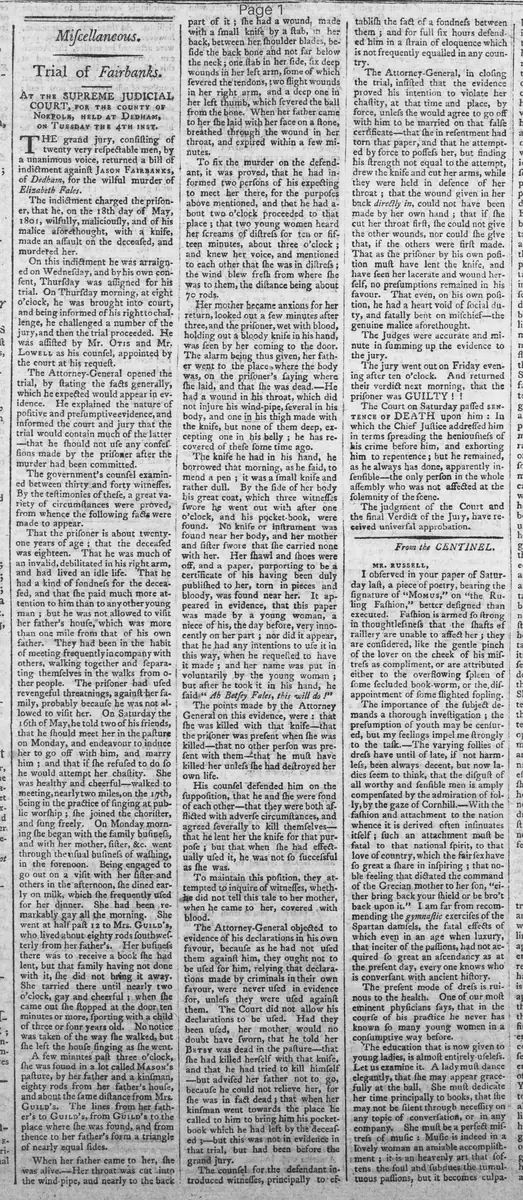
Trial of Fairbanks.
AT THE SUPREME JUDICIAL
COURT, FOR THE COUNTY OF
Norfolk, Held AT Dedham,
ON TUESDAY THE 4TH INST.
The grand jury
with a unanimous voice, returned a bill of
indictment against Jason Fairbanks,
of Dedham, for the wilful murder of
Elizabeth Fales.
The indictment charged the prison-
er, that he, on the 18th day of May,
1801, wilfully, maliciously, and of his
malice aforethought, with a knife,
made an assault on the deceased, and
murdered her.
On this indictment he was arraigned
on Wednesday, and by his own con-
sent, Thursday was assigned for his
trial. On Thursday morning, at eight
o'clock, he was brought into court,
and being informed of his right to chal-
lenge, he challenged a number of the
jury, and then the trial proceeded. He
was assisted by Mr. Otis and Mr.
Lowell as his counsel, appointed by
the court at his request.
The Attorney-General opened the
trial, by stating the facts generally,
which he expected would appear in ev-
idence. He explained the nature of
positive and presumptive evidence, and
informed the court and jury that the
trial would contain much of the latter
-that he should not use any confes-
sions made by the prisoner after the
murder had been committed.
The government's counsel examin-
ed between thirty and forty witnesses.
By the testimonies of these, a great va-
riety of circumstances were proved,
from whence the following facts were
made to appear.
That the prisoner is about twenty-
one years of age: that the deceased
was eighteen. That he was much of
an invalid, debilitated in his right arm,
and had lived an idle life. That he
had a kind of fondness for the decea-
sed, and that she paid much more at-
tention to him than to any other young
man; but he was not allowed to visit
her father's house, which was more
than one mile from that of his own
father. They had been in the habit
of meeting frequently in company with
others, walking together and sepa-
rating themselves in the walks from o-
ther people. The prisoner had used
revengeful threatenings, against her fa-
mily, probably because he was not al-
lowed to visit her. On Saturday the
16th of May, he told two of his friends,
that he should meet her in the pasture
on Monday, and endeavour to induce
her to go off with him, and marry
him; and that if she refused to do so
he would attempt her chastity. She
was healthy and cheerful - walked to
meeting, nearly two miles, on the 17th,
being in the practice of singing at pub-
lic worship; she joined the choristers,
and sung freely. On Monday morn-
ing she began with the family business,
and with her mother, sister, &c. went
through the usual business of washing,
in the forenoon. Being engaged to
go out on a visit with her sister and
others in the afternoon, she dined ear-
ly on milk, which she frequently used
for her dinner. She had been re-
markably gay all the morning. She
went at half past 12 to Mrs. Guild's,
who lived about eighty rods southwe-
sterly from her father's. Her business
there was to receive a book she had
lent, but that family having not done
with it, she did not bring it away.
She tarried there until nearly two
o'clock, gay and cheerful; when she
came out she stopped at the door ten
minutes or more, sporting with a child
of three or four years old. No notice
was taken of the way she walked, but
she left the house singing as she went.
A few minutes past three o'clock,
she was found in a lot called Mason's
pasture, by her father and a kinsman,
eighty rods from her father's house,
and about the same distance from Mrs.
Guild's. The lines from her fath-
er's to Guild's, from Guild's to the
place where she was found, and from
thence to her father's form a triangle
of nearly equal sides.
When her father came to her, she
was alive. - Her throat was cut into
the wind-pipe, and nearly to the back
part of it; he had a wound, made
with a small knife by a stab, in her
back, between her shoulder blades, be-
side the back bone and not far below
the neck; one stab in her side, six deep
wounds in her left arm, some of which
severed the tendons, two slight wounds
in her right arm, and a deep one in
her left thumb, which severed the ball
from the bone. When her father came
to her he lay with her face on a stone,
breathed through the wound in her
throat, and expired within a few mi-
nutes.
To fix the murder on the defend-
ant, it was proved, that he had in-
formed two persons of his expecting
to meet her there, for the purposes
above mentioned, and that he had a-
bout two o'clock proceeded to that
place; that two young women heard
her screams of distress for ten or fif-
teen minutes, about three o'clock
and knew her voice, and mentioned
to each other that she was in distress;
the wind blew fresh from where she
was to them, the distance being about
70 rods.
Her mother became anxious for her
return, looked out a few minutes after
three, and the prisoner, wet with blood,
holding out a bloody knife in his hand,
was seen by her coming to the door.
The alarm being thus given, her fath-
er went to the place where the body
was, on the prisoner's saying where
she lay, and that she was dead. - He
had a wound in his throat, which did
not injure his wind-pipe, several in his
body, and one in his thigh made with
the knife, but none of them deep, ex-
cepting one in his belly; he has re-
covered of these some time ago.
The knife he had in his hand, he
borrowed that morning, as he said, to
mend a pen: it was a small knife and
rather dull. By the side of her body
his great coat, which three witnesses
swore he went out with after one
o'clock, and his pocket-book, were
found. No knife or instrument was
found near her body, and her mother
and sister swore that she carried none
with her. Her shawl and shoes were
off, and a paper, purporting to be a
certificate of his having been duly
published to her, torn in pieces and
bloody, was found near her. It ap-
peared in evidence, that this paper
was made by a young woman, a
niece of his, the day before, very inno-
cently on her part; nor did it appear,
that he had any intentions to use it in
this way, when he requested to have
it made; and her name was put in
voluntarily by the young woman;
but after he took it in his hand, he
said "Ah Betsy Fales, this will do!"
The points made by the Attorney
General on this evidence, were: that
she was killed with that knife that
the prisoner was present when she was
killed - that no other person was pre-
sent with them that he must have
killed her unless she had destroyed her
own life.
His counsel defended him on the
supposition, that he and she were fond
of each other that they were both af-
flicted with adverse circumstances, and
agreed severally to kill themselves
that he lent her the knife for that pur-
pose; but that when he had effect-
ually used it, he was not so successful
as she was.
To maintain this position, they at-
tempted to inquire of witnesses, wheth-
er he did not tell this tale to her mother,
when he came to her, covered with
blood.
The Attorney-General objected to
evidence of his declarations in his own
favour, because as he had not used
them against him, they ought not to
be used for him, relying that declara-
tions made by criminals in their own
favour, were never used in evidence
for, unless they were used against
them. The Court did not allow his
declarations to be used. Had they
been used, her mother would no
doubt have sworn, that he told her
Betsy was dead in the pasture - that
she had killed herself with that knife.
and that he had tried to kill himself
—but advised her father not to go,
because he could not relieve her, for
he was in fact dead; that when her
kinsman went towards the place he
called to him to bring him his pocket-
book which he had left by the decea-
sed; - but this was not in evidence in
that trial, but had been before the
grand jury.
The counsel for the defendant in-
troduced witnesses, principally to es-
tablish the fact of a fondness between
them; and for full six hours defend-
ed him in a train of eloquence which
is not frequently equalled in any coun-
try.
The Attorney-General, in closing
the trial, insisted that the evidence
proved his intention to violate her
chastity, at that time and place, by
force, unless she would agree to go off
with him to be married on that false
certificate - that she in resentment had
torn that paper, and that he attempt-
ed by force to possess her, but finding
his strength not equal to the attempt,
drew the knife and cut her arms, while
they were held in defence of her
throat; that the wound given in her
back directly in, could not have been
made by her own hand; that if she
cut her throat first, she could not give
the other wounds, nor could he give
that, if the others were first made.
That as the prisoner by his own posi-
tion must have lent the knife, and
have seen her lacerate and wound her-
self, no presumptions remained in his
favour. That even, on his own posi-
tion, he had a heart void of social du-
ty, and fatally bent on mischief - the
genuine malice aforethought.
The Judges were accurate and mi-
nute in summing up the evidence to
the jury.
The jury went out on Friday even-
ing after ten o'clock. And returned
their verdict next morning, that the
prisoner was GUILTY!!
The Court on Saturday passed SEN-
TENCE OF DEATH upon him: In
which the Chief Justice addressed him
in terms portraying the heinousness of
his crime before him, and exhorting
him to repentance; but he remained,
as he always has done, apparently in-
sensible - the only person in the whole
assembly who was not affected at the
solemnity of the scene.
The judgment of the Court and
the final Verdict of the Jury, have re-
ceivd universal approbation.
What sub-type of article is it?
What themes does it cover?
What keywords are associated?
What entities or persons were involved?
Where did it happen?
Story Details
Key Persons
Location
Dedham, Norfolk County
Event Date
1801 05 18
Story Details
Jason Fairbanks, 21, murdered 18-year-old Elizabeth Fales by stabbing her multiple times in Mason's pasture after she rejected his marriage proposal and advances; he attempted suicide but survived; trial evidence proved his guilt, leading to a death sentence.