Thank you for visiting SNEWPapers!
Sign up free
Editorial
November 22, 1855
The Religious Herald
Hartford, Hartford County, Connecticut
What is this article about?
A Congregationalist Director of the American Tract Society defends against accusations of suppressing anti-slavery content in publications, reviewing alterations in Gurney's 'Love to God' and Mary Lundie Duncan's memoir, arguing changes are minor, authorized, and do not weaken abolitionist testimony.
Clipping
OCR Quality
95%
Excellent
Full Text
Letter to the General Association of New York, by a Congregationalist Director of the American Tract Society.
(CONTINUED.)
GURNEY.
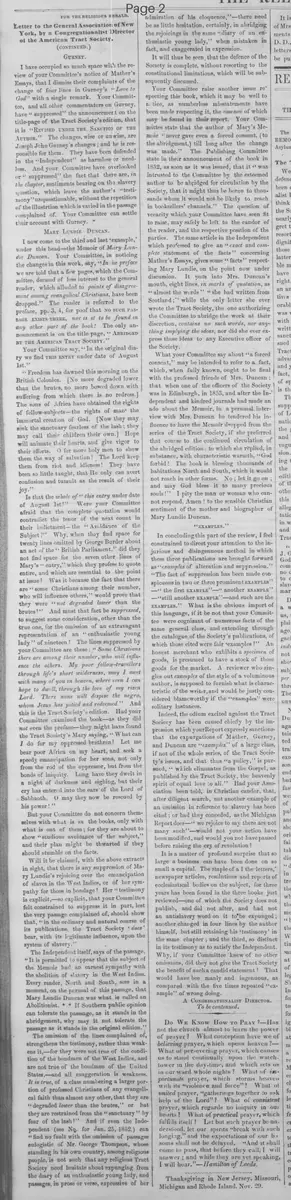
I have occupied so much space with the review of your Committee's notice of Mather's Essays, that I dismiss their complaints of the change of four lines in Gurney's Love to God with a single remark. Your Committee, and all other commentators on Gurney, have "suppressed" the announcement on the title-page of the Tract Society's edition, that it is "REVISED UNDER THE SANCTION OF THE AUTHOR." The changes, wise or unwise, are Joseph John Gurney's changes; and he is responsible for them. They have been defended in the "Independent" as harmless or needless. And your Committee have overlooked or "suppressed" the fact that there are, in the chapter, sentiments bearing on the slavery question, which leave the author's "testimony" unquestionable, without the repetition of the illustration which is varied in the passage complained of. Your Committee can settle their account with Gurney.
Mary Lundie Duncan.
I now come to the third and last example, under this head—the Memoir of Mary Lundie Duncan. Your Committee, in noticing the changes in this work, say, "In the preface we are told that a few pages, which the Committee deemed of less interest to the general reader, which alluded to points of disagreement among evangelical Christians, have been dropped." The reader is referred to the preface, pp. 3, 4, for proof that no such passage exists there, nor is it to be found in any other part of the book! The only announcement is on the title page, "ABRIDGED BY THE AMERICAN TRACT SOCIETY."
Your Committee say, "In the original diary we find this entry under date of August 1st."
"Freedom has dawned this morning on the British Colonies. No more degraded lower than the brutes, no more bowed down with suffering from which there is no redress. The sons of Africa have obtained the rights of fellow-subjects—the rights of man, the immortal creation of God. Now they may seek the sanctuary fearless of the lash; they may call their children their own. Hope will animate their hearts, and give vigor to their efforts. O for more holy men to show them the way of salvation! The Lord keep them from riot and idleness! They have been so little taught, that He only can avert confusion and tumult as the result of their joy."
Is that the whole of "this entry under date of August 1st?" Were your Committee afraid that the complete quotation would contradict the tenor of the next count in their indictment—the "Avoidance of the Subject?" Why, when they find space for twenty lines omitted by George Burder about an act of the "British Parliament," did they not find space for the seven other lines of Mary's entry, which they profess to quote entire, and which are essential to the point at issue? Was it because the fact that there are "some Christians among their number, who will influence others," would prove that they were "not degraded lower than the brutes?" And must that fact be suppressed to suggest some consideration, other than the true one, for the omission of an extravagant representation of an "enthusiastic young lady" of nineteen? The lines suppressed by your Committee are these: "Some Christians there are among their number, who will influence the others. My poor fellow-travellers through life's short wilderness, may I meet with many of you in heaven, where even I can hope to dwell, through the love of my risen Lord. There none will despise the negro, whom Jesus has pitied and redeemed." And this is the Tract Society's edition. Had your Committee examined the book—as they did not even the preface—they might have found the Tract Society's Mary saying, "What can I do for my oppressed brethren? Let me bear poor Africa on my heart, and seek a speedy emancipation for her sons, not only from the rod of the oppressor, but from the bonds of iniquity. Long have they dwelt in a night of darkness and sighing, but their cry has entered into the ears of the Lord of Sabaoth. O may they now be rescued by his power!"
But your Committee do not concern themselves with what is in the books, only with what is out of them; for they are about to show "studious avoidance of the subject," and their plan might be thwarted if they should stumble on the facts.
Will it be claimed, with the above extracts in sight, that there is any suppression of Mary Lundie's rejoicing over the emancipation of slaves in the West Indies, or of her sympathy for those in bondage? Her "testimony is explicit,—so explicit, that your Committee felt constrained to suppress it in part, lest the very passage complained of, should show that, "in the ordinary and natural course of its publications, the Tract Society does bear, with its legitimate influence, upon the system of slavery."
The Independent itself, says of the passage, "It is permitted to appear that the subject of the Memoir had an earnest sympathy with the abolition of slavery in the West Indies. Every reader, North and South, sees in a moment, on the perusal of this passage, that Mary Lundie Duncan was what is called an Abolitionist. * * If Southern public opinion can tolerate the passage, as it stands in the abridgement, why may it not tolerate the passage as it stands in the original edition."
The omission of the lines complained of, strengthens the testimony, rather than weakens it,—for they were not true of the condition of the bondmen of the West Indies, and are not true of the bondmen of the United States,—and all exaggeration is weakness.
It is true, of a class numbering a larger portion of professed Christians of any evangelical faith than almost any other, that they are "degraded lower than the brutes," or that they are restrained from the "sanctuary" by fear of the lash? And if even the Independent (see No. for Jan. 25, 1852,) can "find no fault with the omission of passages eulogistic of Mr. George Thompson, whose standing in his own country, among religious people, is not such that any religious Tract Society need hesitate about expunging from the diary of an enthusiastic young lady, passages, in prose or verse, expressive of her admiration of his eloquence."—there need be as little hesitation, certainly, in abridging the rejoicings in the same "diary of an enthusiastic young lady," when mistaken in fact, and exaggerated in expression.
It will thus be seen, that the defence of the Society is complete, without resorting to the constitutional limitations, which will be subsequently discussed.
Your Committee raise another issue respecting this book, which it may be well to notice, as numberless misstatements have been made respecting it, the essence of which may be found in their report. Your Committee state that the author of Mary's Memoir "never gave even a forced consent, (to the abridgment,) till long after the change was made." The Publishing Committee state in their announcement of the book in 1852, as soon as it was issued, that it "was intrusted to the Committee by the esteemed author to be abridged for circulation by the Society, that it might thus be borne to thousands whom it would not be likely to reach in booksellers' channels." The question of veracity which your Committee have seen fit to raise, may safely be left to the candor of the reader, and the respective position of the parties. The same article in the Independent which professed to give an "exact and complete statement of the facts" concerning Mather's Essays, gives some "facts" respecting Mary Lundie, on the point now under discussion. It puts into Mrs. Duncan's mouth, eight lines, in marks of quotation, as "almost the words" she had written from Scotland; while the only letter she ever wrote the Tract Society, the one authorizing the Committee to abridge the work at their discretion, contains no such words, nor anything implying the ideas, nor did she ever express those ideas to any Executive officer of the Society.
What your Committee say about "a forced consent," may be intended to refer to a fact, which, when fully known, ought to be final with the professed friends of Mrs. Duncan : that when one of the officers of the Society was in Edinburgh, in 1853, and after the Independent and kindred journals had made an ado about the Memoir, in a personal interview with Mrs. Duncan he tendered his influence to have the Memoir dropped from the series of the Tract Society, if she preferred that course to the continued circulation of the abridged edition: to which she replied, in substance, with characteristic warmth, "God forbid! The book is blessing thousands of habitations North and South, which it would not reach in other forms. No; let it go on ; and may God bless it to many precious souls!" I pity the man or woman who cannot respond, Amen! to the sensible Christian sentiment of the mother and biographer of Mary Lundie Duncan.
In concluding this part of the review, I feel constrained to direct your attention to the injurious and disingenuous method in which these three publications are brought forward as "examples of alteration and suppression." "The fact of suppression has been made conspicuous in two or three prominent Examples" —"the first EXAMPLE"—"another EXAMPLE" —"still another Example"—and such are the Examples." What is the obvious import of this language, if it be not that your Committee were cognizant of numerous facts of the same general class, and extending through the catalogue of the Society's publications, of which those cited were fair "examples?"
An honest merchant who exhibits a specimen of goods, is presumed to have a stock of those goods for the market. A reviewer who singles out examples of the style of a voluminous author, is supposed to furnish what is characteristic of the writer, and would be justly considered blameworthy if the "examples" were solitary instances.
Indeed, the odium excited against the Tract Society has been caused chiefly by the impression which your Report expressly sanctions, that the expurgations of Mather, Gurney, and Duncan are "examples" of a large class, if not of the whole series, of the Tract Society's issues, and that thus "a policy," is pursued, "which eliminates from the Gospel, as published by the Tract Society, the heavenly spirit of equal love to all."
Had your Association been told, in Christian candor, that, after diligent search, not another example of an omission in reference to slavery has been cited; or had they conceded, as the Michigan Report does—"we rejoice to say there are not many such"—would not your action have been modified, and would you not have paused before raising the cry of revolution?
It is a matter of profound surprise that so large a business can have been done on so small a capital. The staple of all the letters, newspaper articles, resolutions and reports of ecclesiastical bodies on the subject, for three years has been found in the three books just reviewed—one of which the Society does not publish, and did not alter, and had not an antislavery word on it to be expunged; another changed in four lines by the author himself, but still retaining his "testimony" in the same chapter : and the third, so distinct in its testimony as to satisfy the Independent.
Why, if your Committee knew of no other omissions, did they not give the Tract Society the benefit of such a candid statement? That would have been manly and ingenuous, as compared with the five times repeated "example" of wrong doing.
A Congregationalist Director.
To be continued.
(CONTINUED.)
GURNEY.
I have occupied so much space with the review of your Committee's notice of Mather's Essays, that I dismiss their complaints of the change of four lines in Gurney's Love to God with a single remark. Your Committee, and all other commentators on Gurney, have "suppressed" the announcement on the title-page of the Tract Society's edition, that it is "REVISED UNDER THE SANCTION OF THE AUTHOR." The changes, wise or unwise, are Joseph John Gurney's changes; and he is responsible for them. They have been defended in the "Independent" as harmless or needless. And your Committee have overlooked or "suppressed" the fact that there are, in the chapter, sentiments bearing on the slavery question, which leave the author's "testimony" unquestionable, without the repetition of the illustration which is varied in the passage complained of. Your Committee can settle their account with Gurney.
Mary Lundie Duncan.
I now come to the third and last example, under this head—the Memoir of Mary Lundie Duncan. Your Committee, in noticing the changes in this work, say, "In the preface we are told that a few pages, which the Committee deemed of less interest to the general reader, which alluded to points of disagreement among evangelical Christians, have been dropped." The reader is referred to the preface, pp. 3, 4, for proof that no such passage exists there, nor is it to be found in any other part of the book! The only announcement is on the title page, "ABRIDGED BY THE AMERICAN TRACT SOCIETY."
Your Committee say, "In the original diary we find this entry under date of August 1st."
"Freedom has dawned this morning on the British Colonies. No more degraded lower than the brutes, no more bowed down with suffering from which there is no redress. The sons of Africa have obtained the rights of fellow-subjects—the rights of man, the immortal creation of God. Now they may seek the sanctuary fearless of the lash; they may call their children their own. Hope will animate their hearts, and give vigor to their efforts. O for more holy men to show them the way of salvation! The Lord keep them from riot and idleness! They have been so little taught, that He only can avert confusion and tumult as the result of their joy."
Is that the whole of "this entry under date of August 1st?" Were your Committee afraid that the complete quotation would contradict the tenor of the next count in their indictment—the "Avoidance of the Subject?" Why, when they find space for twenty lines omitted by George Burder about an act of the "British Parliament," did they not find space for the seven other lines of Mary's entry, which they profess to quote entire, and which are essential to the point at issue? Was it because the fact that there are "some Christians among their number, who will influence others," would prove that they were "not degraded lower than the brutes?" And must that fact be suppressed to suggest some consideration, other than the true one, for the omission of an extravagant representation of an "enthusiastic young lady" of nineteen? The lines suppressed by your Committee are these: "Some Christians there are among their number, who will influence the others. My poor fellow-travellers through life's short wilderness, may I meet with many of you in heaven, where even I can hope to dwell, through the love of my risen Lord. There none will despise the negro, whom Jesus has pitied and redeemed." And this is the Tract Society's edition. Had your Committee examined the book—as they did not even the preface—they might have found the Tract Society's Mary saying, "What can I do for my oppressed brethren? Let me bear poor Africa on my heart, and seek a speedy emancipation for her sons, not only from the rod of the oppressor, but from the bonds of iniquity. Long have they dwelt in a night of darkness and sighing, but their cry has entered into the ears of the Lord of Sabaoth. O may they now be rescued by his power!"
But your Committee do not concern themselves with what is in the books, only with what is out of them; for they are about to show "studious avoidance of the subject," and their plan might be thwarted if they should stumble on the facts.
Will it be claimed, with the above extracts in sight, that there is any suppression of Mary Lundie's rejoicing over the emancipation of slaves in the West Indies, or of her sympathy for those in bondage? Her "testimony is explicit,—so explicit, that your Committee felt constrained to suppress it in part, lest the very passage complained of, should show that, "in the ordinary and natural course of its publications, the Tract Society does bear, with its legitimate influence, upon the system of slavery."
The Independent itself, says of the passage, "It is permitted to appear that the subject of the Memoir had an earnest sympathy with the abolition of slavery in the West Indies. Every reader, North and South, sees in a moment, on the perusal of this passage, that Mary Lundie Duncan was what is called an Abolitionist. * * If Southern public opinion can tolerate the passage, as it stands in the abridgement, why may it not tolerate the passage as it stands in the original edition."
The omission of the lines complained of, strengthens the testimony, rather than weakens it,—for they were not true of the condition of the bondmen of the West Indies, and are not true of the bondmen of the United States,—and all exaggeration is weakness.
It is true, of a class numbering a larger portion of professed Christians of any evangelical faith than almost any other, that they are "degraded lower than the brutes," or that they are restrained from the "sanctuary" by fear of the lash? And if even the Independent (see No. for Jan. 25, 1852,) can "find no fault with the omission of passages eulogistic of Mr. George Thompson, whose standing in his own country, among religious people, is not such that any religious Tract Society need hesitate about expunging from the diary of an enthusiastic young lady, passages, in prose or verse, expressive of her admiration of his eloquence."—there need be as little hesitation, certainly, in abridging the rejoicings in the same "diary of an enthusiastic young lady," when mistaken in fact, and exaggerated in expression.
It will thus be seen, that the defence of the Society is complete, without resorting to the constitutional limitations, which will be subsequently discussed.
Your Committee raise another issue respecting this book, which it may be well to notice, as numberless misstatements have been made respecting it, the essence of which may be found in their report. Your Committee state that the author of Mary's Memoir "never gave even a forced consent, (to the abridgment,) till long after the change was made." The Publishing Committee state in their announcement of the book in 1852, as soon as it was issued, that it "was intrusted to the Committee by the esteemed author to be abridged for circulation by the Society, that it might thus be borne to thousands whom it would not be likely to reach in booksellers' channels." The question of veracity which your Committee have seen fit to raise, may safely be left to the candor of the reader, and the respective position of the parties. The same article in the Independent which professed to give an "exact and complete statement of the facts" concerning Mather's Essays, gives some "facts" respecting Mary Lundie, on the point now under discussion. It puts into Mrs. Duncan's mouth, eight lines, in marks of quotation, as "almost the words" she had written from Scotland; while the only letter she ever wrote the Tract Society, the one authorizing the Committee to abridge the work at their discretion, contains no such words, nor anything implying the ideas, nor did she ever express those ideas to any Executive officer of the Society.
What your Committee say about "a forced consent," may be intended to refer to a fact, which, when fully known, ought to be final with the professed friends of Mrs. Duncan : that when one of the officers of the Society was in Edinburgh, in 1853, and after the Independent and kindred journals had made an ado about the Memoir, in a personal interview with Mrs. Duncan he tendered his influence to have the Memoir dropped from the series of the Tract Society, if she preferred that course to the continued circulation of the abridged edition: to which she replied, in substance, with characteristic warmth, "God forbid! The book is blessing thousands of habitations North and South, which it would not reach in other forms. No; let it go on ; and may God bless it to many precious souls!" I pity the man or woman who cannot respond, Amen! to the sensible Christian sentiment of the mother and biographer of Mary Lundie Duncan.
In concluding this part of the review, I feel constrained to direct your attention to the injurious and disingenuous method in which these three publications are brought forward as "examples of alteration and suppression." "The fact of suppression has been made conspicuous in two or three prominent Examples" —"the first EXAMPLE"—"another EXAMPLE" —"still another Example"—and such are the Examples." What is the obvious import of this language, if it be not that your Committee were cognizant of numerous facts of the same general class, and extending through the catalogue of the Society's publications, of which those cited were fair "examples?"
An honest merchant who exhibits a specimen of goods, is presumed to have a stock of those goods for the market. A reviewer who singles out examples of the style of a voluminous author, is supposed to furnish what is characteristic of the writer, and would be justly considered blameworthy if the "examples" were solitary instances.
Indeed, the odium excited against the Tract Society has been caused chiefly by the impression which your Report expressly sanctions, that the expurgations of Mather, Gurney, and Duncan are "examples" of a large class, if not of the whole series, of the Tract Society's issues, and that thus "a policy," is pursued, "which eliminates from the Gospel, as published by the Tract Society, the heavenly spirit of equal love to all."
Had your Association been told, in Christian candor, that, after diligent search, not another example of an omission in reference to slavery has been cited; or had they conceded, as the Michigan Report does—"we rejoice to say there are not many such"—would not your action have been modified, and would you not have paused before raising the cry of revolution?
It is a matter of profound surprise that so large a business can have been done on so small a capital. The staple of all the letters, newspaper articles, resolutions and reports of ecclesiastical bodies on the subject, for three years has been found in the three books just reviewed—one of which the Society does not publish, and did not alter, and had not an antislavery word on it to be expunged; another changed in four lines by the author himself, but still retaining his "testimony" in the same chapter : and the third, so distinct in its testimony as to satisfy the Independent.
Why, if your Committee knew of no other omissions, did they not give the Tract Society the benefit of such a candid statement? That would have been manly and ingenuous, as compared with the five times repeated "example" of wrong doing.
A Congregationalist Director.
To be continued.
What sub-type of article is it?
Slavery Abolition
Moral Or Religious
What keywords are associated?
American Tract Society
Slavery Abolition
Publication Alterations
Mary Lundie Duncan
Joseph Gurney
Anti Slavery Testimony
Tract Society Defense
What entities or persons were involved?
American Tract Society
Joseph John Gurney
Mary Lundie Duncan
General Association Of New York
The Independent
Editorial Details
Primary Topic
Defense Against Suppression Of Anti Slavery Sentiments In Tract Society Publications
Stance / Tone
Defensive Justification Of Editorial Changes
Key Figures
American Tract Society
Joseph John Gurney
Mary Lundie Duncan
General Association Of New York
The Independent
Key Arguments
Changes In Gurney's Work Were Revised Under The Author's Sanction And Retain Anti Slavery Testimony.
Mary Lundie Duncan's Memoir Abridgment Omits Exaggerations But Preserves Explicit Sympathy For Emancipation And Opposition To Slavery.
Omitted Passages In Duncan's Diary Were Not Indicative Of Total Degradation Of Slaves, And Full Context Shows Christian Influence Among Them.
No Widespread Suppression Exists; Cited Examples Are Misrepresented As Representative Of A Policy.
Society's Actions Strengthen Rather Than Weaken Anti Slavery Messages By Removing Inaccuracies.