Thank you for visiting SNEWPapers!
Sign up free
Story
February 1, 1930
Douglas Daily Dispatch
Douglas, Cochise County, Arizona
What is this article about?
Cornell University plant breeder Dr. C. H. Myers develops innovative cabbage varieties, including a deep red rosebud-like type and a purple-green mosaic one, promising enhanced flavors, textures, and appeal beyond traditional uses.
Clipping
OCR Quality
95%
Excellent
Full Text
Plant Wizard Develops Cabbage Like Enormous Red Rosebud; Meal Harmony
By HOWARD W. BLAKESLEE Science Editor (Associated Press Feature Service)
ITHACA, N. Y. (P)—A new variety of cabbage that resembles an enormous red rosebud has been grown at Cornell university.
The color matches the deep red of sunset and is a complete departure from the purple commercial cabbage often called red. It is one of several new color combinations in cabbages, garbs that promise to lift this ancient edible above its corned beef social standing, not simply because of the fancy dress, but through novel flavors and better values.
Although the colors are not the causes of the flavors, the raiment is eye-filling, a natural poster advertising, for the more serious objectives at Cornell, which are to find methods of improving garden products.
A salad in the exact shades of the Cornell colors, red and white, has been made by mixing the new red and white varieties. But outside the campus no hostess has had opportunity to play with the sunset vegetable, for it has not gone into commercial production.
A few housewives who patronize a certain grocery in Batavia, N. Y., recently had the thrill of discovering a cabbage unlike any other ever seen. It was shaped like a sugar loaf, its colors a mosaic of purple and green. It was another of Cornell's new cabbages, smaller than the ordinary size, but surprisingly heavy, tender, solid, edible to its pointed tip, and lacking almost entirely the usual hard center core.
One crate of these cabbages was brought in by a farmer who asked the grocer to sprinkle them among his other cabbages as an experiment. They were snapped up by buyers. This farmer obtained the seed from Cornell's experimental cabbage patch.
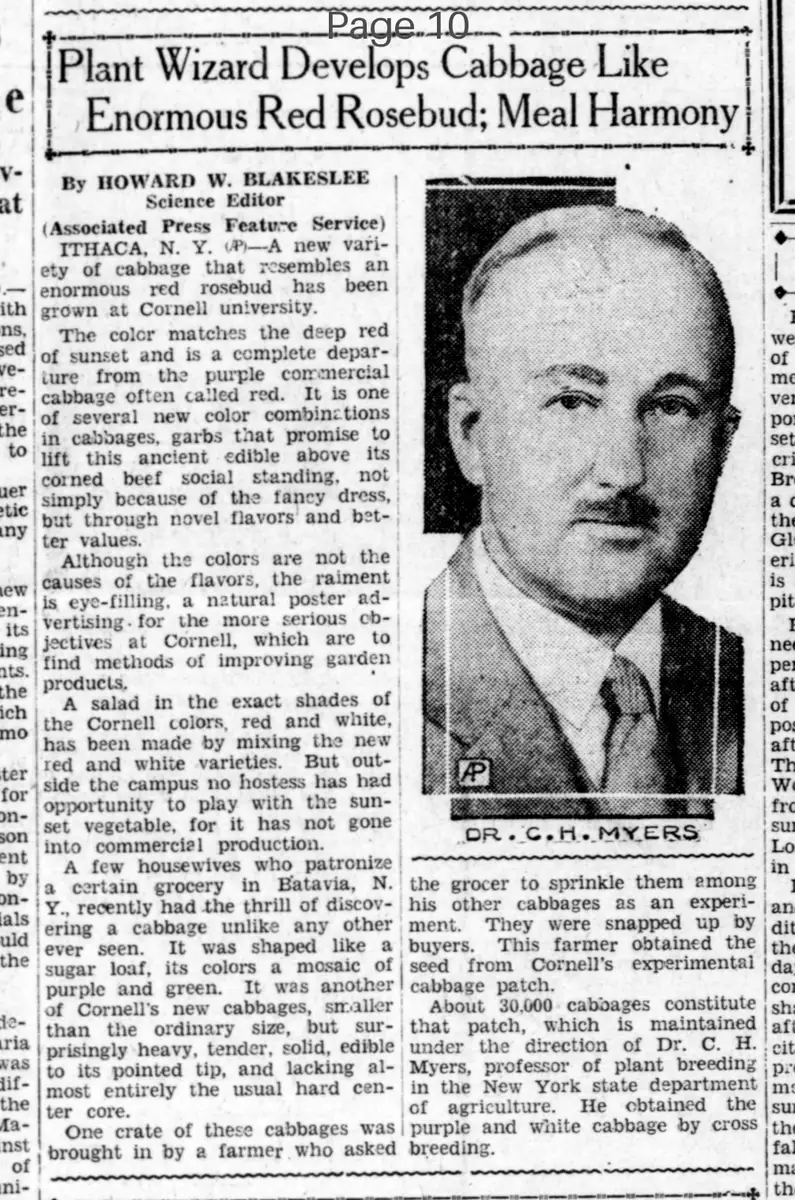
About 30,000 cabbages constitute that patch, which is maintained under the direction of Dr. C. H. Myers, professor of plant breeding in the New York state department of agriculture. He obtained the purple and white cabbage by cross breeding.
By HOWARD W. BLAKESLEE Science Editor (Associated Press Feature Service)
ITHACA, N. Y. (P)—A new variety of cabbage that resembles an enormous red rosebud has been grown at Cornell university.
The color matches the deep red of sunset and is a complete departure from the purple commercial cabbage often called red. It is one of several new color combinations in cabbages, garbs that promise to lift this ancient edible above its corned beef social standing, not simply because of the fancy dress, but through novel flavors and better values.
Although the colors are not the causes of the flavors, the raiment is eye-filling, a natural poster advertising, for the more serious objectives at Cornell, which are to find methods of improving garden products.
A salad in the exact shades of the Cornell colors, red and white, has been made by mixing the new red and white varieties. But outside the campus no hostess has had opportunity to play with the sunset vegetable, for it has not gone into commercial production.
A few housewives who patronize a certain grocery in Batavia, N. Y., recently had the thrill of discovering a cabbage unlike any other ever seen. It was shaped like a sugar loaf, its colors a mosaic of purple and green. It was another of Cornell's new cabbages, smaller than the ordinary size, but surprisingly heavy, tender, solid, edible to its pointed tip, and lacking almost entirely the usual hard center core.
One crate of these cabbages was brought in by a farmer who asked the grocer to sprinkle them among his other cabbages as an experiment. They were snapped up by buyers. This farmer obtained the seed from Cornell's experimental cabbage patch.
About 30,000 cabbages constitute that patch, which is maintained under the direction of Dr. C. H. Myers, professor of plant breeding in the New York state department of agriculture. He obtained the purple and white cabbage by cross breeding.
What sub-type of article is it?
Curiosity
Prodigy
Personal Triumph
What themes does it cover?
Triumph
Exploration
What keywords are associated?
Cabbage Varieties
Plant Breeding
Cornell University
Red Cabbage
Purple Green Cabbage
What entities or persons were involved?
Howard W. Blakeslee
Dr. C. H. Myers
Where did it happen?
Ithaca, N. Y., Cornell University; Batavia, N. Y.
Story Details
Key Persons
Howard W. Blakeslee
Dr. C. H. Myers
Location
Ithaca, N. Y., Cornell University; Batavia, N. Y.
Story Details
A new variety of cabbage resembling an enormous red rosebud has been developed at Cornell University by Dr. C. H. Myers through cross-breeding, featuring deep red color, novel flavors, and better nutritional value. Other varieties include a purple and green mosaic cabbage that is tender and coreless, tested in Batavia, N.Y.