Thank you for visiting SNEWPapers!
Sign up free
The Age Herald
Birmingham, Jefferson County, Alabama
What is this article about?
Biography of American pianist Joseph H. Denck, a child prodigy who trained in Europe, performed for royalty like Queen Victoria, and collaborated with masters like Liszt, achieving virtuosic success.
Clipping
OCR Quality
Full Text
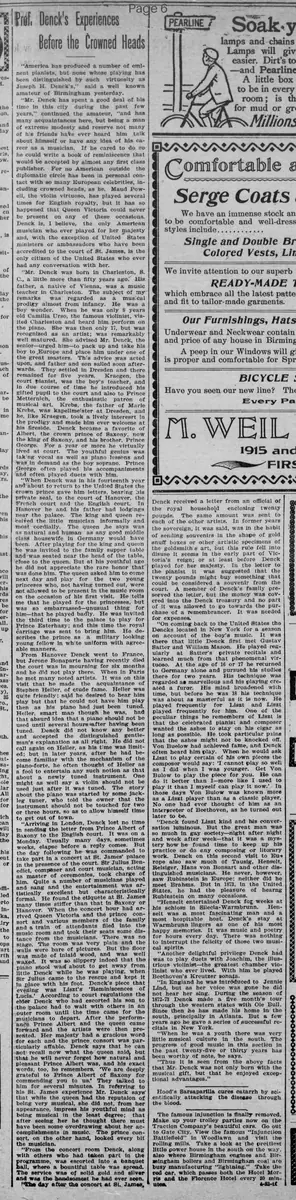
Before the Crowned Heads
"America has produced a number of eminent pianists, but none whose playing has been distinguished by such virtuosity as Joseph H. Denck's," said a well known amateur of Birmingham yesterday.
"Mr. Denck has spent a good deal of his time in this city during the past few years," continued the amateur, "and has many acquaintances here, but being a man of extreme modesty and reserve not many of his friends have ever heard him talk about himself or have any idea of his career as a musician. If he cared to do so he could write a book of reminiscences that would be accepted by almost any first class publisher. For no American outside the diplomatic circle has been in personal contact with so many European celebrities, including crowned heads, as he. Maud Powell, the violin virtuoso, has played several times for English royalty, but it has so happened that Queen Victoria could never be present on any of these occasions. Denck is, I believe, the only American musician who ever played for her majesty and, with the exception of United States ministers or ambassadors who have been accredited to the court of St. James, is the only citizen of the United States who ever had any conversation with her.
"Mr. Denck was born in Charleston, S. C., a little more than fifty years ago. His father, a native of Vienna, was a music teacher in Charleston. The subject of my remarks was regarded as a musical prodigy almost from infancy. He was a boy wonder. When he was only 8 years old Camilla Urso, the famous violinist, visited Charleston and heard him perform on the piano. She was then only 17, but was recognized as an artist; was remarkably well matured. She advised Mr. Denck, the senior-urged him-to pack up and take his boy to Europe and place him under one of the great masters. This advice was acted upon, and father and son sailed soon afterwards. They settled in Dresden and there remained for five years. Kraegen, the court pianist, was the boy's teacher, and in due course of time he introduced his gifted pupil to the court and also to Prince Metternich, the enthusiastic patron of musical art. Krebs, the father of Marie Krebs, was kapellmeister at Dresden, and he, like Kraegen, took a lively interest in the prodigy and made him ever welcome at his fireside. Denck became a favorite of Albert, the crown prince of Saxony, now the king of Saxony, and his brother, Prince George. For a year or more he virtually lived at court. The youthful genius was taking vocal as well as piano lessons and was in demand as the boy soprano. Prince George often played his accompaniments and often played duets with him.
"When Denck was in his fourteenth year and about to return to the United States the crown prince gave him letters, bearing his private seal, to the court of Hanover, the French court and the English court. In Hanover he and his father had lodgings near the palace. The king and queen received the little musician informally and most cordially. The queen, he says was as natural and human as any good middle class housewife in Germany would have been. After playing for the king and queen he was invited to the family supper table and was seated near the head of the table, close to the queen. But at his youthful age he did not appreciate the rare honor that was done him. The queen asked him to come next day and play for the two young princesses who, not having turned out, were not allowed to be present in the music room on the occasion of his first visit. He tells me that he played for the princesses, but was so embarrassed-unusual thing for him-that he played badly. He was invited the third time to the palace to play for Prince Esterhazy; and this time the royal carriage was sent to bring him. He describes the prince as a military looking young fellow in white uniform with agreeable manners.
From Hanover Denck went to France, but Jerome Bonaparte having recently died the court was in mourning for six months and he did not play there. When in Paris he met many noted artists. It was on this visit that he made the acquaintance of Stephen Heller, of etude fame. Heller was quite friendly; said he desired to hear him play but that he could not have him play then as his piano had just been tuned. Heller, smart man though he was, had that absurd idea that a piano should not be used until several hours after having been tuned. Denck did not know any better and accepted the distinguished gentleman's explanation as all right. He did not call again on Heller, as his time was limited; but in later years, after he had become familiar with the mechanism of the piano-forte, he often thought of Heller as a fool to entertain any such notion as that about a newly tuned instrument. One might as well say a violin should not be used just after it was tuned. The story about the piano was started by some jack-leg tuner, who told the owner that the instrument should not be touched for two or three hours, so as to allow himself time to get out of town.
"Arriving in London, Denck lost no time in sending the letter from Prince Albert of Saxony to the English court. It was on a Monday. Usually many days, sometimes weeks, elapse before a reply comes. But the day following he was commanded to take part in a concert at St. James' palace in the presence of the court. Sir Julius Benedict, conductor, composer and court musician, acting as master of ceremonies, took charge of him. Quite a number of musicians played and sang and the entertainment was artistically excellent but characteristically formal. He found the etiquette at St. James many times stiffer than that in Saxony or Hanover. When the concert hour had arrived Queen Victoria and the prince consort and a train of attendants filed into the music room and took their seats some distance from the musicians. There was no stage. The room was very plain and the walls were bare of pictures. But the floor was made of inlaid wood, and was well waxed. It was so slippery indeed that the piano stool was about to get away from little Denck while he was playing, when Sir Julius came to the rescue and kept it in place with his foot. Denck's piece that evening was Liszt's Reminiscences of Lucia.' According to court regulations the elder Denck who had escorted his son to the palace had to wait with others in an outer room until the time came for the musicians to depart. After the performance Prince Albert and the queen came forward and the artists were then presented. Her majesty had a gracious word for each and the prince consort was particularly affable. Denck says that he can not recall now what the queen said, but that he will never forget how natural and pleasant Prince Albert was, and his exact words, too, he remembers. 'We are deeply grateful to Prince Albert of Saxony for commending you to us.' They talked to him for several minutes. In referring to his St. James experience Mr. Denck says that while the queen had the reputation of being very musical, she did not, from her appearance, impress his youthful mind as being musical in the least degree; that after seeing her he thought there must have been some overdrawing about her accomplishments in music. The prince consort, on the other hand, looked every bit the musician.
"From the concert room Denck, along with others who had taken part in the programme, was escorted into a banquet hall, where a bountiful table was spread. The service was of solid gold and silver and was the handsomest he had ever seen.
"The day after the concert at St. James Denck received a letter from an official of the royal household enclosing twenty pounds. The same amount was sent to each of the other artists. In former years the sovereign, it was said, was in the habit of sending souvenirs in the shape of gold snuff boxes or other artistic specimens of the goldsmith's art, but this rule fell into disuse it seems in the early part of Victoria's reign; or at least before Denck played for her majesty. In the letter to the pianist it was suggested that the twenty pounds might buy something that could be considered a souvenir from the court. A member of Denck's family preserved the letter, but the money was covered into the Denck treasury and no part of it was allowed to go towards the purchase of a remembrancer. It was needed for expenses.
"On coming back to the United States the Dencks located in New York for a season on account of the boy's music. It was there that little Denck first met Gustav Satter and William Mason. He played regularly at Satter's private recitals and learned much from that phenomenal virtuoso. At the age of 16 or 17 he returned to Germany alone and pursued his studies there for two years. His technique was regarded as marvellous and his playing created a furor. His mind broadened with time, but before he was 18 his technique was about as masterful as it is now. He played frequently for Liszt and Liszt played frequently for him. One of the peculiar things he remembers of Liszt is that the celebrated pianist and composer wanted the ashes to stay on his cigar as long as possible. He took particular pains that the ashes might not be knocked off. Von Buelow had achieved fame, and Denck often heard him play. When he would ask Liszt to play certain of his own pieces the composer would say: 'I cannot play so well as I did when I was younger. Get Von Bulow to play the piece for you. He can do it better than I-more like I used to play it than I myself can play it now.' In those days Von Bulow was known more as a Liszt player than as a classic player. No one had ever thought of him as an interpreter of Beethoven, as he turned out later to be.
"Denck found Liszt kind and his conversation luminous. But the great man was so much in gay society-night after night and week after week-that it was a mystery how he found time to keep up his practice or do any composing or literary work. Denck on this second visit to Europe also saw much of Tausig, Henselt, Reisiger, Hans von Bulow and other distinguished musicians. He never, however, saw Rubinstein in Europe; neither did he meet Brahms. But in 1873, in the United States, he had the pleasure of hearing Rubinstein on many occasions.
"Henselt entertained Denck for weeks at his schloss in Silesia-Warmbrunn. Henselt was a most fascinating man and a most hospitable host. Denck's stay at Warmbrunn lingers as one of his most happy memories. It was music and poetry for hours every day. There was nothing to interrupt the felicity of those two musical spirits.
"Another delightful privilege Denck had was to play duets with Joachim, the illustrious violinist-the greatest chamber violinist who ever lived. With him he played Beethoven's Kreutzer sonata.
"In England he was introduced to Jennie Lind, but as her voice was gone he did not hear her sing. During the season of 1872-73 Denck made a five months' tour through the western states with Ole Bull. Since then he has made his home in the south, principally in Atlanta. But a few years ago he gave a series of successful recitals in New York.
"When he was a youth there was very little musical culture in the south. The progress of good music in this section in the past twenty-five or thirty years has been worthy of note, he says.
"Thus it is seen from the above facts that Mr. Denck was not only born with the musical gift, but that he enjoyed exceptional advantages."
What sub-type of article is it?
What themes does it cover?
What keywords are associated?
What entities or persons were involved?
Where did it happen?
Story Details
Key Persons
Location
Charleston S. C., Dresden, Hanover, Paris, London, New York, Atlanta
Event Date
Born In Charleston, S. C., A Little More Than Fifty Years Ago
Story Details
Joseph H. Denck, a musical prodigy born in Charleston, S. C., trained in Dresden under Kraegen, performed for European royalty including Queen Victoria, Prince Albert consort, and courts of Saxony and Hanover, met famous musicians like Liszt, Henselt, and Joachim, and built a successful career in the United States.