Thank you for visiting SNEWPapers!
Sign up free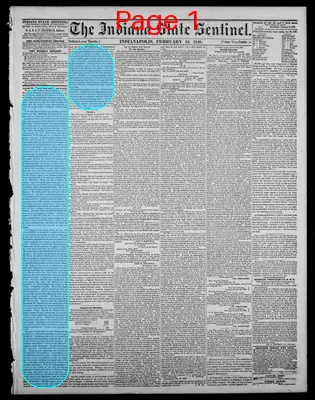
Editorial
February 12, 1846
Indiana State Sentinel
Indianapolis, Marion County, Indiana
What is this article about?
The editorial critiques A.W. Morris's defense of a controversial Indiana law on canal lands, accusing him of self-interest in extending forfeiture times while undermining a more favorable relief bill. It defends Governor Whitcomb for signing the bill under duress and later halting its enforcement to protect settlers.
Clipping
OCR Quality
98%
Excellent
Full Text
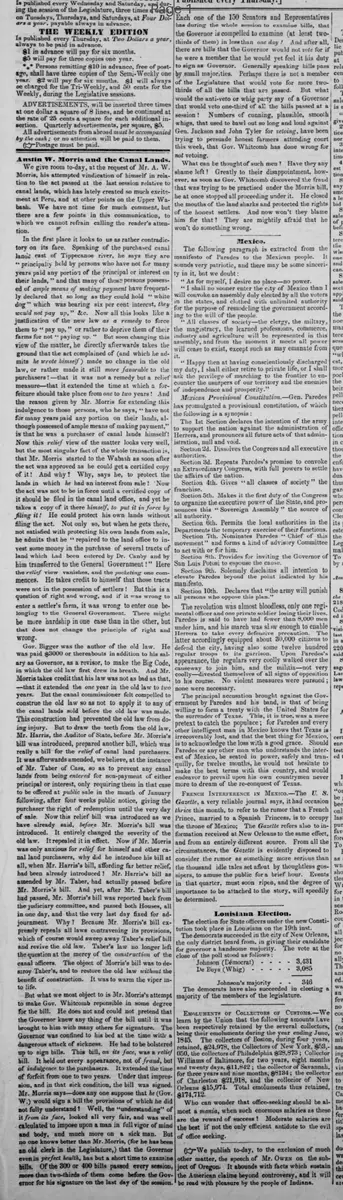
Austin W. Morris and the Canal Lands.
We give room to-day, at the request of Mr. A. W. Morris, his attempted vindication of himself in relation to the act passed at the last session relative to canal lands, which has lately created so much excitement at Peru, and at other points on the Upper Wabash. We have not time for much comment, but there are a few points in this communication, to which we cannot refrain calling the reader's attention.
In the first place it looks to us as rather contradictory on its face. Speaking of the purchased canal lands east of Tippecanoe river, he says they are "principally held by persons who have not for many years paid any portion of the principal or interest on their lands," and that many of those persons possessed of ample means of making payment have frequently declared that so long as they could hold "white dog" which was bearing six per cent interest, they would not pay up, &c. Now all this looks like a justification of the new law as a remedy to force them to "pay up," or rather to deprive them of their farms for not "paying up." But soon changing this view of the matter, he directly afterwards takes the ground that the act complained of (and which he admits he wrote himself) made no change in the old law, or rather made it still more favorable to the purchasers!--that it was not a remedy but a relief measure--that it extended the time at which a forfeiture should take place from one to two years! And the reason given by Mr. Morris for extending this indulgence to those persons, who he says, "have not for many years paid any portion on their lands, although possessed of ample means of making payment," is that he was a purchaser of canal lands himself! Now this relief view of the matter looks very well, but the most singular fact of the whole transaction is, that Mr. Morris started to the Wabash as soon after the act was approved as he could get a certified copy of it! And why! Why, says he, to protect the lands in which he had an interest from sale! Now the act was not to be in force until a certified copy of it should be filed in the canal land office, and yet he takes a copy of it there himself, to put it in force by filing it! He could protect his own lands without filing the act. Not only so, but when he gets there, not satisfied with protecting his own lands from sale, he admits that he "repaired to the land office to invest some money in the purchase of several tracts of land which had been entered by Dr. Canby and by him transferred to the General Government!" Here the relief view vanishes, and the pocketing one commences. He takes credit to himself that those tracts were not in the possession of settlers! But this is a question of right and wrong, and if it was wrong to enter a settler's farm, it was wrong to enter one belonging to the General Government. There might be more hardship in one case than in the other, but that does not change the principle of right and wrong.
Gov. Bigger was the author of the old law. He was paid $3000 or thereabouts in addition to his salary as Governor, as a revisor, to make the Big Code, in which the old law first drew its breath. And Mr. Morris takes credit that his law was not as bad as that.--that it extended the one year in the old law to two years. But the canal commissioner felt compelled to construe the old law so as not to apply it to any of the canal lands sold before the old law was made. This construction had prevented the old law from doing injury. But to draw the teeth from the old law, Mr. Harris, the Auditor of State, before Mr. Morris's bill was introduced, prepared another bill, which was really a bill for the relief of canal land purchasers. It was afterwards amended, we believe, at the instance of Mr. Taber of Cass, so as to prevent any canal lands from being entered for non-payment of either principal or interest, only requiring them in that case to be offered at public sale in the month of January following, after four weeks public notice, giving the purchaser the right of redemption until the very day of sale. Now this relief bill was introduced as we have already said, before Mr. Morris's bill was introduced. It entirely changed the severity of the old law. It repealed it in effect. Now if Mr. Morris was only anxious for relief for himself and other canal land purchasers, why did he introduce his bill at all, when Mr. Harris's bill, affording far better relief, had been already introduced! Mr. Harris's bill as amended by Mr. Taber, had actually passed before Mr. Morris's bill. And yet, after Mr. Taber's bill had passed, Mr. Morris's bill was reported back from the judiciary committee, and passed both Houses, all in one day, and that the very last day fixed for adjournment. Why? Because Mr. Morris's bill expressly repeals all laws contravening its provisions, which of course would sweep away Taber's relief bill and revive the old law. Taber's law no longer left the question at the mercy of the construction of the canal officers. The object of Morris's bill was to destroy Taber's, and to restore the old law without the benefit of construction. It was to warm the viper into life.
But what we most object to is Mr. Morris's attempt to make Gov. Whitcomb responsible in some degree for the bill. He does not and could not pretend that the Governor knew any thing of the bill until it was brought to him with many others for signature. The Governor was confined to his bed at the time with a dangerous attack of sickness. He had to be bolstered up to sign bills. This bill, on its face, was a relief bill. It held out every appearance, not of fraud, but of indulgence to the purchasers. It extended the time of forfeit from one to two years. Under that impression, and in that sick condition, the bill was signed. Mr. Morris says--does any one suppose that he (Gov. W.) would sign a bill the provisions of which he did not fully understand! Well, the "understanding" of it from its face, looked all very fair, and was well calculated to impose upon a man in full vigor of mind and body, and much more on a sick man. But no one knows better than Mr. Morris, (for he has been an old clerk in the Legislature,) that the Governor even in perfect health, has but a short time to examine bills. Of the 300 or 400 bills passed every session, more than two-thirds of them come before the Governor for his signature on the last day of the session.
Each one of the 150 Senators and Representatives has during the whole session to examine bills, that the Governor is compelled to examine (at least two-thirds of them) in less than one day! And after all, there are bills that the Governor would not vote for if he were a member that he would yet feel it his duty to sign as Governor. Generally speaking bills pass by small majorities. Perhaps there is not a member of the Legislature that would vote for more two-thirds of all the bills that are passed. But what would the anti-veto or whig party say of a Governor that would veto one-third of all the bills passed at a session! Numbers of cunning, plausible, smooth whigs, that used to bawl out so long and loud against Gen. Jackson and John Tyler for vetoing, have been trying to persuade honest farmers, attending court this week, that Gov. Whitcomb has done wrong for not vetoing. What can be thought of such men? Have they any shame left? Greatly to their disappointment, however, as soon as Gov. Whitcomb discovered the fraud that was trying to be practised under the Morris bill, he at once stopped all proceeding under it. He closed the mouths of the land sharks and protected the rights of the honest settlers. And now won't they blame him for that! They are mightily afraid that he won't do something wrong.
We give room to-day, at the request of Mr. A. W. Morris, his attempted vindication of himself in relation to the act passed at the last session relative to canal lands, which has lately created so much excitement at Peru, and at other points on the Upper Wabash. We have not time for much comment, but there are a few points in this communication, to which we cannot refrain calling the reader's attention.
In the first place it looks to us as rather contradictory on its face. Speaking of the purchased canal lands east of Tippecanoe river, he says they are "principally held by persons who have not for many years paid any portion of the principal or interest on their lands," and that many of those persons possessed of ample means of making payment have frequently declared that so long as they could hold "white dog" which was bearing six per cent interest, they would not pay up, &c. Now all this looks like a justification of the new law as a remedy to force them to "pay up," or rather to deprive them of their farms for not "paying up." But soon changing this view of the matter, he directly afterwards takes the ground that the act complained of (and which he admits he wrote himself) made no change in the old law, or rather made it still more favorable to the purchasers!--that it was not a remedy but a relief measure--that it extended the time at which a forfeiture should take place from one to two years! And the reason given by Mr. Morris for extending this indulgence to those persons, who he says, "have not for many years paid any portion on their lands, although possessed of ample means of making payment," is that he was a purchaser of canal lands himself! Now this relief view of the matter looks very well, but the most singular fact of the whole transaction is, that Mr. Morris started to the Wabash as soon after the act was approved as he could get a certified copy of it! And why! Why, says he, to protect the lands in which he had an interest from sale! Now the act was not to be in force until a certified copy of it should be filed in the canal land office, and yet he takes a copy of it there himself, to put it in force by filing it! He could protect his own lands without filing the act. Not only so, but when he gets there, not satisfied with protecting his own lands from sale, he admits that he "repaired to the land office to invest some money in the purchase of several tracts of land which had been entered by Dr. Canby and by him transferred to the General Government!" Here the relief view vanishes, and the pocketing one commences. He takes credit to himself that those tracts were not in the possession of settlers! But this is a question of right and wrong, and if it was wrong to enter a settler's farm, it was wrong to enter one belonging to the General Government. There might be more hardship in one case than in the other, but that does not change the principle of right and wrong.
Gov. Bigger was the author of the old law. He was paid $3000 or thereabouts in addition to his salary as Governor, as a revisor, to make the Big Code, in which the old law first drew its breath. And Mr. Morris takes credit that his law was not as bad as that.--that it extended the one year in the old law to two years. But the canal commissioner felt compelled to construe the old law so as not to apply it to any of the canal lands sold before the old law was made. This construction had prevented the old law from doing injury. But to draw the teeth from the old law, Mr. Harris, the Auditor of State, before Mr. Morris's bill was introduced, prepared another bill, which was really a bill for the relief of canal land purchasers. It was afterwards amended, we believe, at the instance of Mr. Taber of Cass, so as to prevent any canal lands from being entered for non-payment of either principal or interest, only requiring them in that case to be offered at public sale in the month of January following, after four weeks public notice, giving the purchaser the right of redemption until the very day of sale. Now this relief bill was introduced as we have already said, before Mr. Morris's bill was introduced. It entirely changed the severity of the old law. It repealed it in effect. Now if Mr. Morris was only anxious for relief for himself and other canal land purchasers, why did he introduce his bill at all, when Mr. Harris's bill, affording far better relief, had been already introduced! Mr. Harris's bill as amended by Mr. Taber, had actually passed before Mr. Morris's bill. And yet, after Mr. Taber's bill had passed, Mr. Morris's bill was reported back from the judiciary committee, and passed both Houses, all in one day, and that the very last day fixed for adjournment. Why? Because Mr. Morris's bill expressly repeals all laws contravening its provisions, which of course would sweep away Taber's relief bill and revive the old law. Taber's law no longer left the question at the mercy of the construction of the canal officers. The object of Morris's bill was to destroy Taber's, and to restore the old law without the benefit of construction. It was to warm the viper into life.
But what we most object to is Mr. Morris's attempt to make Gov. Whitcomb responsible in some degree for the bill. He does not and could not pretend that the Governor knew any thing of the bill until it was brought to him with many others for signature. The Governor was confined to his bed at the time with a dangerous attack of sickness. He had to be bolstered up to sign bills. This bill, on its face, was a relief bill. It held out every appearance, not of fraud, but of indulgence to the purchasers. It extended the time of forfeit from one to two years. Under that impression, and in that sick condition, the bill was signed. Mr. Morris says--does any one suppose that he (Gov. W.) would sign a bill the provisions of which he did not fully understand! Well, the "understanding" of it from its face, looked all very fair, and was well calculated to impose upon a man in full vigor of mind and body, and much more on a sick man. But no one knows better than Mr. Morris, (for he has been an old clerk in the Legislature,) that the Governor even in perfect health, has but a short time to examine bills. Of the 300 or 400 bills passed every session, more than two-thirds of them come before the Governor for his signature on the last day of the session.
Each one of the 150 Senators and Representatives has during the whole session to examine bills, that the Governor is compelled to examine (at least two-thirds of them) in less than one day! And after all, there are bills that the Governor would not vote for if he were a member that he would yet feel it his duty to sign as Governor. Generally speaking bills pass by small majorities. Perhaps there is not a member of the Legislature that would vote for more two-thirds of all the bills that are passed. But what would the anti-veto or whig party say of a Governor that would veto one-third of all the bills passed at a session! Numbers of cunning, plausible, smooth whigs, that used to bawl out so long and loud against Gen. Jackson and John Tyler for vetoing, have been trying to persuade honest farmers, attending court this week, that Gov. Whitcomb has done wrong for not vetoing. What can be thought of such men? Have they any shame left? Greatly to their disappointment, however, as soon as Gov. Whitcomb discovered the fraud that was trying to be practised under the Morris bill, he at once stopped all proceeding under it. He closed the mouths of the land sharks and protected the rights of the honest settlers. And now won't they blame him for that! They are mightily afraid that he won't do something wrong.
What sub-type of article is it?
Infrastructure
Legal Reform
Partisan Politics
What keywords are associated?
Canal Lands
Morris Bill
Indiana Legislation
Land Forfeiture
Governor Whitcomb
Political Intrigue
Settler Rights
What entities or persons were involved?
A. W. Morris
Gov. Bigger
Mr. Harris
Mr. Taber
Gov. Whitcomb
Dr. Canby
Editorial Details
Primary Topic
Critique Of Morris's Canal Lands Legislation
Stance / Tone
Critical Of Morris And Whigs, Defensive Of Governor Whitcomb
Key Figures
A. W. Morris
Gov. Bigger
Mr. Harris
Mr. Taber
Gov. Whitcomb
Dr. Canby
Key Arguments
Morris's Defense Of The Canal Lands Act Is Contradictory, Portraying It As Both Remedy And Relief
Morris Rushed To File The Act To Protect His Own Interests And Purchase Lands
Morris's Bill Undermined A Prior, More Favorable Relief Bill By Taber
Governor Whitcomb Signed The Bill While Ill, Misled By Its Apparent Benevolence
Whitcomb Later Halted Enforcement To Protect Settlers From Fraud