Thank you for visiting SNEWPapers!
Sign up free
The New Hampshire Gazette And General Advertiser
Portsmouth, Exeter, Rockingham County, New Hampshire
What is this article about?
A letter responding to 'Oliver Cromwell' in the New Hampshire Gazette, arguing that Americans remained subjects of the British King until the Declaration of Independence on July 4, 1776, refuting earlier absolution claims and defending Congress's petition as sincere.
Merged-components note: These three components form a single continuous letter to the editor, split likely due to column boundaries; merging preserves the logical unit.
Clipping
OCR Quality
Full Text
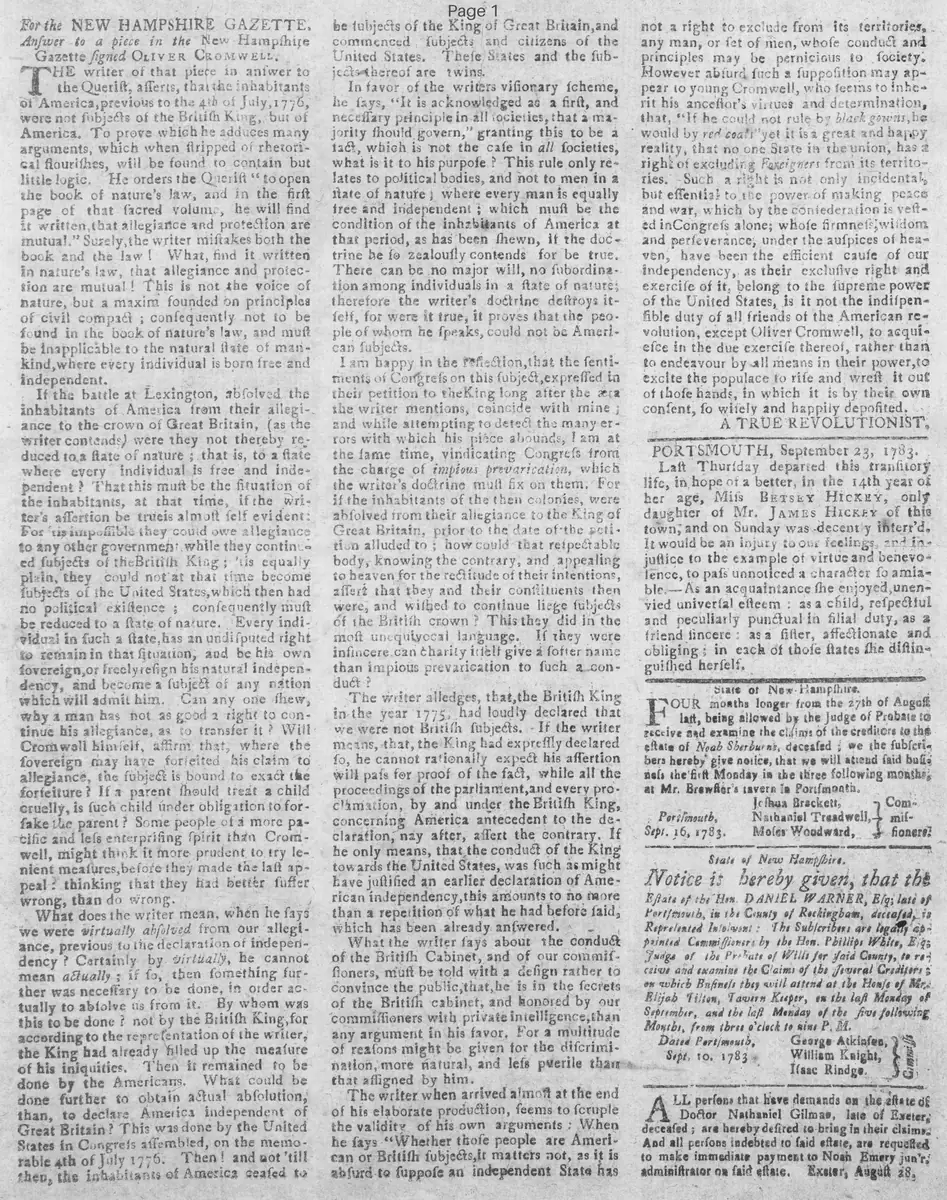
Answer to a piece in the New Hampshire Gazette Signed OLIVER CROMWELL.
The writer of that piece in answer to the Querist asserts, that the inhabitants of America, previous to the 4th of July, 1776, were not subjects of the British King, but of America. To prove which he adduces many arguments, which when stripped of rhetorical flourishes, will be found to contain but little logic. He orders the Querist "to open the book of nature's law, and in the first page of that sacred volume, he will find it written, that allegiance and protection are mutual." Surely, the writer mistakes both the book and the law! What, find it written in nature's law, that allegiance and protection are mutual! This is not the voice of nature, but a maxim founded on principles of civil compact: consequently not to be found in the book of nature's law, and must be inapplicable to the natural state of mankind, where every individual is born free and independent.
If the battle at Lexington absolved the inhabitants of America from their allegiance to the crown of Great Britain, (as the writer contends) were they not thereby reduced to a state of nature; that is, to a state where every individual is free and independent? That this must be the situation of the inhabitants, at that time, if the writer's assertion be true, is almost self evident: For 'tis impossible they could owe allegiance to any other government, while they continued subjects of the British King; 'tis equally plain, they could not at that time become subjects of the United States, which then had no political existence; consequently must be reduced to a state of nature. Every individual in such a state, has an undisputed right to remain in that situation, and be his own sovereign, or freely resign his natural independency, and become a subject of any nation which will admit him. Can any one show, why a man has not as good a right to continue his allegiance, as to transfer it? Will Cromwell himself, affirm that, where the sovereign may have forfeited his claim to allegiance, the subject is bound to exact the forfeiture? If a parent should treat a child cruelly, is such child under obligation to forsake the parent? Some people of a more pacific and less enterprising spirit than Cromwell, might think it more prudent to try lenient measures, before they made the last appeal: thinking that they had better suffer wrong, than do wrong.
What does the writer mean, when he says we were virtually absolved from our allegiance, previous to the declaration of independency? Certainly by virtually, he cannot mean actually: if so, then something further was necessary to be done, in order actually to absolve us from it. By whom was this to be done? not by the British King, for according to the representation of the writer, the King had already filled up the measure of his iniquities. Then it remained to be done by the Americans. What could be done further to obtain actual absolution, than, to declare America independent of Great Britain? This was done by the United States in Congress assembled, on the memorable 4th of July 1776. Then! and not till then, the inhabitants of America ceased to
be subjects of the King of Great Britain, and commenced subjects and citizens of the United States. These States and the subjects thereof are twins.
In favor of the writer's visionary scheme, he says, "It is acknowledged as a first, and necessary principle in all societies, that a majority should govern," granting this to be a fact, which is not the case in all societies, what is it to his purpose? This rule only relates to political bodies, and not to men in a state of nature; where every man is equally free and independent: which must be the condition of the inhabitants of America at that period, as has been shown, if the doctrine be so zealously contends for be true. There can be no majority will, no subordination among individuals in a state of nature; therefore the writer's doctrine destroys itself, for were it true, it proves that the people of whom he speaks, could not be American subjects.
I am happy in the reflection, that the sentiments of Congress on this subject, expressed in their petition to the King long after the ara the writer mentions, coincide with mine: and while attempting to detect the many errors with which his piece abounds, I am at the same time, vindicating Congress from the charge of impious prevarication, which the writer's doctrine must fix on them. For if the inhabitants of the then colonies, were absolved from their allegiance to the King of Great Britain, prior to the date of the petition alluded to: how could that respectable body, knowing the contrary, and appealing to heaven for the rectitude of their intentions, assert that they and their constituents then were, and wished to continue liege subjects of the British crown? This they did in the most unequivocal language. If they were insincere, can Charity itself give a softer name than impious prevarication to such a conduct?
The writer alleges, that the British King in the year 1775, had loudly declared that we were not British subjects. - If the writer means, that, the King had expressly declared so, he cannot rationally expect his assertion will pass for proof of the fact, while all the proceedings of the parliament, and every proclamation, by and under the British King, concerning America antecedent to the declaration, nay after, assert the contrary. If he only means, that the conduct of the King towards the United States, was such as might have justified an earlier declaration of American independency, this amounts to no more than a repetition of what he had before said, which has been already answered.
What the writer says about the conduct of the British Cabinet, and of our commissioners, must be told with a design rather to convince the public, that, he is in the secrets of the British cabinet, and honored by our commissioners with private intelligence, than any argument in his favor. For a multitude of reasons might be given for the discrimination, more natural, and less puerile than that assigned by him.
The writer when arrived almost at the end of his elaborate production, seems to scruple the validity of his own arguments: When he says "Whether those people are American or British subjects, it matters not, as it is absurd to suppose an independent State has
not a right to exclude from its territories, any man, or set of men, whose conduct and principles may be pernicious to society. However absurd such a supposition may appear to young Cromwell, who seems to inherit his ancestor's virtues and determination, that, "if he could not rule by black gowns, he would by red coats" yet it is a great and happy reality, that no one State in the union, has a right of excluding Foreigners from its territories. -Such a right is not only incidental but essential to the power of making peace and war, which by the confederation is vested in Congress alone: whose firmness, wisdom and perseverance, under the auspices of heaven, have been the efficient cause of our independency, as their exclusive right and exercise of it, belong to the supreme power of the United States. Is it not the indispensable duty of all friends of the American revolution, except Oliver Cromwell, to acquiesce in the due exercise thereof, rather than to endeavour by all means in their power, to excite the populace to rise and wrest it out of those hands, in which it is by their own consent, so wisely and happily deposited.
A TRUE REVOLUTIONIST.
What sub-type of article is it?
What themes does it cover?
What keywords are associated?
What entities or persons were involved?
Letter to Editor Details
Author
A True Revolutionist.
Recipient
For The New Hampshire Gazette.
Main Argument
americans were subjects of the british king until the declaration of independence on july 4, 1776, which formally absolved allegiance; prior claims of absolution reduce people to a state of nature without forming a new government, and congress's later petition confirms continued loyalty until then.
Notable Details