Thank you for visiting SNEWPapers!
Sign up free
Editorial
July 20, 1943
The Wilmington Morning Star
Wilmington, New Hanover County, North Carolina
What is this article about?
Editorial criticizes President Roosevelt for transforming the cabinet into mere executors of his will, discontinuing consultations, and making solo decisions during global war, leading to errors. References Lippmann's article on rebukes of Wallace and Jones.
Clipping
OCR Quality
98%
Excellent
Full Text
One-Man Government
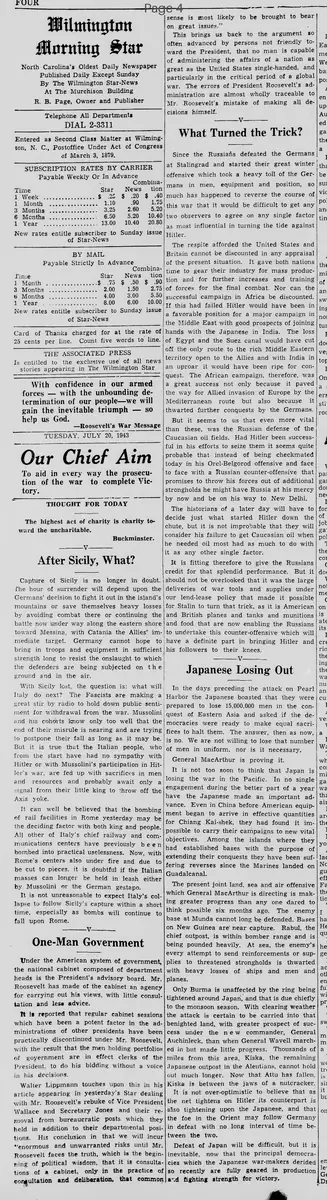
Under the American system of government, the national cabinet composed of department heads is the President's advisory board. Mr. Roosevelt has made of the cabinet an agency for carrying out his views, with little consultation and less advice.
It is reported that regular cabinet sessions which have been a potent factor in the administrations of other presidents have been practically discontinued under Mr. Roosevelt, with the result that the men holding portfolios of government are in effect clerks of the President, to do his bidding without a voice in his decisions.
Walter Lippmann touches upon this in his article appearing in yesterday's Star dealing with Mr. Roosevelt's rebuke of Vice President Wallace and Secretary Jones and their removal from bureaucratic posts which they held in addition to their departmental positions. His conclusion in that we will incur "enormous and unwarranted risks until Mr. Roosevelt faces the truth, which is the beginning of political wisdom, that it is consultations of a cabinet, only in the practice of consultation and deliberation, that common sense is most likely to be brought to bear on great issues.
This brings us back to the argument so often advanced by persons not friendly toward the President. that no man is capable of administering the affairs of a nation as great as the United States single-handed, and particularly in the critical period of a global war. The errors of President Roosevelt's administration are almost wholly traceable to Mr. Roosevelt's mistake of making all decisions himself
Under the American system of government, the national cabinet composed of department heads is the President's advisory board. Mr. Roosevelt has made of the cabinet an agency for carrying out his views, with little consultation and less advice.
It is reported that regular cabinet sessions which have been a potent factor in the administrations of other presidents have been practically discontinued under Mr. Roosevelt, with the result that the men holding portfolios of government are in effect clerks of the President, to do his bidding without a voice in his decisions.
Walter Lippmann touches upon this in his article appearing in yesterday's Star dealing with Mr. Roosevelt's rebuke of Vice President Wallace and Secretary Jones and their removal from bureaucratic posts which they held in addition to their departmental positions. His conclusion in that we will incur "enormous and unwarranted risks until Mr. Roosevelt faces the truth, which is the beginning of political wisdom, that it is consultations of a cabinet, only in the practice of consultation and deliberation, that common sense is most likely to be brought to bear on great issues.
This brings us back to the argument so often advanced by persons not friendly toward the President. that no man is capable of administering the affairs of a nation as great as the United States single-handed, and particularly in the critical period of a global war. The errors of President Roosevelt's administration are almost wholly traceable to Mr. Roosevelt's mistake of making all decisions himself
What sub-type of article is it?
Constitutional
Partisan Politics
What keywords are associated?
One Man Government
Roosevelt Cabinet
Presidential Consultation
Wartime Administration
Political Decisions
What entities or persons were involved?
Mr. Roosevelt
Walter Lippmann
Vice President Wallace
Secretary Jones
Editorial Details
Primary Topic
Criticism Of Roosevelt's One Man Government
Stance / Tone
Critical Of Presidential Centralization
Key Figures
Mr. Roosevelt
Walter Lippmann
Vice President Wallace
Secretary Jones
Key Arguments
Cabinet Functions As Agency To Carry Out President's Views With Little Consultation
Regular Cabinet Sessions Discontinued
Cabinet Members Act As Clerks Without Voice In Decisions
Consultation In Cabinet Brings Common Sense To Great Issues
No Man Can Administer The United States Single Handedly, Especially In Global War
Errors Of Administration Traceable To Roosevelt Making All Decisions Himself