Thank you for visiting SNEWPapers!
Sign up free
Vermont Watchman And State Journal
Montpelier, Washington County, Vermont
What is this article about?
On May 23, 1842, the U.S. Secretary of the Treasury presented a report and tariff bill to the House, proposing duties on wool, cotton, silks, and other goods to protect American labor and generate revenue, estimated at $27 million net annually, with comparisons to Mr. Saltonstall's bill.
Clipping
OCR Quality
Full Text
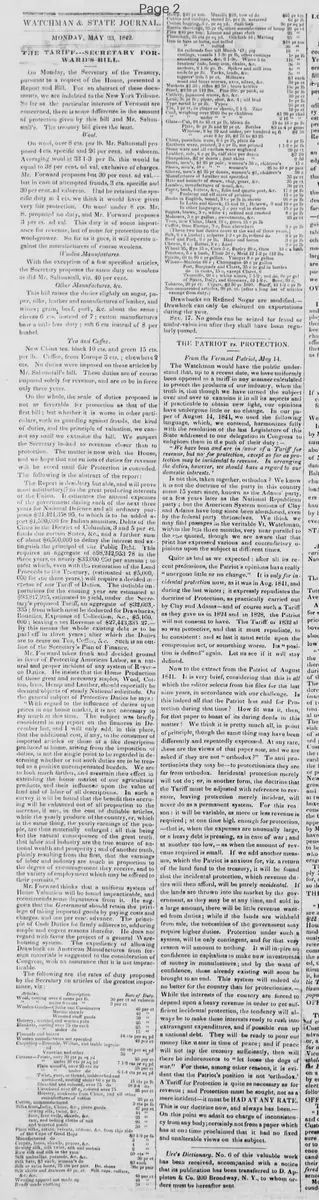
DEPARTMENT OF THE TREASURY.
On Monday, the Secretary of the Treasury, pursuant to a request of the House, presented a Report and Bill. For an abstract of these documents, we are indebted to the New York Tribune.
So far as the particular interests of Vermont are concerned, there is some difference in the amount of protection given by this bill and Mr. Saltonstall's. The treasury bill gives the least.
Wool.
On wool, over 8 cts. per lb. Mr. Saltonstall proposed 4 cts. specific and 26 per cent. ad valorem. Averaging wool at 33 1-3 per lb. this would be equal to 38 per cent. ad val. exclusive of charges. Mr. Forward proposes but 30 per cent. ad val. But in case of attempted frauds, 3 cts. specific and 30 per cent. ad valorem. Had he retained the specific duty at 4 cts. we think it would have given very fair protection. On wool under 8 cts. Mr. S. proposed no duty, and Mr. Forward proposes 3 per ct. ad val. This duty is of some importance for revenue, but of none for protection to the wool-grower. So far as it goes, it will operate against the manufacturers of coarse woolens.
Woolen Manufactures.
With the exception of a few specified articles, the Secretary proposes the same duty on woolens as did Mr. Saltonstall, viz. 40 per cent.
Other Manufactures, &c.
This bill raises the duties slightly on sugar, hemp, silks, leather and manufactures of leather, and wines; grain, beef, pork, &c. about the same; cheese 6 cts. instead of 7; cotton manufactures bearing a little less duty; salt 6 cts instead of 8 per bushel.
Tea and Coffee.
New China tea, black 10 cts. and green 15 cts. per lb. Coffee, from Europe 3 cts.: elsewhere 2 cts. No duties were imposed on these articles by Mr. Saltonstall's bill. These duties are of course imposed solely for revenue, and are to be in force only three years.
On the whole, the scale of duties proposed is not as favorable for protection as that of the first bill; but whether it is worse in other particulars, such as guarding against frauds, the kind of duties, and the principle of valuation, we cannot say until we examine the bill. We suspect the Secretary looked to revenue closer than to protection. The matter is now with the House, and we hope that not one jota of duties for revenue will be voted until fair Protection is conceded.
The following is the abstract of the report:
The Report is desultory but able, and will prove most satisfactory to the great producing interests of the Union. It estimates the annual expenses of the government during each of the next three years for National Defence and all ordinary purposes $24,421,358 95, to which is to be added a part $1,500,000 for Indian annuities, Debts of the Cities in the District of Columbia, 3 and 5 per ct. funds due certain States, &c., and a further sum of about $6,500,000 to defray the interest and extinguish the principal of our Public Debt. This requires an aggregate of $32,242,953 78 in the three years, or nearly $33,000,000 per annum; to meet which, even with the restoration of the Land Proceeds to the Treasury, (estimated at $5,000,000 for the three years.) will require a decided increase of our Tariff of Duties. The dutiable importations for the ensuing year are estimated at $93,817,985, estimated to yield, under the Secretary's proposed Tariff, an aggregate of $32,603,335; from which must be deducted for Drawbacks, Bounties, Expenses of Collection, &c., $5,160,000: leaving a net Revenue of $27,443,335 27.
By this means the whole existing debt is to be paid off in three years; after which the Duties are to cease on Tea, Coffee, &c. such is an outline of the Secretary's Plan of Finance.
Mr. Forward takes frank and decided ground in favor of Protecting American Labor, as a natural and proper incident of any system of Revenue Duties. He insists that the Home Production of those great and necessary staples, Wool, Cotton, Iron, Hemp and Leather, should especially be deemed objects of steady National solicitude. "On the general subject of Protective Duties he says:
"With regard to the influence of duties upon prices in our home market, it is not necessary to say much at this time. The subject was briefly considered in my report on the finances in December last, and I will only add, in this place, that the additional cost, if any, to the consumer of imported articles or those of a like description produced at home, arising from the imposition of duties, is not the single point to be regarded in determining whether or not such duties are to be treated as a positive uncompensated burden. We are to look much farther, and ascertain their effect in extending the home market of our agricultural products, and their influence upon the value of land and of labor of all descriptions. In such a survey it will be found that the benefit thus accruing will be enhanced out of all proportion to the increase, if any, in the cost of dutiable articles while the yearly produce of the country, or, which is the same thing, the yearly earnings of the people, are thus materially enlarged: all this being but the natural consequence of the great truth, that labor and industry are the true source of national wealth and prosperity; and of another truth, plainly resulting from the first, that the earnings of labor and industry are much in proportion to the degree of encouragement they receive, and to the variety of employment which may be offered to their pursuits."
Mr. Forward thinks that a uniform system of Home Valuation will be found impracticable, and recommends some departures from it. He suggests that the Government should retain the privilege of taking imported goods by paying costs and charges, and ten per cent. advance. The principle of Cash Duties he firmly adheres to, adducing ample and cogent reasons therefor. He does not regard with favor the project of a general Warehousing system. The expediency of allowing Drawback on American Manufactures from foreign materials is suggested to the consideration of Congress, with an assurance that it is not impracticable.
The following are the rates of duty proposed by the Secretary on articles of the greatest importance, viz:
Articles,
Description.
Rate of Duty.
Wool, costing over 8 cents per lb.
30 per ct ad valorem
under 8 cents
3 per ct
Woolen Goods—Cloths and Cassimeres
40 per ct
Merino shawls
40 per ct
Worsted stuff goods
40 per ct
Hosiery, worsted and woolen yarn
40 per ct
Blankets, costing over 75 cts each
40 per ct
under do
40 per ct
Flannels and baizes
14 cts per sq yd
Woolen manufactures not specified
40 per ct
Carpeting—Brussels, Wilton, and treble ingrain
60 cts per sq yd
Venetian and other
35
Cottons—Prints, over 30 cts pr sq yd
25 per ct
under 30 cts pr sq yd
7 1-2 cts pr sq yd
Plain uncol'd, over 25 cts do
25 per ct
under do
6 1-4 cts pr sq yd
Twist, yarn, or thread, unbleached and uncolored, costing under 60 c pr lb
15 cts pr lb
Bleached and colored, over 75 do
18 3-4 do
Uncolored over 60 c, colored over 75
25 per ct
Hosiery, nankeens from China, and all other manufactures of cotton
25 pr ct
Cotton, unmanufactured
3 cts pr lb
Silks from India, China, &c., piece goods
47 per ct
sewing silk, twist, &c.
47 per ct
Lace, lace veils, shawls, &c.
47 per ct
raw, and bolting cloths of silk and worsted goods
47 per ct
Plain silks, satins, velvets, ribbons, &c. from this side
$2 1-2 pr lb
Manufactured do of the Cape of Good Hope
$2 1-2 pr lb
Crapes, laces, shawls, gauzes, &c.
30 pr ct
Sewing silk, silk twist, silk and mohair
30 pr ct
Raw silk and silk in the yarn
3 cts
Silk umbrellas parasols, &c. &c.
30 pr ct
Silk hats, $1 each. woman's do each
$1 each
Silk or satin boots, 75 cts per pair. Do. shoes 30c pr pair
30c pr pair
Silk shirts and drawers 40 pr., ct. Silk caps, collars, &c. &c.
40 per ct
Wearing apparel not made up
40 per ct
Ready made clothing
$8
Manilla 35, tow of do $25 pr ton
$25 pr ton
Cables and cordage, tarred 5c. per lb untarred 6c pr lb
6c pr lb
Cotton bagging, 5 c. pr sq yd. Sailcloth 9c pr sq yd
9c pr sq yd
Russia sheetings, 25 pr ct, other manufactures of hemp 25 pr ct
25 pr ct
Flax $40 per ton: Linens and grass cloth 20 pr ct
20 pr ct
Floorcloth, 35 cts pr sq yd. Oilcloth 10; Matting 25 pr ct
25 pr ct
Iron in bars or bolts, not rolled $18 pr ton
$18 pr ton
rolled 30 for railroads free till March '43; pig 10
30
castings, vessels 1 1/2c pr lb, other castings 1 1/2c pr lb
1 1/2c pr lb
smoothing irons, &c. 2 1/2c. Wires 5 to 11c
11c
braziers' rods, hoop iron, chains, &c. 3c
3c
anchors, 2 1/2c pr. lb. Spikes and mill iron 4c
4c
nails 5c pr lb. Tacks, brads, &c. 5c
5c
taggers' iron 5 pr ct. Mill saws $1 each
$1 each
wood and brass screws, axes, adzes, &c. 30 pr ct
30 pr ct
Muskets $1 50; rifles $2 50; brass kettles 15c pr lb
15c pr lb
Steel, $9 50 pr 112 lbs. Pins 25c. pr pack, or 15c pr lb
15c pr lb
Cutlery, japanned wares, &c. &c. 30 pr ct
30 pr ct
Lead, 3c pr lb; pipes, shot, &c. 4; old lead 1c pr lb
1c pr lb
Tin, 1 pr ct, in plates or sheets, 2 1/2. Zinc 10 pr ct
10 pr ct
Type metal 1c pr lb. Types 25 pr ct
25 pr ct
Coal, weighing over 2700 lbs pr chaldron $1 90 pr chal under 2 1/2 c
2 1/2 c
Glass—Cut, 24 to 40 ct pr lb, blown do 10 to 16 c pr lb
10 to 16 c pr lb
Plate, 2c pr lb and 20 pr ct. Bottles $3 to 4 pr gross
$3 to 4 pr gross
Window, 8 by 10 and under, per hundred sq ft $2.50 over 8 by 10, $2 75 to $3 25
$2.50
China, porcelain ware, 6 c pr lb, plain do 4 c pr lb
4 c pr lb
Earthen ware, printed, 3 c pr lb, not printed 1 1/2c pr lb
1 1/2c pr lb
Stone ware and all earthen ware unglazed 20 pr ct
20 pr ct
Leather, sole, 6 c pr lb, calf skin per dozen $3 50
$3 50
Sheepskins, $2 pr dozen; goat skins 2 50
2 50
Boots, men's, $1 25 pr pair; women's 50 c, children's 15 c
15 c
Shoes, men's, 40 c women's 25 to 40 c pr pair
25 to 40 c pr pair
Gloves, men's $1 25 pr dozen, women's $1, children's 50 c
50 c
Manufactures of Leather not specified 35 pr ct
35 pr ct
Hats and bonnets of straw, chip, grass, &c. 35 pr ct
35 pr ct
Lumber, manufactures of wood, &c. 30 pr ct
30 pr ct
Paper, bank, letters, &c., folio and quarto post, &c. 17 c pr lb
17 c pr lb
Foolscap and all sizes of printing 15 c pr lb
15 c pr lb
Books in English, bound, 3 1/2 c pr lb in sheets 2 6 c pr lb
2 6 c pr lb
In Latin and Greek, 15 and 18; Hebrew, 8 and 10 c pr lb
15 and 18
In other languages, 5 c per vol in sheets 15 c pr lb
15 c pr lb
Sugars, brown, 3 c, white 4; refined and crushed 8c pr lb
8c pr lb
Molasses, 5 c pr gallon; sweetmeats, &c. 25 pr ct
25 pr ct
Teas, new China, black 10 c, green 15 c pr lb
10 c, green 15 c pr lb
Coffee, from Europe, 3 c, from elsewhere 2c pr lb
2c pr lb
(These two last duties cease at the end of three years.)
Salt, 6 c a bushel; salpetre 1 2 c pr lb, refined do 2 c pr lb
2 c pr lb
Beef and Pork, 2 c pr lb. Hams and bacon 2c pr lb
2c pr lb
Cheese, 6c; Butter, 5c; Lard 2c pr lb
2c pr lb
Wheat 25, Rye 15 c, Corn 5 c, Barley 20 c, Oats 10 c a bush
10 c a bush
Potatoes, 6 c a bush, Flour 50 c, Meal 12 1/2 pr 112 lbs
12 1/2 pr 112 lbs
Spirits, 60 to 90 c pr gallon. Vinegar 8 c pr gallon
8 c pr gallon
Wines—Madeira 60 c; Champagne 40 c pr gallon
40 c pr gallon
Port, Burgundy and Claret, 35 c pr gal in bottles do in casks, 15 c, except Claret, 6
15 c, except Claret, 6
Teneriffe, 20 c; white wines, 7 1/2; red do, 6c pr gal of Spain, Italy, and Germany, 12 1/2 c. Beer, 20 c.
12 1/2 c. Beer, 20 c.
Tobacco, 20 pr ct. Cigars, $2 50 pr 1000. Snuff, 12 1/2 c pr lb
$2 50 pr 1000. Snuff, 12 1/2 c pr lb
Non-enumerated articles, 50 pr. ct. (after a long list of articles exempt from duty.)
Drawbacks on Refined Sugar are modified.
Drawback can only be claimed on exportations during the year.
Sec. 17. No goods can be seized for fraud or undervaluation after they shall have been regularly passed.
What sub-type of article is it?
What keywords are associated?
What entities or persons were involved?
Domestic News Details
Event Date
Monday, May 23, 1842
Key Persons
Outcome
proposed tariff to generate $27,443,335 net revenue annually, pay off public debt in three years, and protect american industries like wool, cotton, iron; duties on tea and coffee temporary for three years.
Event Details
The Secretary of the Treasury presented a report and bill to the House proposing tariff duties on imports to protect domestic production and raise revenue, with detailed rates on wool, woolens, cottons, silks, iron, leather, and other goods; compared to prior bill by Mr. Saltonstall, emphasizing protection for Vermont interests and American labor.