Thank you for visiting SNEWPapers!
Sign up free
The West End News
Frederiksted, Saint Croix County, Virgin Islands
What is this article about?
Rev. Walter Schmiz explains key changes in the Catholic Holy Week ritual for Good Friday services, including permission for Communion, omission of Host elevation, addition of prayer for civil authorities, and timing adjustments.
Merged-components note: Continuation of the story on changes in Holy Week rituals, with text flowing directly from the description of services.
Clipping
OCR Quality
Full Text
Change
In
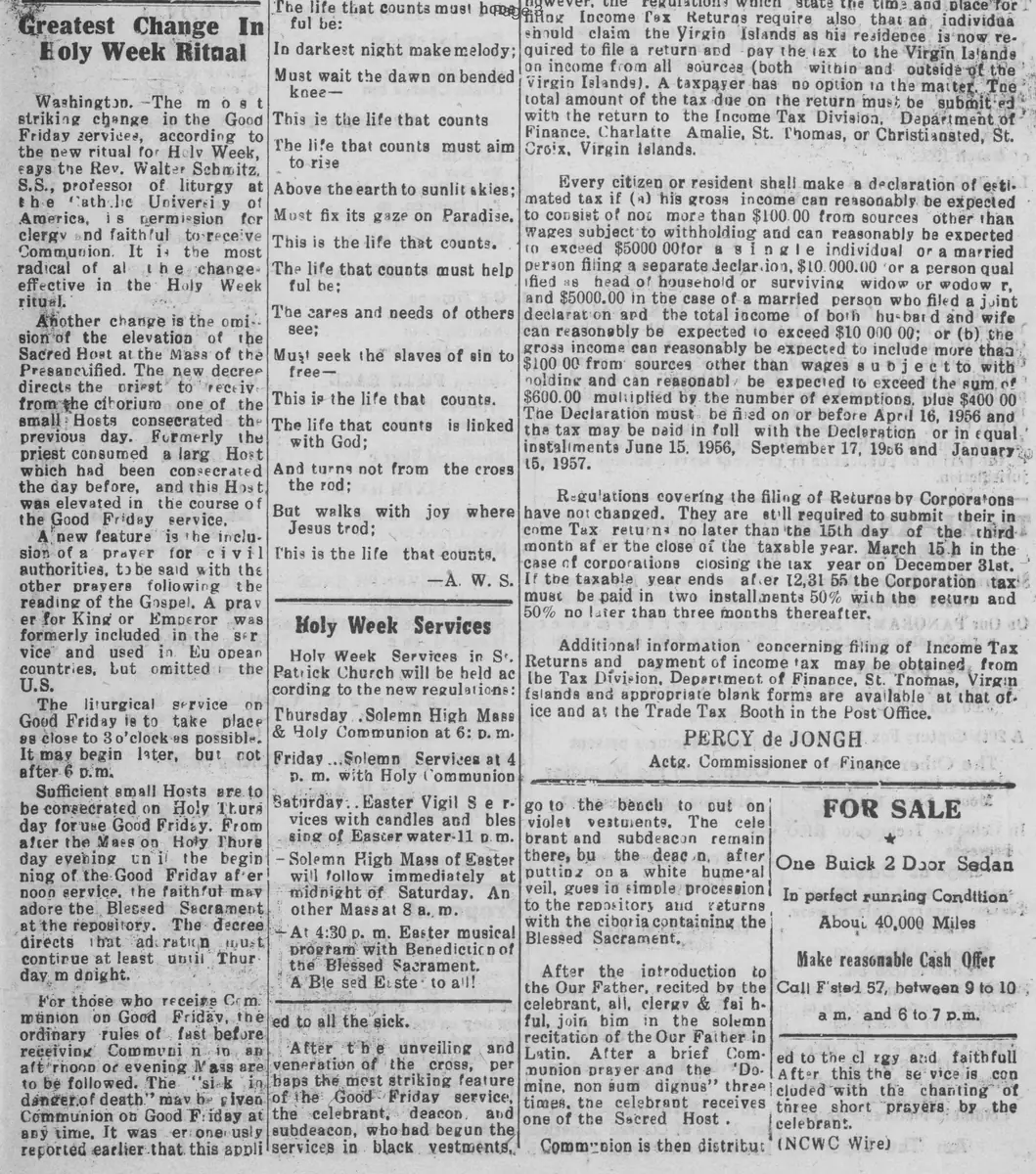
Holy Week Ritual
Washington. - The most striking change in the Good Friday services, according to the new ritual for Holy Week, says the Rev. Walter Schmiz, S.S., professor of liturgy at the Catholic University of America, is permission for clergy and faithful to receive Communion. It is the most radical of all the changes effective in the Holy Week ritual.
Another change is the omission of the elevation of the Sacred Host at the Mass of the Presanctified. The new decree directs the priest to receive from the ciborium one of the small Hosts consecrated the previous day. Formerly the priest consumed a large Host which had been consecrated the day before, and this Host was elevated in the course of the Good Friday service.
A new feature is the inclusion of a prayer for civil authorities, to be said with the other prayers following the reading of the Gospel. A prayer for King or Emperor was formerly included in the service and used in European countries, but omitted in the U.S.
The liturgical service on Good Friday is to take place as close to 3 o'clock as possible. It may begin later, but not after 6 p.m.
Sufficient small Hosts are to be consecrated on Holy Thursday for use on Good Friday. From after the Mass on Holy Thursday evening until the beginning of the Good Friday afternoon service, the faithful may adore the Blessed Sacrament at the repository. The decree directs that adoration must continue at least until Thursday midnight.
For those who receive Communion on Good Friday, the ordinary rules of fast before receiving Communion, in an afternoon or evening Mass are to be followed. The 'sick in danger of death' may be given Communion on Good Friday at any time. It was erroneously reported earlier that this applies
After the unveiling and veneration of the cross, perhaps the most striking feature of the Good Friday service, the celebrant, deacon, and subdeacon, who had begun the services in black vestments, go to the bench to put on violet vestments. The celebrant and subdeacon remain there, but the deacon, after putting on a white humeral veil, goes in simple procession to the repository and returns with the ciboria containing the Blessed Sacrament.
After the introduction to the Our Father, recited by the celebrant, all clergy & faithful join him in the solemn recitation of the Our Father in Latin. After a brief Communion prayer and the 'Domine, non sum dignus' three times, the celebrant receives one of the Sacred Hosts.
Communion is then distributed to the clergy and faithful. After this the service is concluded with the chanting of three short prayers by the celebrant.
(NCWC Wire)
What sub-type of article is it?
What themes does it cover?
What keywords are associated?
What entities or persons were involved?
Where did it happen?
Story Details
Key Persons
Location
Washington
Story Details
The new Holy Week ritual introduces permission for Communion on Good Friday, omits elevation of the Sacred Host, adds a prayer for civil authorities, specifies service timing near 3 p.m., and details procedures for Hosts, adoration, fasting, and Communion distribution.