Thank you for visiting SNEWPapers!
Sign up free
Story
July 25, 1882
The Evening Critic
Washington, District Of Columbia
What is this article about?
Comptroller Lawrence denies New York Tribune's allegations of using government clerks for private business, explaining their roles and his limited private practice, emphasizing no neglect of duties.
Clipping
OCR Quality
98%
Excellent
Full Text
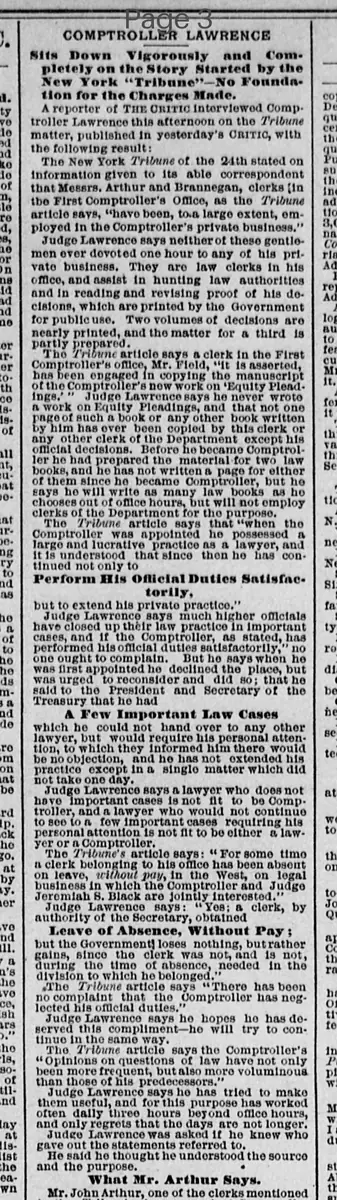
Comptroller Lawrence Sits Down Vigorously and Completely on the Story Started by the New York Tribune—No Foundation for the Charges Made.
A reporter of THE CRITIC interviewed Comptroller Lawrence this afternoon on the Tribune matter, published in yesterday's CRITIC, with the following result:
The New York Tribune of the 24th stated on information given to its able correspondent that Messrs. Arthur and Brannegan, clerks in the First Comptroller's Office, as the Tribune article says, "have been, to a large extent, employed in the Comptroller's private business."
Judge Lawrence says neither of these gentlemen ever devoted one hour to any of his private business. They are law clerks in his office, and assist in hunting law authorities and in reading and revising proof of his decisions, which are printed by the Government for public use. Two volumes of decisions are nearly printed, and the matter for a third is partly prepared.
The Tribune article says a clerk in the First Comptroller's office, Mr. Field, "it is asserted, has been engaged in copying the manuscript of the Comptroller's new work on 'Equity Pleadings.' " Judge Lawrence says he never wrote a work on Equity Pleadings, and that not one page of such a book or any other book written by him has ever been copied by this clerk or any other clerk of the Department except his official decisions. Before he became Comptroller he had prepared the material for two law books, and he has not written a page for either of them since he became Comptroller, but he says he will write as many law books as he chooses out of office hours, but will not employ clerks of the Department for the purpose.
The Tribune article says that "when the Comptroller was appointed he possessed a large and lucrative practice as a lawyer, and it is understood that since then he has continued not only to perform his official duties satisfactorily, but to extend his private practice."
Judge Lawrence says much higher officials have closed up their law practice in important cases, and if the Comptroller, as stated, has performed his official duties satisfactorily, no one ought to complain. But he says when he was first appointed he declined the place, but was urged to reconsider and did so: that he said to the President and Secretary of the Treasury that he had a few important law cases which he could not hand over to any other lawyer, but would require his personal attention, to which they informed him there would be no objection, and he has not extended his practice except in a single matter which did not take one day.
Judge Lawrence says a lawyer who does not have important cases is not fit to be Comptroller, and a lawyer who would not continue to see to a few important cases requiring his personal attention is not fit to be either a lawyer or a Comptroller.
The Tribune's article says: "For some time a clerk belonging to his office has been absent on leave, without pay, in the West, on legal business in which the Comptroller and Judge Jeremiah S. Black are jointly interested."
Judge Lawrence says: "Yes; a clerk, by authority of the Secretary, obtained leave of absence, without pay; but the Government loses nothing, but rather gains, since the clerk was not, and is not, during the time of absence, needed in the division to which he belonged."
The Tribune article says "There has been no complaint that the Comptroller has neglected his official duties."
Judge Lawrence says he hopes he has deserved this compliment—he will try to continue in the same way.
The Tribune article says the Comptroller's "opinions on questions of law have not only been more frequent, but also more voluminous than those of his predecessors."
Judge Lawrence says he has tried to make them useful, and for this purpose has worked often daily three hours beyond office hours, and only regrets that the days are not longer.
Judge Lawrence was asked if he knew who gave out the statements referred to. He said he thought he understood the source and the purpose.
A reporter of THE CRITIC interviewed Comptroller Lawrence this afternoon on the Tribune matter, published in yesterday's CRITIC, with the following result:
The New York Tribune of the 24th stated on information given to its able correspondent that Messrs. Arthur and Brannegan, clerks in the First Comptroller's Office, as the Tribune article says, "have been, to a large extent, employed in the Comptroller's private business."
Judge Lawrence says neither of these gentlemen ever devoted one hour to any of his private business. They are law clerks in his office, and assist in hunting law authorities and in reading and revising proof of his decisions, which are printed by the Government for public use. Two volumes of decisions are nearly printed, and the matter for a third is partly prepared.
The Tribune article says a clerk in the First Comptroller's office, Mr. Field, "it is asserted, has been engaged in copying the manuscript of the Comptroller's new work on 'Equity Pleadings.' " Judge Lawrence says he never wrote a work on Equity Pleadings, and that not one page of such a book or any other book written by him has ever been copied by this clerk or any other clerk of the Department except his official decisions. Before he became Comptroller he had prepared the material for two law books, and he has not written a page for either of them since he became Comptroller, but he says he will write as many law books as he chooses out of office hours, but will not employ clerks of the Department for the purpose.
The Tribune article says that "when the Comptroller was appointed he possessed a large and lucrative practice as a lawyer, and it is understood that since then he has continued not only to perform his official duties satisfactorily, but to extend his private practice."
Judge Lawrence says much higher officials have closed up their law practice in important cases, and if the Comptroller, as stated, has performed his official duties satisfactorily, no one ought to complain. But he says when he was first appointed he declined the place, but was urged to reconsider and did so: that he said to the President and Secretary of the Treasury that he had a few important law cases which he could not hand over to any other lawyer, but would require his personal attention, to which they informed him there would be no objection, and he has not extended his practice except in a single matter which did not take one day.
Judge Lawrence says a lawyer who does not have important cases is not fit to be Comptroller, and a lawyer who would not continue to see to a few important cases requiring his personal attention is not fit to be either a lawyer or a Comptroller.
The Tribune's article says: "For some time a clerk belonging to his office has been absent on leave, without pay, in the West, on legal business in which the Comptroller and Judge Jeremiah S. Black are jointly interested."
Judge Lawrence says: "Yes; a clerk, by authority of the Secretary, obtained leave of absence, without pay; but the Government loses nothing, but rather gains, since the clerk was not, and is not, during the time of absence, needed in the division to which he belonged."
The Tribune article says "There has been no complaint that the Comptroller has neglected his official duties."
Judge Lawrence says he hopes he has deserved this compliment—he will try to continue in the same way.
The Tribune article says the Comptroller's "opinions on questions of law have not only been more frequent, but also more voluminous than those of his predecessors."
Judge Lawrence says he has tried to make them useful, and for this purpose has worked often daily three hours beyond office hours, and only regrets that the days are not longer.
Judge Lawrence was asked if he knew who gave out the statements referred to. He said he thought he understood the source and the purpose.
What sub-type of article is it?
Biography
Deception Fraud
What themes does it cover?
Deception
Justice
Moral Virtue
What keywords are associated?
Comptroller Lawrence
Tribune Allegations
Clerk Misuse
Official Denial
Private Practice
Government Clerks
What entities or persons were involved?
Comptroller Lawrence
Judge Lawrence
Messrs. Arthur
Brannegan
Mr. Field
Judge Jeremiah S. Black
President
Secretary Of The Treasury
Story Details
Key Persons
Comptroller Lawrence
Judge Lawrence
Messrs. Arthur
Brannegan
Mr. Field
Judge Jeremiah S. Black
President
Secretary Of The Treasury
Story Details
Comptroller Lawrence refutes New York Tribune's claims of clerks aiding his private business, denies writing on Equity Pleadings, explains limited private practice approved by superiors, and affirms dedication to official duties.