Thank you for visiting SNEWPapers!
Sign up free
Story
October 2, 1921
Tombstone Epitaph
Tombstone, Cochise County, Arizona
What is this article about?
Arizona auditor Charles Fairfield questions sharp drop in national forest revenue to $42,430 from $124,629, resolved by US Forest Service engineer T. W. Norcross as deferred grazing fees under 1921 congressional act.
Clipping
OCR Quality
95%
Excellent
Full Text
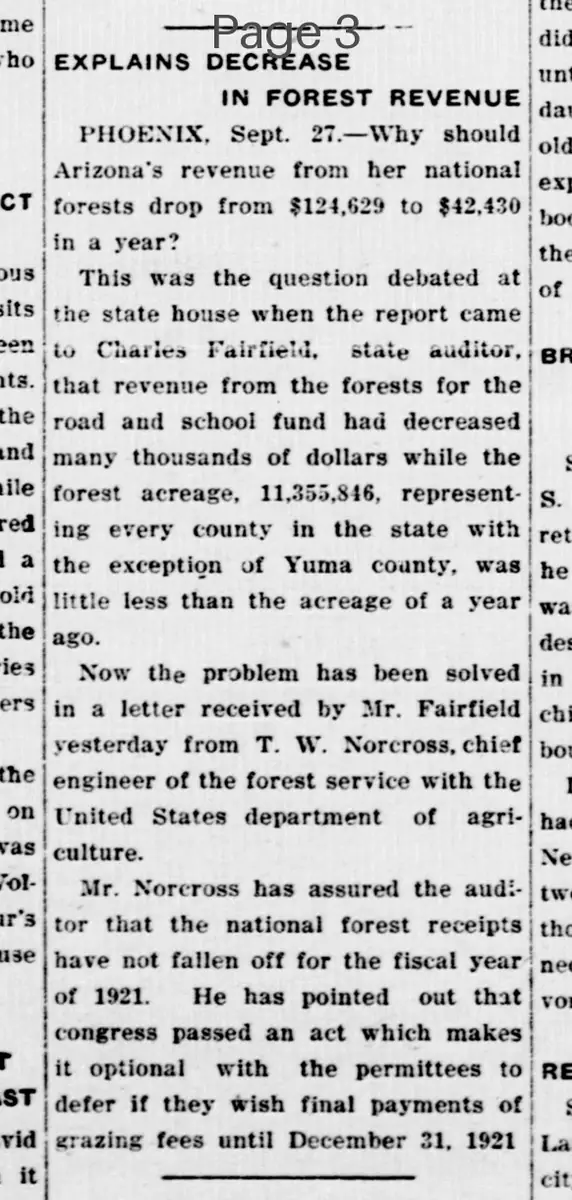
EXPLAINS DECREASE IN FOREST REVENUE
PHOENIX, Sept. 27.—Why should Arizona's revenue from her national forests drop from $124,629 to $42,430 in a year?
This was the question debated at the state house when the report came to Charles Fairfield, state auditor, that revenue from the forests for the road and school fund had decreased many thousands of dollars while the forest acreage, 11,355,846, representing every county in the state with the exception of Yuma county, was little less than the acreage of a year ago.
Now the problem has been solved in a letter received by Mr. Fairfield yesterday from T. W. Norcross, chief engineer of the forest service with the United States department of agriculture.
Mr. Norcross has assured the auditor that the national forest receipts have not fallen off for the fiscal year of 1921. He has pointed out that congress passed an act which makes it optional with the permittees to defer if they wish final payments of grazing fees until December 31, 1921.
PHOENIX, Sept. 27.—Why should Arizona's revenue from her national forests drop from $124,629 to $42,430 in a year?
This was the question debated at the state house when the report came to Charles Fairfield, state auditor, that revenue from the forests for the road and school fund had decreased many thousands of dollars while the forest acreage, 11,355,846, representing every county in the state with the exception of Yuma county, was little less than the acreage of a year ago.
Now the problem has been solved in a letter received by Mr. Fairfield yesterday from T. W. Norcross, chief engineer of the forest service with the United States department of agriculture.
Mr. Norcross has assured the auditor that the national forest receipts have not fallen off for the fiscal year of 1921. He has pointed out that congress passed an act which makes it optional with the permittees to defer if they wish final payments of grazing fees until December 31, 1921.
What sub-type of article is it?
Curiosity
What themes does it cover?
Fortune Reversal
What keywords are associated?
Forest Revenue
Arizona
National Forests
Grazing Fees
Deferred Payments
What entities or persons were involved?
Charles Fairfield
T. W. Norcross
Where did it happen?
Phoenix, Arizona
Story Details
Key Persons
Charles Fairfield
T. W. Norcross
Location
Phoenix, Arizona
Event Date
Sept. 27, 1921
Story Details
Arizona's national forest revenue for roads and schools dropped from $124,629 to $42,430, but the US Forest Service explains it is due to a congressional act allowing permittees to defer grazing fee payments until December 31, 1921.