Thank you for visiting SNEWPapers!
Sign up free
Literary
October 12, 1801
The National Intelligencer And Washington Advertiser
Washington, District Of Columbia
What is this article about?
Monge describes the mirage optical illusion in Lower Egypt: a flat plain with villages on eminences appears flooded when heated by the sun, making distant villages look like islands in a lake with inverted reflections that recede as one approaches.
Clipping
OCR Quality
98%
Excellent
Full Text
FROM A LATE LONDON PAPER.
THE MIRAGE.
Monge gives the following description of a singular optical illusion, called the Mirage:
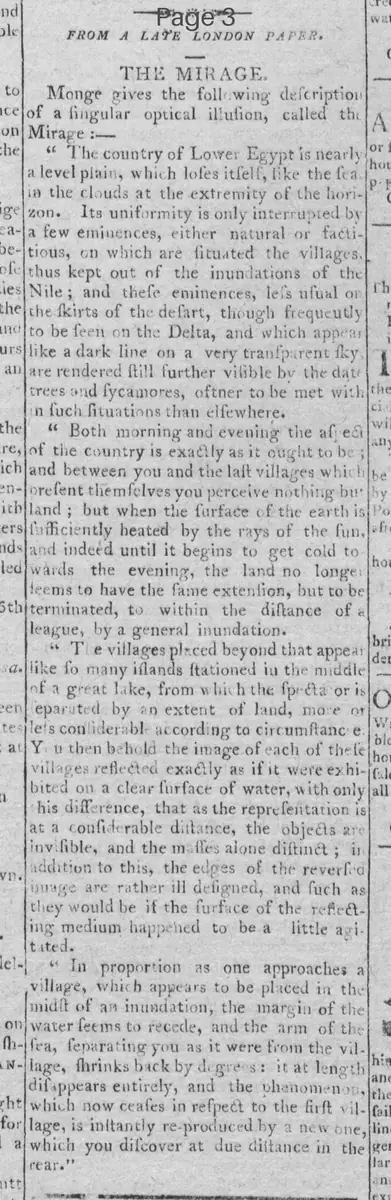
"The country of Lower Egypt is nearly a level plain, which loses itself, like the sea in the clouds at the extremity of the horizon. Its uniformity is only interrupted by a few eminences, either natural or factitious, on which are situated the villages thus kept out of the inundations of the Nile; and these eminences, less usual on the skirts of the desert, though frequently to be seen on the Delta, and which appear like a dark line on a very transparent sky are rendered still further visible by the date trees and sycamores, oftener to be met with in such situations than elsewhere.
"Both morning and evening the aspect of the country is exactly as it ought to be; and between you and the last villages which present themselves you perceive nothing but land; but when the surface of the earth is sufficiently heated by the rays of the sun, and indeed until it begins to get cold towards the evening, the land no longer seems to have the same extension, but to be terminated, to within the distance of a league, by a general inundation.
"The villages placed beyond that appear like so many islands stationed in the middle of a great lake, from which the spectator is separated by an extent of land, more or less considerable according to circumstances. You then behold the image of each of these villages reflected exactly as if it were exhibited on a clear surface of water, with only this difference, that as the representation is at a considerable distance, the objects are invisible, and the masses alone distinct; in addition to this, the edges of the reversed image are rather ill defined, and such as they would be if the surface of the reflecting medium happened to be a little agitated.
"In proportion as one approaches a village, which appears to be placed in the midst of an inundation, the margin of the water seems to recede, and the arm of the sea, separating you as it were from the village, shrinks back by degrees: it at length disappears entirely, and the phenomenon, which now ceases in respect to the first village, is instantly re-produced by a new one, which you discover at due distance in the rear."
THE MIRAGE.
Monge gives the following description of a singular optical illusion, called the Mirage:
"The country of Lower Egypt is nearly a level plain, which loses itself, like the sea in the clouds at the extremity of the horizon. Its uniformity is only interrupted by a few eminences, either natural or factitious, on which are situated the villages thus kept out of the inundations of the Nile; and these eminences, less usual on the skirts of the desert, though frequently to be seen on the Delta, and which appear like a dark line on a very transparent sky are rendered still further visible by the date trees and sycamores, oftener to be met with in such situations than elsewhere.
"Both morning and evening the aspect of the country is exactly as it ought to be; and between you and the last villages which present themselves you perceive nothing but land; but when the surface of the earth is sufficiently heated by the rays of the sun, and indeed until it begins to get cold towards the evening, the land no longer seems to have the same extension, but to be terminated, to within the distance of a league, by a general inundation.
"The villages placed beyond that appear like so many islands stationed in the middle of a great lake, from which the spectator is separated by an extent of land, more or less considerable according to circumstances. You then behold the image of each of these villages reflected exactly as if it were exhibited on a clear surface of water, with only this difference, that as the representation is at a considerable distance, the objects are invisible, and the masses alone distinct; in addition to this, the edges of the reversed image are rather ill defined, and such as they would be if the surface of the reflecting medium happened to be a little agitated.
"In proportion as one approaches a village, which appears to be placed in the midst of an inundation, the margin of the water seems to recede, and the arm of the sea, separating you as it were from the village, shrinks back by degrees: it at length disappears entirely, and the phenomenon, which now ceases in respect to the first village, is instantly re-produced by a new one, which you discover at due distance in the rear."
What sub-type of article is it?
Essay
What themes does it cover?
Nature
What keywords are associated?
Mirage
Optical Illusion
Lower Egypt
Nile Inundations
Desert
Villages
Date Trees
What entities or persons were involved?
Monge
Literary Details
Title
The Mirage.
Author
Monge
Subject
Description Of A Singular Optical Illusion
Form / Style
Prose Observation
Key Lines
The Country Of Lower Egypt Is Nearly A Level Plain, Which Loses Itself, Like The Sea In The Clouds At The Extremity Of The Horizon.
The Villages Placed Beyond That Appear Like So Many Islands Stationed In The Middle Of A Great Lake.
In Proportion As One Approaches A Village, Which Appears To Be Placed In The Midst Of An Inundation, The Margin Of The Water Seems To Recede.