Thank you for visiting SNEWPapers!
Sign up free
Editorial
August 20, 1805
The Enquirer
Richmond, Henrico County, Virginia
What is this article about?
This editorial, part No. V on the Yazoo Speculation, condemns the fraudulent land deals in Georgia's Mississippi territory, arguing no valid titles exist without Indian consent or U.S. authority. It details corruption, Indian massacres to devalue land, and legislative bribery, calling for national condemnation of the fraud.
Clipping
OCR Quality
95%
Excellent
Full Text
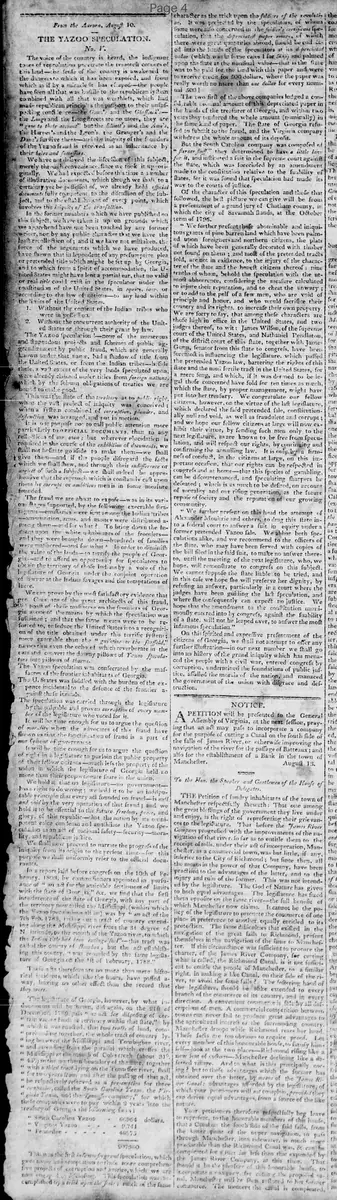
THE YAZOO SPECULATION.
No. V.
The voice of the country is heard, the indignant tones of reprobation penetrate the remotest corners of this land—the sense of the country is awakened to the dangers to which it has been exposed, and from which as if by a miracle it has escaped—the people have seen all that was hostile to the republican system combined with all that was worthless, which had made republican principles the passport to their unworthling confidence—the Gur.'s and the Glafeack's—the Longs and the Longtreets are no more, they are "gone to their account" but the Elliott's and the Sime's, the Harpes's and the Iron's, the Granger's and the Pains's survive them—and the iniquity of the founders of the Yazoo fraud is received as an inheritance by their heirs and successors.
We have not delayed the discussion of this subject merely through convenience, since we took it up originally. We had expected before this time a number of illustrative documents, which though we shall to a certainty yet be possessed of, we already hold official documents fully competent to the discussion of the subject, and to the establishment of every point, which involves the iniquity of the transaction.
In the former numbers which we have published on this subject, we have taken it up on grounds which we apprehend have not been touched by any former writer, nor by any public character that we have the least recollection of; and if we have not mistaken the force of the arguments which we have produced, have shown that independent of any presumptive plea or pretended title which might be set up by Georgia, and to which from a spirit of accommodation, the United States might have lent a partial ear, that no valid or real title could exist in the peculator under the constitution of the United States, in equity, law, or according to the law of nations—to any land within the limits of the United States.
1. Without the consent of the Indian tribes who were in possession.
2. Without the concurrent authority of the United States or through their grant by law.
The Yazoo peculation!—none of the numerous and stupendous projects and schemes of public aggrandizement by public fraud, which are generally known under that name, had a shadow of title from the United States, or from the Indian tribes—besides these, a vast extent of the very lands peculated upon, were already claimed under titles from foreign nations, which by the solemn obligations of treaties we are bound to make good.
This was the state of the territory as to public right, when the vast project of iniquity was conceived: when a system combined of corruption, plunder, and destruction was arranged, and put in motion.
It is our purpose now to call public attention more particularly to official documents, than to any reflections of our own; but wherever elucidation is required in the course of the exhibition of documents, we shall not hesitate gladly to make them—we shall give them—and if the people disregard the facts which we shall show, and through their indifference or neglect of such a subject—we shall indeed be apprehensive that the reproach which is constantly cast upon them by corrupt or ambitious men is in some measure founded.
The fraud we are about to expose—was in its various stages supported, by the following execrable stratagems—emissaries were sent among the Indian tribes—ammunition, arms, and money were distributed among them—and for what? To bring down the Indians upon the white inhabitants of the frontiers—and they were brought down—hundreds of families were massacred—and for what? In order to diminish the value of the lands—to terrify the people of Georgia—and to afford an opportunity for speculators to obtain the territory of those Indians by a vote of the legislature of Georgia under the conjoint operation of horror at the Indian savages and the temptations of lucre.
We can prove by the most satisfactory evidence that Agent Gunn one of the great architects of this fraud, boasts of these massacres on the frontiers of Georgia as one of the means by which the speculation was sustained; and that the same means were to be resorted to, to induce the United States into a recognition of the title obtained under this terrific system; more execrable than the "guillotine or the scaffold," names that even the echo of which reverberate in the ears and convert the downy pillows of Yazoo speculators into pillows of thorns.
The Yazoo peculation was consecrated by the massacres of the frontier inhabitants of Georgia.
The U. States was saddled with the burden of the expense incidental to the defence of the frontier against these inroads.
The peculation was carried through the legislature by the palpable and proven corruption of every member of the legislature who voted for it.
It will be time enough for us to argue the question of morality when the advocates of this fraud have shown us that the sanctification of fraud is a part of our system of government.
It will be time enough for us to argue the question of right in a legislature to purloin the public property of their fellow citizens—much less the property of the union in which the legislature of Georgia held no more than their proportionate share in the union.
We hold it that no legislature—no government—has a right to do wrong; we hold it to be an indisputable principle that every act founded on fraud—is null and void by the very operation of that fraud; and we hold it to be essential to the future freedom, peace, and glory, of this republic—that the nation by its omnipotent voice condemn and annihilate the Yazoo peculation as an act of national safety—security—morality, and republican justice.
We shall now proceed to narrate the progress of the iniquity from its origin to the present time—for this purpose we shall uniformly refer to the official documents.
In a report laid before congress on the 10th of February, 1802, by commissioners appointed in pursuance of "an act for the amicable settlement of limits with the state of Georgia." &c. we find that the first interference of the state of Georgia, with any part of the territory now called the Mississippi, (within which the Yazoo speculation all lies) was by "an act of the 7th Feb. 1785, laying out a tract of country extending along the Mississippi river from the 31 degree of north latitude, to the mouth of the Yazoo river, to which the Indian title had been extinguished"—this tract was called the county of Bourbon, but the act establishing this county, "was repealed by the same legislature of Georgia on the 1st of February, 1788."
These acts therefore are no more than mere historical incidents, which like the hours, have passed away, leaving no other effect than the record that they were.
The legislature of Georgia, however, by what in due time will be shown, did again, on the 21st of December, 1789, pass "an act for disposing of certain tracts of territory within that state," by which it was enacted, that two tracts of land, containing together, the whole tract of country lying between the Mississippi and Tombigbee river, and extending from the parallel which crosses the Mississippi at the mouth of Colos creek (about 31 degrees) to the northern boundary of the state, together with a third tract lying on the Tennessee river, shall for two years from and after the passing of that act, be respectively reserved as a pre-emption for three companies, called the South Carolina Yazoo, the Virginia Yazoo, and the Tennessee company," for which these companies were to pay within 2 years into the treasury of Georgia the following sums:
"South Carolina Yazoo 66964 dollars.
"Virginia Yazoo 9741
"Tennessee— 46075
207380
This is the first infamous and grand peculation, which gave name and some speculation to those more comprehensive projects of corruption and avarice, which we are now engaged in disclosing. This speculation was accomplished by a trick upon the state; much on the same character as the trick upon the soldiers of the revolution. It was projected by the speculators, of whom some were also concerned in the soldier's certificate speculation, that the depreciated paper money, of which there were great quantities abroad, should be collected into the hands of the speculators at its depreciated value (which was in some cases 1 for 500) and palmed upon the state at the nominal value—that is the state was to be paid for the land with this paper and were to receive credit for 500 dollars, where the paper was really worth no more than one dollar for every nominal 500!
The two first of the above companies lodged a considerable nominal amount of this depreciated paper in the hands of the treasurer of Georgia, and within two years they tendered the whole amount (nominally) in the same kind of paper. The state of Georgia refused to submit to the fraud. and the Virginia company withdrew the whole amount of its deposit.
But the South Carolina company was composed of sturdier stuff; they determined to have a little law for it, and instituted a suit in the supreme court against the state. which was foreclosed by an amendment made to the constitution relative to the liability of states, for it was found that peculation had made its way to the courts of justice.
Of the character of this peculation and those that followed, the best picture we can give will be from a presentment of a grand jury of Chatham county, in which the city of Savannah stands, at the October term of 1796.
"We further present those abominable and iniquitous grants of pine barren land which have been palmed upon foreigners and northern citizens, the plats of which have been generally decorated with timber not found on them; and not of the pretended tracts sold, are not in existence, to the injury of the character of the state and the honest citizens thereof: nine tenths of whom, behold the peculation with the utmost abhorrence, considering the measure calculated to injure their reputation, and to cheat the unwary; or to add to the pelf of a few men, who are void of principle and honor, and who would sacrifice their country and its rights, to increase their own property. We are sorry to say, that among these characters are those high in office in the United States, and two judges thereof, to wit: James Wilson, of the supreme court of the United States, and Nathaniel Pendleton, of the district court of this state, together with James Gunn, senator from this state to congress, have been foremost in influencing the legislature, which passed the pretended Yazoo law, bartering the rights of this state and the union for a mere song, and which, if it was deemed to be legal those concerned have sold for ten times as much, which the state, by proper management, might have put into her treasury. We congratulate our fellow citizens, however, on the virtue of the last legislature, which declared the said pretended sale, constitutionally null and void, as well as fraudulent and corrupt; and we hope our fellow citizens at large will now exhibit their virtue, by sending such men only to the next legislature, as are known to be free from peculation, and will respect our rights, by continuing and confirming the annulling law. It is only by a firmness of conduct, in the citizens at large, on this important occasion, that our rights can be respected in congress and at home—that this species of gambling can be discountenanced, and peculating sharpers be defeated; which is as much to be desired, on account of morality and our rising generation, as the future repose of society and the reputation of our growing community."
"We further present on this head the attempt of Alexander Moultrie and others, to drag this state into a federal court to answer a suit in equity under a former pretended Yazoo sale. We abhor both peculations alike, and we recommend to the officers of the state, who may have been served with copies of the bill filed in the said suit, to make no answer thereto, until the meeting of the next legislature, who, we hope, will remonstrate to congress on this subject. We cannot suppose the state liable to be tried, and in this case we hope she will preserve her dignity, by refusing an answer, particularly in a court where the judges have been guiding the last peculation, and where she consequently can expect no justice. We hope that the amendment to the constitution unanimously entered into by congress, against the liability of a state, will not be leaped over, to answer the most infamous peculation."
On this spirited and expressive presentment of the citizens of Georgia, we shall not attempt to offer any further illustration—in our next number we shall go into a history of the grand iniquity which has menaced the people with a civil war, entered congress by corruption, undermined the foundations of public justice, assailed the morals of the nation, and menaced the government of the union with disgrace and destruction.
No. V.
The voice of the country is heard, the indignant tones of reprobation penetrate the remotest corners of this land—the sense of the country is awakened to the dangers to which it has been exposed, and from which as if by a miracle it has escaped—the people have seen all that was hostile to the republican system combined with all that was worthless, which had made republican principles the passport to their unworthling confidence—the Gur.'s and the Glafeack's—the Longs and the Longtreets are no more, they are "gone to their account" but the Elliott's and the Sime's, the Harpes's and the Iron's, the Granger's and the Pains's survive them—and the iniquity of the founders of the Yazoo fraud is received as an inheritance by their heirs and successors.
We have not delayed the discussion of this subject merely through convenience, since we took it up originally. We had expected before this time a number of illustrative documents, which though we shall to a certainty yet be possessed of, we already hold official documents fully competent to the discussion of the subject, and to the establishment of every point, which involves the iniquity of the transaction.
In the former numbers which we have published on this subject, we have taken it up on grounds which we apprehend have not been touched by any former writer, nor by any public character that we have the least recollection of; and if we have not mistaken the force of the arguments which we have produced, have shown that independent of any presumptive plea or pretended title which might be set up by Georgia, and to which from a spirit of accommodation, the United States might have lent a partial ear, that no valid or real title could exist in the peculator under the constitution of the United States, in equity, law, or according to the law of nations—to any land within the limits of the United States.
1. Without the consent of the Indian tribes who were in possession.
2. Without the concurrent authority of the United States or through their grant by law.
The Yazoo peculation!—none of the numerous and stupendous projects and schemes of public aggrandizement by public fraud, which are generally known under that name, had a shadow of title from the United States, or from the Indian tribes—besides these, a vast extent of the very lands peculated upon, were already claimed under titles from foreign nations, which by the solemn obligations of treaties we are bound to make good.
This was the state of the territory as to public right, when the vast project of iniquity was conceived: when a system combined of corruption, plunder, and destruction was arranged, and put in motion.
It is our purpose now to call public attention more particularly to official documents, than to any reflections of our own; but wherever elucidation is required in the course of the exhibition of documents, we shall not hesitate gladly to make them—we shall give them—and if the people disregard the facts which we shall show, and through their indifference or neglect of such a subject—we shall indeed be apprehensive that the reproach which is constantly cast upon them by corrupt or ambitious men is in some measure founded.
The fraud we are about to expose—was in its various stages supported, by the following execrable stratagems—emissaries were sent among the Indian tribes—ammunition, arms, and money were distributed among them—and for what? To bring down the Indians upon the white inhabitants of the frontiers—and they were brought down—hundreds of families were massacred—and for what? In order to diminish the value of the lands—to terrify the people of Georgia—and to afford an opportunity for speculators to obtain the territory of those Indians by a vote of the legislature of Georgia under the conjoint operation of horror at the Indian savages and the temptations of lucre.
We can prove by the most satisfactory evidence that Agent Gunn one of the great architects of this fraud, boasts of these massacres on the frontiers of Georgia as one of the means by which the speculation was sustained; and that the same means were to be resorted to, to induce the United States into a recognition of the title obtained under this terrific system; more execrable than the "guillotine or the scaffold," names that even the echo of which reverberate in the ears and convert the downy pillows of Yazoo speculators into pillows of thorns.
The Yazoo peculation was consecrated by the massacres of the frontier inhabitants of Georgia.
The U. States was saddled with the burden of the expense incidental to the defence of the frontier against these inroads.
The peculation was carried through the legislature by the palpable and proven corruption of every member of the legislature who voted for it.
It will be time enough for us to argue the question of morality when the advocates of this fraud have shown us that the sanctification of fraud is a part of our system of government.
It will be time enough for us to argue the question of right in a legislature to purloin the public property of their fellow citizens—much less the property of the union in which the legislature of Georgia held no more than their proportionate share in the union.
We hold it that no legislature—no government—has a right to do wrong; we hold it to be an indisputable principle that every act founded on fraud—is null and void by the very operation of that fraud; and we hold it to be essential to the future freedom, peace, and glory, of this republic—that the nation by its omnipotent voice condemn and annihilate the Yazoo peculation as an act of national safety—security—morality, and republican justice.
We shall now proceed to narrate the progress of the iniquity from its origin to the present time—for this purpose we shall uniformly refer to the official documents.
In a report laid before congress on the 10th of February, 1802, by commissioners appointed in pursuance of "an act for the amicable settlement of limits with the state of Georgia." &c. we find that the first interference of the state of Georgia, with any part of the territory now called the Mississippi, (within which the Yazoo speculation all lies) was by "an act of the 7th Feb. 1785, laying out a tract of country extending along the Mississippi river from the 31 degree of north latitude, to the mouth of the Yazoo river, to which the Indian title had been extinguished"—this tract was called the county of Bourbon, but the act establishing this county, "was repealed by the same legislature of Georgia on the 1st of February, 1788."
These acts therefore are no more than mere historical incidents, which like the hours, have passed away, leaving no other effect than the record that they were.
The legislature of Georgia, however, by what in due time will be shown, did again, on the 21st of December, 1789, pass "an act for disposing of certain tracts of territory within that state," by which it was enacted, that two tracts of land, containing together, the whole tract of country lying between the Mississippi and Tombigbee river, and extending from the parallel which crosses the Mississippi at the mouth of Colos creek (about 31 degrees) to the northern boundary of the state, together with a third tract lying on the Tennessee river, shall for two years from and after the passing of that act, be respectively reserved as a pre-emption for three companies, called the South Carolina Yazoo, the Virginia Yazoo, and the Tennessee company," for which these companies were to pay within 2 years into the treasury of Georgia the following sums:
"South Carolina Yazoo 66964 dollars.
"Virginia Yazoo 9741
"Tennessee— 46075
207380
This is the first infamous and grand peculation, which gave name and some speculation to those more comprehensive projects of corruption and avarice, which we are now engaged in disclosing. This speculation was accomplished by a trick upon the state; much on the same character as the trick upon the soldiers of the revolution. It was projected by the speculators, of whom some were also concerned in the soldier's certificate speculation, that the depreciated paper money, of which there were great quantities abroad, should be collected into the hands of the speculators at its depreciated value (which was in some cases 1 for 500) and palmed upon the state at the nominal value—that is the state was to be paid for the land with this paper and were to receive credit for 500 dollars, where the paper was really worth no more than one dollar for every nominal 500!
The two first of the above companies lodged a considerable nominal amount of this depreciated paper in the hands of the treasurer of Georgia, and within two years they tendered the whole amount (nominally) in the same kind of paper. The state of Georgia refused to submit to the fraud. and the Virginia company withdrew the whole amount of its deposit.
But the South Carolina company was composed of sturdier stuff; they determined to have a little law for it, and instituted a suit in the supreme court against the state. which was foreclosed by an amendment made to the constitution relative to the liability of states, for it was found that peculation had made its way to the courts of justice.
Of the character of this peculation and those that followed, the best picture we can give will be from a presentment of a grand jury of Chatham county, in which the city of Savannah stands, at the October term of 1796.
"We further present those abominable and iniquitous grants of pine barren land which have been palmed upon foreigners and northern citizens, the plats of which have been generally decorated with timber not found on them; and not of the pretended tracts sold, are not in existence, to the injury of the character of the state and the honest citizens thereof: nine tenths of whom, behold the peculation with the utmost abhorrence, considering the measure calculated to injure their reputation, and to cheat the unwary; or to add to the pelf of a few men, who are void of principle and honor, and who would sacrifice their country and its rights, to increase their own property. We are sorry to say, that among these characters are those high in office in the United States, and two judges thereof, to wit: James Wilson, of the supreme court of the United States, and Nathaniel Pendleton, of the district court of this state, together with James Gunn, senator from this state to congress, have been foremost in influencing the legislature, which passed the pretended Yazoo law, bartering the rights of this state and the union for a mere song, and which, if it was deemed to be legal those concerned have sold for ten times as much, which the state, by proper management, might have put into her treasury. We congratulate our fellow citizens, however, on the virtue of the last legislature, which declared the said pretended sale, constitutionally null and void, as well as fraudulent and corrupt; and we hope our fellow citizens at large will now exhibit their virtue, by sending such men only to the next legislature, as are known to be free from peculation, and will respect our rights, by continuing and confirming the annulling law. It is only by a firmness of conduct, in the citizens at large, on this important occasion, that our rights can be respected in congress and at home—that this species of gambling can be discountenanced, and peculating sharpers be defeated; which is as much to be desired, on account of morality and our rising generation, as the future repose of society and the reputation of our growing community."
"We further present on this head the attempt of Alexander Moultrie and others, to drag this state into a federal court to answer a suit in equity under a former pretended Yazoo sale. We abhor both peculations alike, and we recommend to the officers of the state, who may have been served with copies of the bill filed in the said suit, to make no answer thereto, until the meeting of the next legislature, who, we hope, will remonstrate to congress on this subject. We cannot suppose the state liable to be tried, and in this case we hope she will preserve her dignity, by refusing an answer, particularly in a court where the judges have been guiding the last peculation, and where she consequently can expect no justice. We hope that the amendment to the constitution unanimously entered into by congress, against the liability of a state, will not be leaped over, to answer the most infamous peculation."
On this spirited and expressive presentment of the citizens of Georgia, we shall not attempt to offer any further illustration—in our next number we shall go into a history of the grand iniquity which has menaced the people with a civil war, entered congress by corruption, undermined the foundations of public justice, assailed the morals of the nation, and menaced the government of the union with disgrace and destruction.
What sub-type of article is it?
Constitutional
Indian Affairs
Moral Or Religious
What keywords are associated?
Yazoo Speculation
Land Fraud
Indian Massacres
Georgia Legislature Corruption
Constitutional Nullity
Peculation
Depreciated Paper Money
Agent Gunn
James Wilson
Nathaniel Pendleton
What entities or persons were involved?
Gur.'S
Glafeack's
Longs
Longtreets
Elliott's
Sime's
Harpes's
Irons
Granger's
Pains's
Agent Gunn
James Wilson
Nathaniel Pendleton
James Gunn
South Carolina Yazoo Company
Virginia Yazoo Company
Tennessee Company
Alexander Moultrie
Georgia Legislature
United States Congress
Editorial Details
Primary Topic
Yazoo Land Speculation Fraud
Stance / Tone
Strongly Condemnatory Of Fraud And Corruption
Key Figures
Gur.'S
Glafeack's
Longs
Longtreets
Elliott's
Sime's
Harpes's
Irons
Granger's
Pains's
Agent Gunn
James Wilson
Nathaniel Pendleton
James Gunn
South Carolina Yazoo Company
Virginia Yazoo Company
Tennessee Company
Alexander Moultrie
Georgia Legislature
United States Congress
Key Arguments
No Valid Title To Lands Without Consent Of Indian Tribes In Possession
No Valid Title Without Concurrent Authority Or Grant By Law From The United States
Yazoo Schemes Lacked Any Shadow Of Title From U.S. Or Indian Tribes
Lands Already Claimed Under Foreign Titles Bound By Treaties
Fraud Supported By Stratagems Including Inciting Indian Massacres To Devalue Lands And Terrify Georgia Populace
Agent Gunn Boasted Of Using Massacres To Sustain Speculation
Peculation Carried Through Legislature By Proven Corruption Of Every Voting Member
No Legislature Or Government Has Right To Do Wrong; Fraudulent Acts Are Null And Void
Nation Must Condemn And Annihilate Yazoo Peculation For Republican Justice
Early 1789 Act Reserved Lands As Pre Emption For Yazoo Companies Paid With Depreciated Paper Money
South Carolina Company Sued Georgia But Foreclosed By Constitutional Amendment On State Liability
Grand Jury Presentment Condemns Yazoo Grants As Fraudulent And Corrupt