Thank you for visiting SNEWPapers!
Sign up free
Story
April 17, 1952
Miami Labor Citizen
Miami, Dade County, Florida
What is this article about?
J. N. (Newt) Lummus, director of the Florida Assessors Association, advocates for modernizing the 1941 homestead exemption law to make renewals automatic, eliminating yearly applications to reduce taxpayer burden and prevent fraud.
Clipping
OCR Quality
95%
Excellent
Full Text
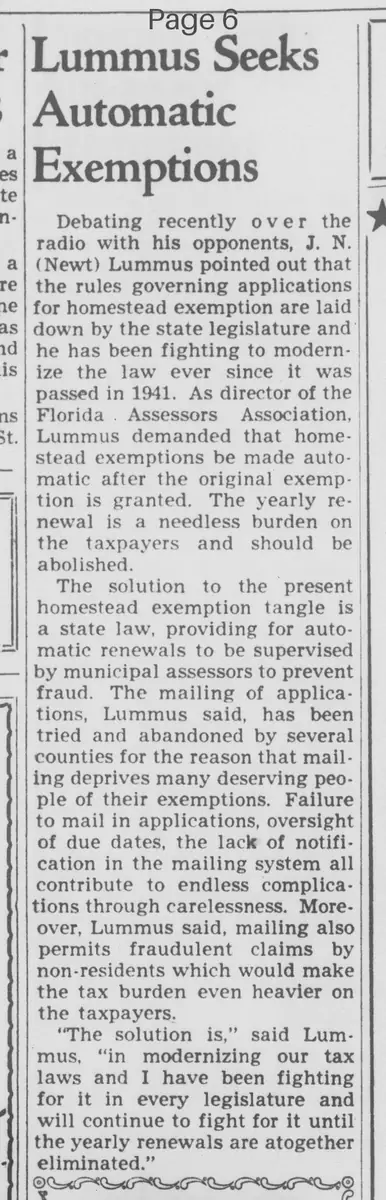
Lummus Seeks
Automatic
Exemptions
Debating recently over the
radio with his opponents, J. N.
(Newt) Lummus pointed out that
the rules governing applications
for homestead exemption are laid
down by the state legislature and
he has been fighting to modernize
the law ever since it was
passed in 1941. As director of the
Florida Assessors
Association.
Lummus demanded that home-
stead exemptions be made auto-
matic after the original exemp-
tion is granted. The yearly re-
newal is a needless burden on
the taxpayers and should be
abolished.
The solution to the present
homestead exemption tangle is
a state law, providing for auto-
matic renewals to be supervised
by municipal assessors to prevent
fraud. The mailing of applica-
tions, Lummus said, has been
tried and abandoned by several
counties for the reason that mail-
ing deprives many deserving peo-
ple of their exemptions. Failure
to mail in applications. oversight
of due dates, the lack of notifi-
cation in the mailing system all
contribute to endless complica-
tions through carelessness. More-
over, Lummus said, mailing also
permits fraudulent claims
by
non-residents which would make
the tax burden even heavier on
the taxpayers.
'The solution is," said Lum-
ms,
"in
modernizing our tax
laws and I have been fighting
for it in every legislature and
will continue to fight for it until
the yearly renewals are altogether
eliminated."
Automatic
Exemptions
Debating recently over the
radio with his opponents, J. N.
(Newt) Lummus pointed out that
the rules governing applications
for homestead exemption are laid
down by the state legislature and
he has been fighting to modernize
the law ever since it was
passed in 1941. As director of the
Florida Assessors
Association.
Lummus demanded that home-
stead exemptions be made auto-
matic after the original exemp-
tion is granted. The yearly re-
newal is a needless burden on
the taxpayers and should be
abolished.
The solution to the present
homestead exemption tangle is
a state law, providing for auto-
matic renewals to be supervised
by municipal assessors to prevent
fraud. The mailing of applica-
tions, Lummus said, has been
tried and abandoned by several
counties for the reason that mail-
ing deprives many deserving peo-
ple of their exemptions. Failure
to mail in applications. oversight
of due dates, the lack of notifi-
cation in the mailing system all
contribute to endless complica-
tions through carelessness. More-
over, Lummus said, mailing also
permits fraudulent claims
by
non-residents which would make
the tax burden even heavier on
the taxpayers.
'The solution is," said Lum-
ms,
"in
modernizing our tax
laws and I have been fighting
for it in every legislature and
will continue to fight for it until
the yearly renewals are altogether
eliminated."
What sub-type of article is it?
Political Advocacy
Policy Debate
What themes does it cover?
Justice
Moral Virtue
What keywords are associated?
Homestead Exemption
Automatic Renewal
Tax Law Modernization
Fraud Prevention
Florida Assessors
Taxpayer Burden
What entities or persons were involved?
J. N. (Newt) Lummus
Where did it happen?
Florida
Story Details
Key Persons
J. N. (Newt) Lummus
Location
Florida
Event Date
Since 1941
Story Details
Lummus argues for automatic homestead exemption renewals to simplify the process, reduce burdens on taxpayers, prevent fraud by non-residents, and avoid complications from mailed applications, which he has fought for since the 1941 law.