Thank you for visiting SNEWPapers!
Sign up free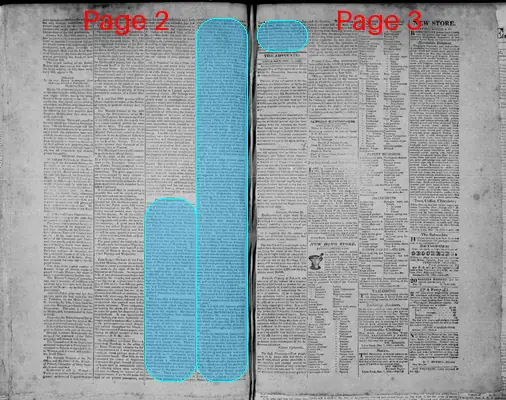
The Arkansas Advocate
Little Rock, Pulaski County, Arkansas
What is this article about?
At Fredericton Supreme Court, American settlers Barnabas Hannawell, Jesse Wetmore, and Daniel Savage were tried and convicted for seditious acts in Madawaska by electing town officers under Maine law. Each fined 50 pounds and imprisoned three months. Highlights border jurisdiction dispute between U.S. and British Province.
Merged-components note: Merged continuation of article on Madawaska settlers trial across pages; relabeled to domestic_news as it concerns a U.S. territorial dispute with Britain.
Clippings
1 of 2
OCR Quality
Full Text
Trial--Conviction--fine and imprisonment of American settlers of Madawaska!
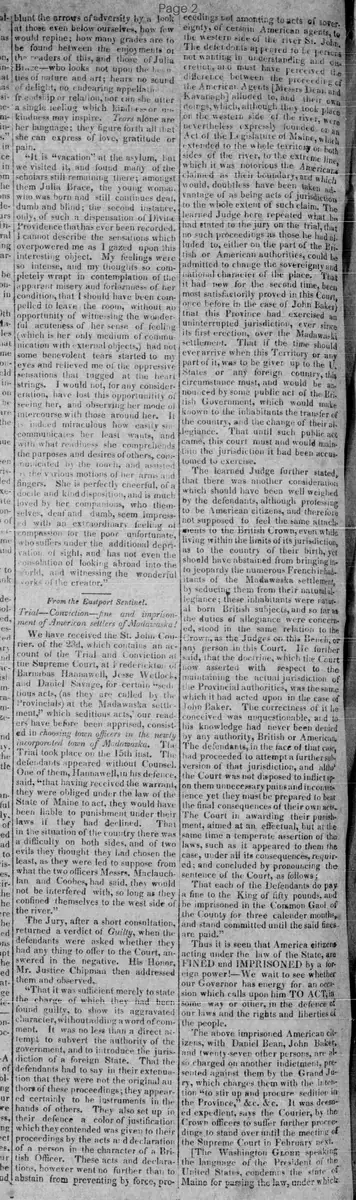
We have received the St. John Courier. of the 23d, which contains an account of the Trial and Conviction at the Supreme Court, at Fredericton of Barnabas Hannawell, Jesse Wetmore, and Daniel Savage, for certain "seditious acts, (as they are called by the Provincials) at the Madawaska settlement," which seditious acts,' our readers have before been apprised, consisted in choosing town officers in the newly incorporated town of Madawaska. The Trial took place on the 15th inst. The defendants appeared without Counsel. One of them, Hannawell,in his defence, said, "that having received the warrant, they were obliged under the law of the State of Maine to act, they would have been liable to punishment under their laws if they had declined. That in the situation of the country there was a difficulty on both sides. and of two evils they thought they had chosen the least, as they were led to suppose from what the two officers Messrs. Maclauchlan and Cook had said, they would not be interfered with, so long as they confined themselves to the west side of the river."
The Jury, after a short consultation, returned a verdict of Guilty, when the defendants were asked whether they had any thing to offer to the Court, answered in the negative. His Honor, Mr. Justice Chipman then addressed them and observed.
"That it was sufficient merely to state the charge of which they had been found guilty, to show its aggravated character, without adding a word of comment. It was no less than a direct attempt: to subvert the authority of the government, and to introduce the jurisdiction of a foreign State. That the defendants had to say in their extenuation that they were not the original authors of these proceedings; they appeared certainly to be instruments in the hands of others. They also set up in their defence a color of justification which they contended was given to their proceedings by the acts and declarations of a person in the character of a British Officer. These acts and declarations, however went no further than to abstain from preventing by force, proceedings not amounting to acts of sovereignty, of certain American agents, to the western side of the river St. John.
The defendants appeared to be persons not wanting in understanding and discretion, and must have perceived the difference between the proceeding of the American Agents [Messrs Dean and Kavanagh] alluded to, and their own doings, which, although they took place on the western side of the river, nevertheless expressly founded on an Act of the Legislature of Maine, which extended to the whole territory on both sides of the river, to the extreme line, which it was notorious the Americans claimed as their boundary, and which would, doubtless have been taken advantage of as being acts of jurisdiction to the whole extent of such claim. The learned Judge here repeated what he had stated to the jury on the trial, that no such proceedings as those he had alluded to, either on the part of the British or American authorities, could be admitted to change the sovereignty and national character of the place. That it had now for the second time, been most satisfactorily proved in this Court. once before in the case of John Baker) that this Province had exercised an uninterrupted jurisdiction, ever since its first erection, over the Madawaska settlement. That if the time should ever arrive when this Territory or any part of it, was to be given up to the U. States or any foreign country, this circumstance must, and would be announced by some public act of the British Government, which would make known to the inhabitants the transfer of the country, and the change of their allegiance. That until such public act came, this court must and would maintain the jurisdiction it had been accustomed to exercise.
The learned Judge further stated. that there was another consideration which should have been well weighed by the defendants, although professing to be American citizens, and therefore not supposed to feel the same attachments to the British Crown, even while living within the limits of its jurisdiction, as to the country of their birth, yet should have abstained from bringing into jeopardy the numerous French inhabitants of the Madawaska settlement. by seducing them from their natural allegiance; these inhabitants were natural born British subjects, and so far as the duties of allegiance were concerned, stood in the same relation to the Crown, as the Judges on this Bench, or any person in this Court. He further said, that the doctrine, which the Court now asserted with respect to the maintaining the actual jurisdiction of the Provincial authorities, was the same which it had acted upon in the case of John Baker. The correctness of it he conceived was unquestionable, and to his knowledge had never been denied by any authority, British or American.
The defendants, in the face of that case, had proceeded to attempt a further subversion of that jurisdiction, and although the Court was not disposed to inflict upon them unnecessary pains and inconvenience yet they must be prepared to bear the final consequences of their own acts. The Court in awarding their punishment, aimed at an effectual, but at the same time a temperate assertion of the laws, such as it appeared to them the case, under all its consequences, required; and concluded by pronouncing the sentence of the Court, as follows:
That each of the Defendants do pay a fine to the King of fifty pounds, and be imprisoned in the Common Gaol of the County for three calendar months, and stand committed until the said fines are paid."
Thus it is seen that American citizens acting under the law of the State, are FINED and IMPRISONED by a foreign power!--We wait to see whether our Governor has energy for an occasion which calls upon him TO ACT in some way or other, in the defence of our laws and the rights and liberties of the people.
The above imprisoned American citizens, with Daniel Bean, John Baker, and twenty-seven other persons, are also charged on another indictment, presented against them by the Grand Jury, which charges them with the intention "to stir up and procure sedition in the Province." &c. &c. It was deemed expedient, says the Courier, by the Crown officers to suffer further proceedings to stand over until the meeting of the Supreme Court in February next.
[The Washington Globe speaking the language of the President of the United States. condemns the state of Maine for passing the law, under which
The contestants were acting in the election of town officers, and says at the time the submission was made to the King of the Netherlands, "there was a distinct understanding that until the question should be finally decided, each of the parties should remain in the exercise of the same jurisdiction over such parts of the territory, as was then held by them respectively."
What sub-type of article is it?
What keywords are associated?
What entities or persons were involved?
Where did it happen?
Domestic News Details
Primary Location
Fredericton
Event Date
15th Inst.
Key Persons
Outcome
each defendant fined fifty pounds and imprisoned for three calendar months until fines paid. further indictment deferred to february supreme court.
Event Details
American settlers tried and convicted at Supreme Court in Fredericton for seditious acts of choosing town officers in Madawaska under Maine law, seen as subverting British authority. Defendants defended based on Maine obligations and assurances from British officers. Judge emphasized uninterrupted British jurisdiction over Madawaska, referencing prior John Baker case.