Thank you for visiting SNEWPapers!
Sign up free
Story
February 16, 1893
The Rawlins Republican
Rawlins, Carbon County, Wyoming
What is this article about?
Article outlines Swiss proportional representation system applied to U.S. state elections to prevent gerrymandering. Districts elect multiple representatives (e.g., nine) via vote quotients, ensuring parties get seats proportional to popular vote.
Clipping
OCR Quality
95%
Excellent
Full Text
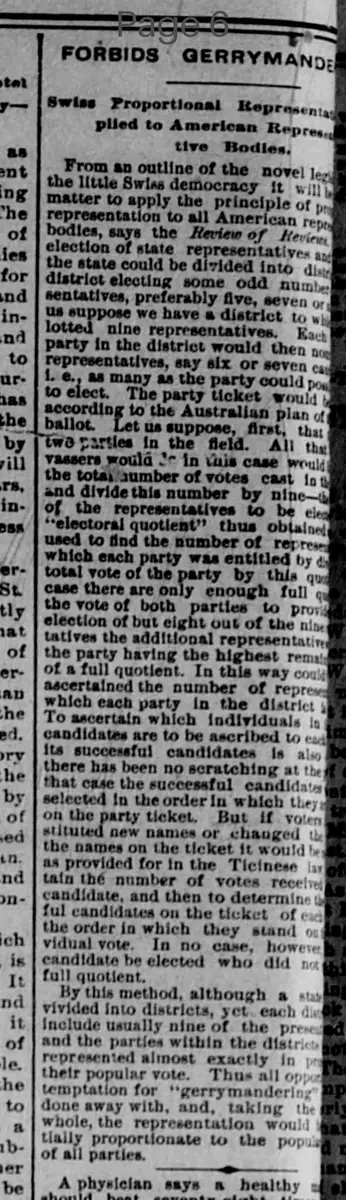
FORBIDS GERRYMANDER
Swiss Proportional Representation Applied to American Representative Bodies.
From an outline of the novel legislation of the little Swiss democracy it will appear no difficult matter to apply the principle of proportional representation to all American representative bodies, says the Review of Reviews. In the election of state representatives and the state could be divided into districts, each district electing some odd number of representatives, preferably five, seven or nine. Let us suppose we have a district to which is allotted nine representatives. Each party in the district would then nominate as many representatives, say six or seven candidates, i.e., as many as the party could possibly hope to elect. The party ticket would be arranged according to the Australian plan of ballot. Let us suppose, first, that there are two parties in the field. All that the canvassers would in this case would be to take the total number of votes cast in the district and divide this number by nine—the number of the representatives to be elected. The "electoral quotient" thus obtained would then be used to find the number of representatives which each party was entitled by dividing the total vote of the party by this quotient. In this case there are only enough full quotients in the vote of both parties to provide for the election of but eight out of the nine representatives the additional representative going to the party having the highest remainder over a full quotient. In this way could be ascertained the number of representatives which each party in the district should have.
To ascertain which individuals of the candidates are to be elected its successful candidates is also provided for. If there has been no scratching at the polls, in that case the successful candidates would be selected in the order in which they stand on the party ticket. But if voters substituted new names or changed the names on the ticket it would be as provided for in the Ticinese law to ascertain the number of votes received by each candidate, and then to determine the successful candidates on the ticket of each party by the order in which they stand on the individual vote. In no case, however, could a candidate be elected who did not receive a full quotient.
By this method, although a state is divided into districts, yet each district would include usually nine of the representatives and the parties within the district would be represented almost exactly in proportion to their popular vote. Thus all opportunity for and temptation for "gerrymandering" would be done away with, and, taking the state as a whole, the representation would be substantially proportionate to the popular vote of all parties.
Swiss Proportional Representation Applied to American Representative Bodies.
From an outline of the novel legislation of the little Swiss democracy it will appear no difficult matter to apply the principle of proportional representation to all American representative bodies, says the Review of Reviews. In the election of state representatives and the state could be divided into districts, each district electing some odd number of representatives, preferably five, seven or nine. Let us suppose we have a district to which is allotted nine representatives. Each party in the district would then nominate as many representatives, say six or seven candidates, i.e., as many as the party could possibly hope to elect. The party ticket would be arranged according to the Australian plan of ballot. Let us suppose, first, that there are two parties in the field. All that the canvassers would in this case would be to take the total number of votes cast in the district and divide this number by nine—the number of the representatives to be elected. The "electoral quotient" thus obtained would then be used to find the number of representatives which each party was entitled by dividing the total vote of the party by this quotient. In this case there are only enough full quotients in the vote of both parties to provide for the election of but eight out of the nine representatives the additional representative going to the party having the highest remainder over a full quotient. In this way could be ascertained the number of representatives which each party in the district should have.
To ascertain which individuals of the candidates are to be elected its successful candidates is also provided for. If there has been no scratching at the polls, in that case the successful candidates would be selected in the order in which they stand on the party ticket. But if voters substituted new names or changed the names on the ticket it would be as provided for in the Ticinese law to ascertain the number of votes received by each candidate, and then to determine the successful candidates on the ticket of each party by the order in which they stand on the individual vote. In no case, however, could a candidate be elected who did not receive a full quotient.
By this method, although a state is divided into districts, yet each district would include usually nine of the representatives and the parties within the district would be represented almost exactly in proportion to their popular vote. Thus all opportunity for and temptation for "gerrymandering" would be done away with, and, taking the state as a whole, the representation would be substantially proportionate to the popular vote of all parties.
What sub-type of article is it?
Historical Event
What themes does it cover?
Justice
What keywords are associated?
Proportional Representation
Gerrymandering
Swiss Democracy
American Elections
Electoral Quotient
Where did it happen?
Swiss Democracy, American Representative Bodies
Story Details
Location
Swiss Democracy, American Representative Bodies
Story Details
Proposes dividing states into districts electing multiple representatives (e.g., nine) using proportional representation via electoral quotients to allocate seats based on party votes, selecting candidates by ticket order or individual votes, eliminating gerrymandering for fair representation.