Thank you for visiting SNEWPapers!
Sign up free
Editorial
May 27, 1797
The Kentucky Gazette
Lexington, Fayette County, Kentucky
What is this article about?
Editorial in Boston Chronicle warns of catastrophic effects of war with France on fisheries, trade, economy, morals, liberties, and society, quoting 1774 to advocate peace over conflict.
Clipping
OCR Quality
95%
Excellent
Full Text
From the BOSTON CHRONICLE
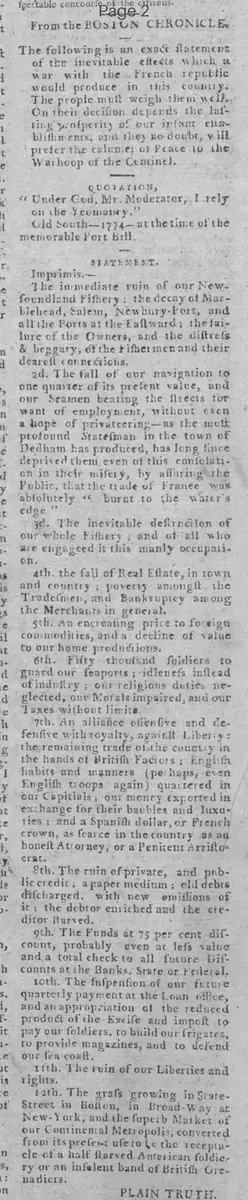
The following is an exact statement of the inevitable effects which a war with the French republic would produce in this country.
The people must weigh them well. On their decision depends the lasting prosperity of our infant establishments, and they no doubt, will prefer the calmest of Peace to the Warwhoop of the Centinel.
QUOTATION,
" Under God, Mr. Moderator, I rely on the Yeomanry."
Old South—1774—at the time of the memorable Port Bill.
STATEMENT.
Imprimis.—
The immediate ruin of our Newfoundland Fishery; the decay of Marblehead, Salem, Newbury-Port, and all the Ports at the Eastward; the failure of the Owners, and the distress & beggary, of the fishermen and their dearest connexions.
2d. The fall of our navigation to one quarter of its present value, and our Seamen beating the streets for want of employment, without even a hope of privateering—as the most profound Statesman in the town of Dedham has produced, has long since deprived them even of this consolation in their misery, by assuring the Public, that the trade of France was absolutely " burnt to the water's edge"
3d. The inevitable destruction of our whole Fishery ; and of all who are engaged in this manly occupation.
4th. the fall of Real Estate, in town and country ; poverty amongst the Tradesmen, and Bankruptcy among the Merchants in general.
5th. An increasing price to foreign commodities, and a decline of value to our home productions.
6th. Fifty thousand soldiers to guard our seaports; idleness instead of industry ; our religious duties neglected, our Morals impaired, and our Taxes without limit.
7th. An alliance offensive and defensive with royalty, against Liberty: the remaining trade of the country in the hands of British Factors ; English habits and manners (perhaps, even English troops again) quartered in our Capitals; our money exported in exchange for their baubles and luxuries ; and a Spanish dollar, or French crown, as scarce in the country as an honest Attorney, or a Penitent Aristocrat.
8th. The ruin of private, and public credit; a paper medium; old debts discharged, with new emissions of it ; the debtor enriched and the creditor starved.
9th. The Funds at 75 per cent discount, probably even at less value and a total check to all future Discounts at the Banks, State or Federal,
10th. The suspension of our future quarterly payments at the Loan office, and an appropriation of the reduced product of the Excise and impost to pay our soldiers, to build our frigates, to provide magazines, and to defend our sea coast.
11th. The ruin of our Liberties and rights.
12th. The grass growing in State-Street in Boston, in Broad-Way at New-York, and the superb Market of our Continental Metropolis, converted from its present use to be the receptacle of a half starved American soldiery or an insolent band of British Grenadiers.
The following is an exact statement of the inevitable effects which a war with the French republic would produce in this country.
The people must weigh them well. On their decision depends the lasting prosperity of our infant establishments, and they no doubt, will prefer the calmest of Peace to the Warwhoop of the Centinel.
QUOTATION,
" Under God, Mr. Moderator, I rely on the Yeomanry."
Old South—1774—at the time of the memorable Port Bill.
STATEMENT.
Imprimis.—
The immediate ruin of our Newfoundland Fishery; the decay of Marblehead, Salem, Newbury-Port, and all the Ports at the Eastward; the failure of the Owners, and the distress & beggary, of the fishermen and their dearest connexions.
2d. The fall of our navigation to one quarter of its present value, and our Seamen beating the streets for want of employment, without even a hope of privateering—as the most profound Statesman in the town of Dedham has produced, has long since deprived them even of this consolation in their misery, by assuring the Public, that the trade of France was absolutely " burnt to the water's edge"
3d. The inevitable destruction of our whole Fishery ; and of all who are engaged in this manly occupation.
4th. the fall of Real Estate, in town and country ; poverty amongst the Tradesmen, and Bankruptcy among the Merchants in general.
5th. An increasing price to foreign commodities, and a decline of value to our home productions.
6th. Fifty thousand soldiers to guard our seaports; idleness instead of industry ; our religious duties neglected, our Morals impaired, and our Taxes without limit.
7th. An alliance offensive and defensive with royalty, against Liberty: the remaining trade of the country in the hands of British Factors ; English habits and manners (perhaps, even English troops again) quartered in our Capitals; our money exported in exchange for their baubles and luxuries ; and a Spanish dollar, or French crown, as scarce in the country as an honest Attorney, or a Penitent Aristocrat.
8th. The ruin of private, and public credit; a paper medium; old debts discharged, with new emissions of it ; the debtor enriched and the creditor starved.
9th. The Funds at 75 per cent discount, probably even at less value and a total check to all future Discounts at the Banks, State or Federal,
10th. The suspension of our future quarterly payments at the Loan office, and an appropriation of the reduced product of the Excise and impost to pay our soldiers, to build our frigates, to provide magazines, and to defend our sea coast.
11th. The ruin of our Liberties and rights.
12th. The grass growing in State-Street in Boston, in Broad-Way at New-York, and the superb Market of our Continental Metropolis, converted from its present use to be the receptacle of a half starved American soldiery or an insolent band of British Grenadiers.
What sub-type of article is it?
War Or Peace
Foreign Affairs
Economic Policy
What keywords are associated?
War With France
Economic Ruin
Fishery Destruction
Navigation Decline
Liberties Threatened
Peace Advocacy
British Influence
Public Credit
Taxes And Soldiers
Moral Impairment
What entities or persons were involved?
French Republic
British Factors
Royalty
Editorial Details
Primary Topic
Consequences Of War With The French Republic
Stance / Tone
Strongly Anti War And Pro Peace
Key Figures
French Republic
British Factors
Royalty
Key Arguments
Ruin Of Newfoundland Fishery And Eastern Ports
Fall Of Navigation To One Quarter Value And Unemployment Of Seamen
Destruction Of Whole Fishery
Fall Of Real Estate And Bankruptcy Among Merchants
Increasing Prices Of Foreign Commodities And Decline Of Home Productions
Need For 50,000 Soldiers Leading To Idleness, Neglected Morals, And Unlimited Taxes
Alliance With Royalty Against Liberty And Dominance Of British Trade And Manners
Ruin Of Private And Public Credit With Paper Medium Enriching Debtors
Funds At 75% Discount And Check To Bank Discounts
Suspension Of Loan Payments And Appropriation Of Revenues For Military
Ruin Of Liberties And Rights
Grass Growing In Streets And Markets Turned To Military Receptacles