Thank you for visiting SNEWPapers!
Sign up free
Virginia Argus
Richmond, Virginia
What is this article about?
Twelve Osage Indian chiefs and two boys arrive in Lexington en route to Washington for a treaty with the US President, accompanied by trader M. Choteau and others. Details include tribe size, stature, conflicts, and curiosities like a unique frog and an Indian woman from Pacific shores seen by hunters aiding Lewis and Clark's expedition.
Clipping
OCR Quality
Full Text
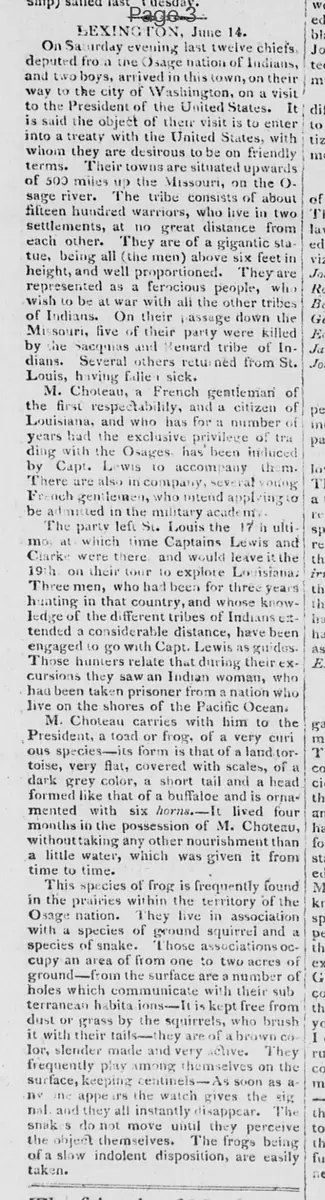
On Saturday evening last twelve chiefs, deputed from a fine Osage nation of Indians, and two boys, arrived in this town, on their way to the city of Washington, on a visit to the President of the United States. It is said the object of their visit is to enter into a treaty with the United States, with whom they are desirous to be on friendly terms. Their towns are situated upwards of 500 miles up the Missouri, on the Osage river. The tribe consists of about fifteen hundred warriors, who live in two settlements, at no great distance from each other. They are of a gigantic stature, being all (the men) above six feet in height, and well proportioned. They are represented as a ferocious people, who wish to be at war with all the other tribes of Indians. On their passage down the Missouri, five of their party were killed by the Sacs and Renard tribe of Indians. Several others returned from St. Louis, having fallen sick.
M. Choteau, a French gentleman of the first respectability, and a citizen of Louisiana, and who has for a number of years had the exclusive privilege of trading with the Osages, has been induced by Capt. Lewis to accompany them. There are also in company, several young French gentlemen, who intend applying to be admitted in the military academy.
The party left St. Louis the 17th ultimo, at which time Captains Lewis and Clark were there and would leave it the 19th on their tour to explore Louisiana.
Three men, who had been for three years hunting in that country, and whose knowledge of the different tribes of Indians extended a considerable distance, have been engaged to go with Capt. Lewis as guides.
Those hunters relate that during their excursions they saw an Indian woman, who had been taken prisoner from a nation who live on the shores of the Pacific Ocean.
M. Choteau carries with him to the President, a toad or frog, of a very curious species—its form is that of a land tortoise, very flat, covered with scales, of a dark grey color, a short tail and a head formed like that of a buffalo and is ornamented with six horns.—It lived four months in the possession of M. Choteau, without taking any other nourishment than a little water, which was given it from time to time.
This species of frog is frequently found in the prairies within the territory of the Osage nation. They live in association with a species of ground squirrel and a species of snake. Those associations occupy an area of from one to two acres of ground—from the surface are a number of holes which communicate with their subterranean habitations—It is kept free from dust or grass by the squirrels, who brush it with their tails—they are of a brown color, slender made and very active. They frequently play among themselves on the surface, keeping centinels—as soon as any one appears the watch gives the signal, and they all instantly disappear. The snakes do not move until they perceive the object themselves. The frogs being of a slow indolent disposition, are easily taken.
What sub-type of article is it?
What themes does it cover?
What keywords are associated?
What entities or persons were involved?
Where did it happen?
Story Details
Key Persons
Location
Lexington, Osage River, Missouri River, St. Louis
Event Date
June 14
Story Details
Twelve Osage chiefs and two boys arrive in Lexington en route to Washington to negotiate a treaty; tribe described as large and warlike; journey marked by attacks and illness; accompanied by trader M. Choteau bringing a curious frog; hunters join Lewis and Clark expedition after sighting captive Pacific Indian woman.