Thank you for visiting SNEWPapers!
Sign up free
Letter to Editor
April 4, 1794
Gazette Of The United States & Evening Advertiser
Philadelphia, Philadelphia County, Pennsylvania
What is this article about?
A letter criticizes Democratic societies for attempting to usurp influence over the public and government, arguing they misrepresent the people's will. It defends the republican system of elected representatives as the true expression of American liberty and sovereignty, contrasting it with mob-like factions inspired by French sans-culottes.
Clipping
OCR Quality
98%
Excellent
Full Text
For the GAZETTE of the UNITED STATES.
Mr. Fenno,
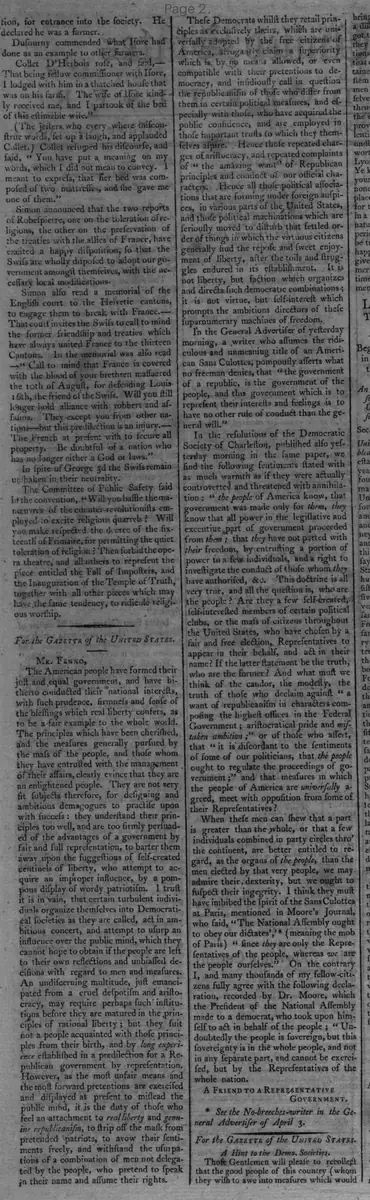
The American people have formed their just and equal government, and have hitherto conducted their national interests, with such prudence, firmness and sense of the blessings which real liberty confers, as to be a fair example to the whole world. The principles which have been cherished, and the measures generally pursued by the mass of the people, and those whom they have entrusted with the management of their affairs, clearly evince that they are an enlightened people. They are not very fit subjects therefore, for designing and ambitious demagogues to practice upon with success: they understand their principles too well, and are too firmly persuaded of the advantages of a government by fair and full representation, to barter them away upon the suggestions of self-created sentinels of liberty, who attempt to acquire an improper influence, by a pompous display of wordy patriotism. I trust it is in vain, that certain turbulent individuals organize themselves into Democratical societies as they are called, act in ambitious concert, and attempt to usurp an influence over the public mind, which they cannot hope to obtain if the people are left to their own reflections and unbiased decisions with regard to men and measures. An undiscerning multitude, just emancipated from a cruel despotism and aristocracy, may require perhaps such institutions before they are matured in the principles of rational liberty; but they suit not a people acquainted with those principles from their birth, and by long experience established in a predilection for a Republican government by representation. However, as the most unfair means and the most forward pretensions are exercised and displayed at present to mislead the public mind, it is the duty of those who feel an attachment to real liberty and genuine republicanism, to strip off the mask from pretended patriots, to avow their sentiments freely, and withstand the usurpations of a combination of men not delegated by the people, who pretend to speak in their name and assume their rights.
These Democrats whilst they retail principles as exclusively theirs, which are universally adopted by the free citizens of America, arrogantly claim a superiority which is by no means allowed, or even compatible with their pretensions to democracy, and insidiously call in question the republicanism of those who differ from them in certain political measures, and especially with those, who have acquired the public confidence, and are employed in those important trusts to which they themselves aspire. Hence those repeated charges of aristocracy, and repeated complaints of "the amazing want" of Republican principles and conduct of our official characters. Hence all those political associations that are forming under foreign auspices, in various parts of the United States, and those political machinations which are seriously moved to disturb that settled order of things in which the virtuous citizens generally find the repose and sweet enjoyment of liberty, after the toils and struggles endured in its establishment. It is not liberty, but faction which organizes and directs such democratic combinations; it is not virtue, but self-interest which prompts the ambitious directors of these supernumerary machines of freedom.
In the General Advertiser of yesterday morning, a writer who assumes the ridiculous and unmeaning title of an American Sans Culottes, pompously asserts what no freeman denies, that "the government of a republic, is the government of the people, and this government which is to represent their interests and feelings is to have no other rule of conduct than the general will."
In the resolutions of the Democratic Society of Charleston, published also yesterday morning in the same paper, we find the following sentiments stated with as much warmth as if they were actually controverted and threatened with annihilation: "the people of America know, that government was made only for them, they know that all power in the legislative and executive part of government proceeded from them; that they have not parted with their freedom, by entrusting a portion of power to a few individuals, and a right to investigate the conduct of those whom they have authorized, &c. This doctrine is all very true, and all the question is, who are the people? Are they a few self-created, self-interested members of certain political clubs, or the mass of citizens throughout the United States, who have chosen by a fair and free election, Representatives to appear in their behalf, and act in their name? If the latter statement be the truth, who are the former? And what must we think of the candor, the modesty, the truth of those who declaim against "a want of republicanism in characters composing the highest offices in the Federal Government; aristocratical pride and mistaken ambition;" or of those who assert, that "it is discordant to the sentiments of some of our politicians, that, the people ought to regulate the proceedings of government;" and that measures in which the people of America are universally agreed, meet with opposition from some of their Representatives?
When these men can show that a part is greater than the whole, or that a few individuals combined in party circles thro' the continent, are better entitled to regard, as the organs of the people, than the men elected by that very people, we may admire their dexterity, but we ought to suspect their integrity. I think they must have imbibed the spirit of the Sans Culottes at Paris, mentioned in Moore's Journal, who said, "The National Assembly ought to obey our dictates," (meaning the mob of Paris) "since they are only the Representatives of the people, whereas we are the people ourselves." On the contrary I, and many thousands of my fellow-citizens fully agree with the following declaration, recorded by Dr. Moore, which the President of the National Assembly made to a democrat, who took upon himself to act in behalf of the people; "Undoubtedly the people is sovereign, but this sovereignty is in the whole people, and not in any separate part, and cannot be exercised, but by the Representatives of the whole nation."
* See the No-breeches-writer in the General Advertiser of April 3.
Mr. Fenno,
The American people have formed their just and equal government, and have hitherto conducted their national interests, with such prudence, firmness and sense of the blessings which real liberty confers, as to be a fair example to the whole world. The principles which have been cherished, and the measures generally pursued by the mass of the people, and those whom they have entrusted with the management of their affairs, clearly evince that they are an enlightened people. They are not very fit subjects therefore, for designing and ambitious demagogues to practice upon with success: they understand their principles too well, and are too firmly persuaded of the advantages of a government by fair and full representation, to barter them away upon the suggestions of self-created sentinels of liberty, who attempt to acquire an improper influence, by a pompous display of wordy patriotism. I trust it is in vain, that certain turbulent individuals organize themselves into Democratical societies as they are called, act in ambitious concert, and attempt to usurp an influence over the public mind, which they cannot hope to obtain if the people are left to their own reflections and unbiased decisions with regard to men and measures. An undiscerning multitude, just emancipated from a cruel despotism and aristocracy, may require perhaps such institutions before they are matured in the principles of rational liberty; but they suit not a people acquainted with those principles from their birth, and by long experience established in a predilection for a Republican government by representation. However, as the most unfair means and the most forward pretensions are exercised and displayed at present to mislead the public mind, it is the duty of those who feel an attachment to real liberty and genuine republicanism, to strip off the mask from pretended patriots, to avow their sentiments freely, and withstand the usurpations of a combination of men not delegated by the people, who pretend to speak in their name and assume their rights.
These Democrats whilst they retail principles as exclusively theirs, which are universally adopted by the free citizens of America, arrogantly claim a superiority which is by no means allowed, or even compatible with their pretensions to democracy, and insidiously call in question the republicanism of those who differ from them in certain political measures, and especially with those, who have acquired the public confidence, and are employed in those important trusts to which they themselves aspire. Hence those repeated charges of aristocracy, and repeated complaints of "the amazing want" of Republican principles and conduct of our official characters. Hence all those political associations that are forming under foreign auspices, in various parts of the United States, and those political machinations which are seriously moved to disturb that settled order of things in which the virtuous citizens generally find the repose and sweet enjoyment of liberty, after the toils and struggles endured in its establishment. It is not liberty, but faction which organizes and directs such democratic combinations; it is not virtue, but self-interest which prompts the ambitious directors of these supernumerary machines of freedom.
In the General Advertiser of yesterday morning, a writer who assumes the ridiculous and unmeaning title of an American Sans Culottes, pompously asserts what no freeman denies, that "the government of a republic, is the government of the people, and this government which is to represent their interests and feelings is to have no other rule of conduct than the general will."
In the resolutions of the Democratic Society of Charleston, published also yesterday morning in the same paper, we find the following sentiments stated with as much warmth as if they were actually controverted and threatened with annihilation: "the people of America know, that government was made only for them, they know that all power in the legislative and executive part of government proceeded from them; that they have not parted with their freedom, by entrusting a portion of power to a few individuals, and a right to investigate the conduct of those whom they have authorized, &c. This doctrine is all very true, and all the question is, who are the people? Are they a few self-created, self-interested members of certain political clubs, or the mass of citizens throughout the United States, who have chosen by a fair and free election, Representatives to appear in their behalf, and act in their name? If the latter statement be the truth, who are the former? And what must we think of the candor, the modesty, the truth of those who declaim against "a want of republicanism in characters composing the highest offices in the Federal Government; aristocratical pride and mistaken ambition;" or of those who assert, that "it is discordant to the sentiments of some of our politicians, that, the people ought to regulate the proceedings of government;" and that measures in which the people of America are universally agreed, meet with opposition from some of their Representatives?
When these men can show that a part is greater than the whole, or that a few individuals combined in party circles thro' the continent, are better entitled to regard, as the organs of the people, than the men elected by that very people, we may admire their dexterity, but we ought to suspect their integrity. I think they must have imbibed the spirit of the Sans Culottes at Paris, mentioned in Moore's Journal, who said, "The National Assembly ought to obey our dictates," (meaning the mob of Paris) "since they are only the Representatives of the people, whereas we are the people ourselves." On the contrary I, and many thousands of my fellow-citizens fully agree with the following declaration, recorded by Dr. Moore, which the President of the National Assembly made to a democrat, who took upon himself to act in behalf of the people; "Undoubtedly the people is sovereign, but this sovereignty is in the whole people, and not in any separate part, and cannot be exercised, but by the Representatives of the whole nation."
* See the No-breeches-writer in the General Advertiser of April 3.
What sub-type of article is it?
Persuasive
Political
What themes does it cover?
Politics
Constitutional Rights
What keywords are associated?
Democratic Societies
Republican Government
Sans Culottes
Political Factions
Elected Representatives
American Liberty
What entities or persons were involved?
Mr. Fenno
Letter to Editor Details
Recipient
Mr. Fenno
Main Argument
democratic societies and self-appointed patriots usurp the people's voice by claiming to represent them over elected officials; true republicanism lies in government by fair representation of the whole people, not factions or clubs.
Notable Details
Critiques 'American Sans Culottes' In General Advertiser
References Democratic Society Of Charleston Resolutions
Quotes Moore's Journal On French Sans Culottes
Cites Dr. Moore On Sovereignty In Representatives