Thank you for visiting SNEWPapers!
Sign up free
The Massachusetts Spy, Or, Thomas's Boston Journal
Boston, Suffolk County, Massachusetts
What is this article about?
At a Boston town meeting on March 23, 1773, Samuel Adams presented a committee report defending the legality and loyalty of a prior town meeting against Governor Hutchinson's accusations of illegality and denial of parliamentary supremacy. The report was unanimously accepted and ordered printed.
Clipping
OCR Quality
Full Text
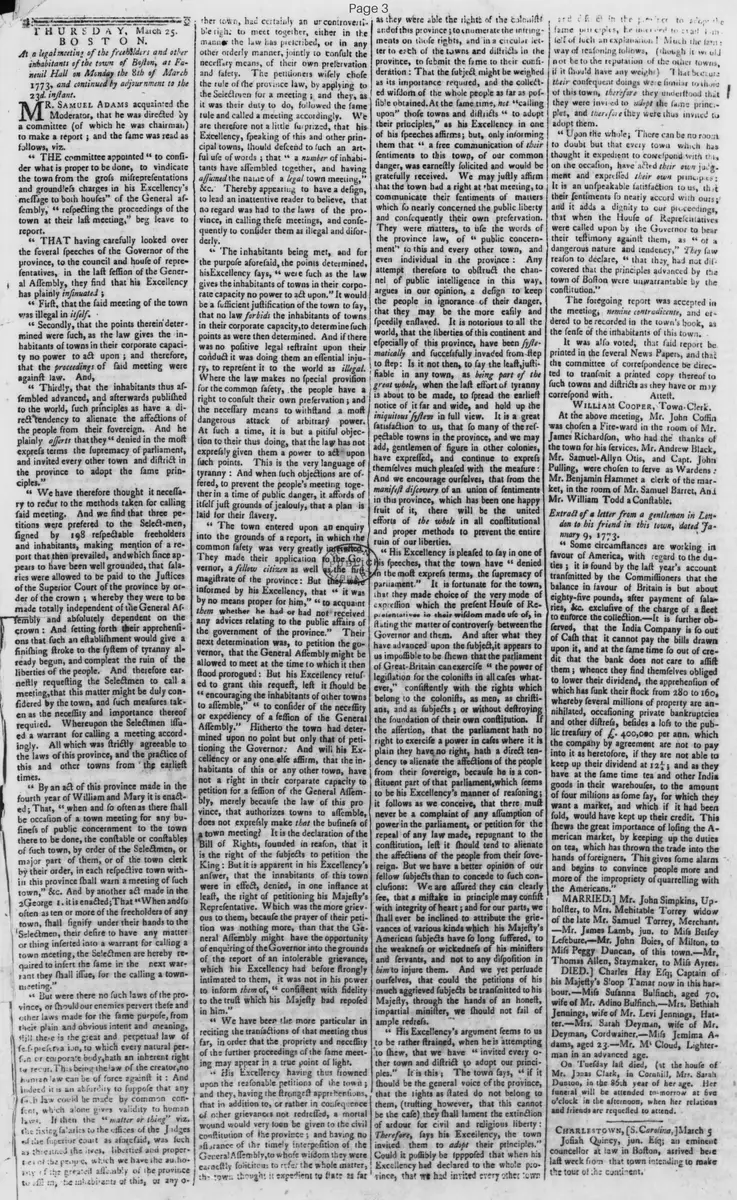
BOSTON.
At a legal meeting of the freeholders and other inhabitants of the town of Boston, at Faneuil Hall on Monday the 8th of March 1773, and continued by adjournment to the 23d. instant.
R. SAMUEL ADAMS acquainted the Moderator, that he was directed by a committee (of which he was chairman) to make a report ; and the same was read as follows, viz.
" THE committee appointed " to consider what is proper to be done, to vindicate the town from the gross misrepresentations and groundless charges in his Excellency's message to both houses" of the General assembly,' " respecting the proceedings of the town at their last meeting," beg leave to report.
" THAT having carefully looked over the several speeches of the Governor of the province, to the council and house of representatives, in the last session of the General Assembly, they find that his Excellency has plainly insinuated ;
" First. that the said meeting of the town was illegal in itself. :
"Secondly, that the points therein determined were such, as the law gives the inhabitants of towns in their corporate capacity no power to act upon ; and therefore, that the proceedings of said meeting were against law. And,
" Thirdly, that the inhabitants thus assembled advanced, and afterwards published to the world, such principles as have a direct tendency to alienate the affections of the people from their sovereign. And he plainly asserts that they " denied in the most express terms the supremacy of parliament, and invited every other town and district in the province to adopt the same principles."
" We have therefore thought it necessary to recur to the methods taken for calling said meeting. And we find that three petitions were preferred to the Select-men, signed by 798 respectable freeholders and inhabitants, making mention of a report that then prevailed, and which since appears to have been well grounded, that salaries were allowed to be paid to the Justices of the Superior Court of the province by order of the crown ; whereby they were to be made totally independent of the General Assembly and absolutely dependent on the crown : And setting forth their apprehensions that such an establishment would give a finishing stroke to the system of tyranny already begun, and complete the ruin of the liberties of the people. And therefore earnestly requesting the Selectmen to call a meeting,that this matter might be duly considered by the town, and such measures taken as the necessity and importance thereof required. Whereupon the Selectmen issued a warrant for calling a meeting accordingly. All which was strictly agreeable to the laws of this province, and the practice of this and other towns from 'the earliest times.
"By an act of this province made in the fourth year of William and Mary it is enacted; That, " when and so often as there shall be occasion of a town meeting for any business of public concernment to the town there to be done, the constable or constables of such town, by order of the Selectmen, or major part of them, or of the town clerk by their order, in each respective town within this province shall warn a meeting of such town," &c. And by another act made in the 2 George I. it is enacted; That "When and so often as ten or more of the freeholders of any town, shall signify under their hands to the Selectmen, their desire to have any matter or thing inserted into a warrant for calling a town meeting, the Selectmen are hereby required to insert the same in the next warrant they shall issue, for the calling a town-meeting."
"But were there no such laws of the province, or should our enemies pervert these and other laws made for the same purpose, from their plain and obvious intent and meaning, still there is the great and perpetual law of self-preservation, to which every natural person or corporate body, hath an inherent right to recur. This being the law of the creator,no human law can be of force against it : And indeed it is an absurdity to suppose that any law could be made by common consent, which alone gives validity to human laws. If then the " matter or thing" viz. the fixing salaries to the justices of the Judges of the superior court as aforesaid, was such as threatened the lives, liberties and properties of the people, which we have the authority of the great council assembly of the province to affirm, the inhabitants of this, or any other town, had certainly an uncontroverted right to meet together, either in the manner the law has prescribed, or in any other orderly manner, jointly to consult the necessary means, of their own preservation and safety. The petitioners wisely chose the rule of the province law, by applying to the Selectmen for a meeting ; and they, as it was their duty to do, followed the same rule and called a meeting accordingly. We are therefore not a little surprised, that his Excellency, speaking of this and other principal towns, should descend to such an artful use of words ; that" a number of inhabitants have assembled together, and having assumed the name of a legal town meeting, &c.' Thereby appearing to have a design, to lead an inattentive reader to believe, that no regard was had to the laws of the province, in calling these meetings, and consequently to consider them as illegal and disorderly.
'The inhabitants being met, and for the purpose aforesaid, the points determined, his Excellency says, " were such as the law gives the inhabitants of towns in their corporate capacity no power to act upon." It would be a sufficient justification of the town to say, that no law forbids the inhabitants of towns in their corporate capacity,to determine such points as were then determined. And if there was no positive legal restraint upon their conduct it was doing them an essential injury, to represent it to the world as illegal. Where the law makes no special provision for the common safety, ,the people have a right to consult their own preservation; and the necessary means to withstand a most dangerous attack of arbitrary power. At such a time, it is but a pitiful objection to their thus doing, that the law has not expressly given them a power to act upon such points. This is the very language of tyranny : And when such objections are offered, to prevent the people's meeting together in a time of public danger, it affords of itself just grounds of jealousy, that a plan is laid for their slavery.
" The town entered upon an enquiry into the grounds of a report, in which the common safety was very greatly interested. They made their application to the Governor, a fellow citizen as well as the first. magistrate of the province: But they were informed by his Excellency, that " it was by no means proper for him," " to acquaint them whether he had or had not received any advices relating to the public affairs of the government of the province." Their next determination was, to petition the governor, that the General Assembly might be allowed to meet at the time to which it then stood prorogued: But his Excellency refused to grant this request, lest it should be "encouraging the inhabitants of other towns to assemble," "to consider of the necessity or expediency of a session of the General Assembly." Hitherto the town had determined upon no point but only that of petitioning the Governor: And will his Excellency or any one else affirm, that the inhabitants of this or any other town, have not a right in their corporate capacity to petition for a session of the General Assembly, merely because the law of this province, that authorizes towns to assemble, does not expressly make that the business of a town meeting? It is the declaration of the Bill of Rights, founded in reason, that it is the right of the subjects to petition the King : But it is apparent in his Excellency's answer, that the inhabitants of this town were in effect, denied, in one instance at least, the right of petitioning his Majesty's Representative. Which was the more grievous to them, because the prayer of their petition was nothing more, than that the General Assembly might have the opportunity of enquiring of the Governor into the grounds of the report of an intolerable grievance, which his Excellency had before strongly intimated to them, it was not in his power to inform them of, "consistent with fidelity to the trust which his Majesty had reposed in him."
" We have been the more particular in reciting the transactions of that meeting thus far, in order that the propriety and necessity of the further proceedings of the same meeting may appear in a true point of light. . His Excellency having thus frowned upon the reasonable petitions of the town; and they, having the strongest apprehensions, that in addition to, or rather in consequence of other grievances not redressed, a mortal wound would very soon be given to the civil constitution of the province; and having no assurance of the timely interposition of the General Assembly,to whose wisdom they were earnestly desirous to refer: the whole matter, the town thought it expedient to state as far as they were able the rights of the colonists and of this province; to enumerate the infringements on those rights, and in a circular letter to each of the towns and districts in the province, to submit the same to their consideration : That the subject might be weighed as its importance required, and the collected wisdom of the whole people as far as possible obtained.At the same time, not "calling upon"those towns and districts " to adopt their principles," as his Excellency in one of his speeches affirms; but, only informing them that " a free communication of their sentiments to this town, of our common danger, was earnestly solicited and would be gratefully received. We may justly affirm that the town had a right at that meeting, to communicate their sentiments of matters which so nearly concerned the public liberty and consequently their own preservation. They were matters, to use the words of the province law, of " public concernment' to this and every other town, and even individual in the province : Any attempt therefore to obstruct the channel of public intelligence in this way, argues in our opinion, a design to keep the people in ignorance of their danger, that they may be the more easily and speedily enslaved. It is notorious to all the world, that the liberties of this continent and especially of this province, have been systematically and successfully invaded from step to step: Is it not then, to say the least,justifiable in any town, as being part of the great whole, when the last effort of tyranny is about to be made, to spread the earliest notice of it far and wide, and hold up the iniquitous system full view. It is a great satisfaction to us, that so many of the respectable towns in the province, and we may add, gentlemen of figure in other colonies, have expressed, and continue to express themselves much pleased with the measure: And we encourage ourselves, that from the manifest discovery of an union of sentiments in this province, which has been one happy fruit of it, there will be the united efforts of the whole in all constitutional and proper methods to prevent the entire ruin of our liberties.
" His Excellency is pleased to say in one of His speeches, that the town have"s denied in the most express terms, the supremacy of parliament." It is fortunate for the town, that they made choice of the very mode of expression which the present House of Representatives in their wisdom made use of, in stating the matter of controversy between the Governor and them. And after what they have advanced upon the subject,it appears to us impossible to be shewn that the parliament of Great-Britain can exercise " the power of legislation for the colonies in all cases whatever," consistently with the rights which belong to the colonies, as men, as christians, and as subjects ; or without destroying the foundation of their own constitution. If the assertion, that the parliament hath no right to exercise a power in cases where it is plain they have no right, hath a direct tendency to alienate the affections of the people from their sovereign, because he is a constituent part of that parliament, which seems to be his Excellency's manner of reasoning; it follows as we conceive, that there must never be a complaint of any assumption of power in the parliament, or petition for the repealof any law made, repugnant to the constitution, lest it should tend to alienate the affections of the people from their sovereign. But we have a better opinion of our fellow subjects than to concede to such conclusions: We are assured they can clearly see, that a mistake in principle may consist with integrity of heart ; and for our parts, we shall ever be inclined to attribute the grievances of various kinds which his Majesty's American subjects have so long suffered, to the weakness or wickedness of his ministers and servants, and not to any disposition in him to injure them. And we yet persuade ourselves, that could the petitions of his much aggrieved subjects be transmitted to his Majesty, through the hands of an honest, impartial minister, we should not fail of ample redress.
"His Excellency's argument seems to us to be rather strained, when he is attempting to shew, that we have " invited every O- ther town and district to adopt our principles." It is this; The town says, " if it should be the general voice of the province, that the rights as stated do not belong to them, (trusting however, that this cannot be the case) they shall lament the extinction of ardour for civil and religious liberty : Therefore, says his Excellency, the town invited them to adopt their principles." Could it possibly be supposed that when his Excellency had declared to the whole province, that we had invited every other town and district in the province to adopt the same principles, he would stoop to stand in need of such an explanation ! Much the same way of reasoning follows, (though it would not be to the reputation of the other towns, if it should have any weight) That because their consequent doings were similar to those of this town,therefore they understood that they were invited to adopt the same principles, and therefore they were thus invited to adopt them.
" Upon the whole; There can be no room to doubt but that every town which has thought it expedient to correspond with this on the occasion, have' acted their own judgment and expressed their own principles: It is an unspeakable satisfaction to us, that their sentiments so nearly accord with ours; and it adds a dignity to our proceedings, that when the House of Representatives were called upon by the Governor to bear their testimony against them, as " of a dangerous nature and tendency," They saw reason to declare, " that they. had not discovered that the principles advanced by the town of Boston were unwarrantable by the constitution."
The foregoing report was accepted in the meeting,nemine contradicente, and ordered to be recorded in the town's book, as the sense of the inhabitants of this town. . It was also voted, that said report be. printed in the several News Papers, and that the committee of correspondence be directed to transmit a printed copy thereof to such towns and districts as they have or may correspond with.
Attest. WiLLiam CoopeR, Town Clerk.
At the above meeting, Mr. John Coffin was chosen a Fire-ward in the room of Mr. James Richardson, who had the thanks of the town for his services. Mr. Andrew Black, Mr. Samuel-Allyn Otis, and Capt. John Pulling, were chosen to serve as Wardens : Mr. Benjamin Hammet a clerk of the market, in the room of Mr. Samuel Barret, And Mr. William Todd a Constable:
What sub-type of article is it?
What keywords are associated?
What entities or persons were involved?
Where did it happen?
Domestic News Details
Primary Location
Boston
Event Date
March 23, 1773
Key Persons
Outcome
report accepted unanimously and ordered printed in newspapers and transmitted to other towns; various local officials appointed.
Event Details
Town meeting at Faneuil Hall where Samuel Adams presented a committee report defending the legality of a prior town meeting against the Governor's accusations of illegality, disloyalty, and denial of parliamentary supremacy. The report detailed the proper calling of the meeting via petitions to selectmen, cited provincial laws, invoked self-preservation rights, and justified petitions to the Governor and circular letters to other towns seeking sentiments on colonial rights.