Thank you for visiting SNEWPapers!
Sign up free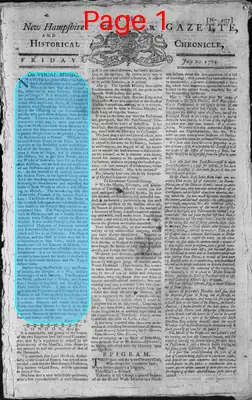
Letter to Editor
July 20, 1764
The New Hampshire Gazette And Historical Chronicle
Portsmouth, Greenland, Rockingham County, New Hampshire
What is this article about?
A philosophical essay on vocal music as humanity's primal and superior art form, emphasizing its ability to convey sentiments and ideas beyond mere sound, with references to ancient figures like Orpheus and Amphion who used it to civilize society.
Clipping
OCR Quality
98%
Excellent
Full Text
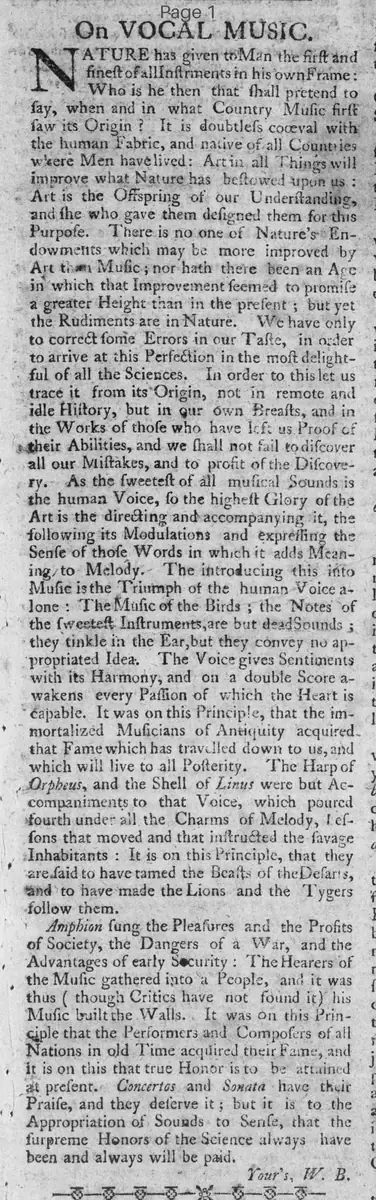
On VOCAL MUSIC.
Nature has given to Man the first and finest of all Instruments in his own Frame:
Who is he then that shall pretend to say, when and in what Country Music first saw its Origin? It is doubtless coeval with the human Fabric, and native of all Countries where Men have lived: Art in all Things will improve what Nature has bestowed upon us:
Art is the Offspring of our Understanding, and he who gave them deigned them for this Purpose. There is no one of Nature's Endowments--which may be more improved by Art than Music; nor hath there been an Age in which that Improvement seemed to promise a greater Height than in the present; but yet the Rudiments are in Nature. We have only to correct some Errors in our Taste, in order to arrive at this Perfection in the most delightful of all the Sciences. In order to this let us trace it from its Origin, not in remote and idle History, but in Our Own Breasts, and in the Works of those who have left us Proof of their Abilities, and we shall not fail to discover all our Mistakes, and to profit of the Discovery.-- As the sweetest of all musical Sounds is the human Voice, so the highest Glory of the Art is the directing and accompanying it, the following its Modulations and expressing the Sense of those Words in which it adds Meaning to Melody.-- The introducing this into Music is the Triumph of the human Voice alone: The Music of the Birds; the Notes of the sweetest Instruments, are but dead Sounds;
they tinkle in the Ear, but they convey no appropriated Idea. The Voice gives Sentiments with its Harmony, and on a double Score awakens every Passion of which the Heart is capable. It was on this Principle, that the immortalized Musicians of Antiquity acquired that Fame which has travelled down to us, and which will live to all Posterity. The Harp of Orpheus, and the Shell of Linus were but Accompaniments to that Voice, which poured forth under all the Charms of Melody, Lessons that moved and that instructed the savage Inhabitants: It is on this Principle, that they are said to have tamed the Beasts of the Desarts, and to have made the Lions and the Tygers follow them.
Amphion sung the Pleasures and the Profits of Society, the Dangers of a War. and the Advantages of early Security: The Hearers of the Music gathered into a People, and it was thus (though Critics have not found it) his Music built the Walls. It was On this Principle that the Performers and Composers of all Nations in old Time acquired their Fame, and it is on this that true Honor is to be attained at present. Concertos and Sonata have their Praise, and they deserve it; but it is to the Appropriation of Sounds to Sense, that the supreme Honors of the Science always have been and always will be paid.
Your's. W. B.
Nature has given to Man the first and finest of all Instruments in his own Frame:
Who is he then that shall pretend to say, when and in what Country Music first saw its Origin? It is doubtless coeval with the human Fabric, and native of all Countries where Men have lived: Art in all Things will improve what Nature has bestowed upon us:
Art is the Offspring of our Understanding, and he who gave them deigned them for this Purpose. There is no one of Nature's Endowments--which may be more improved by Art than Music; nor hath there been an Age in which that Improvement seemed to promise a greater Height than in the present; but yet the Rudiments are in Nature. We have only to correct some Errors in our Taste, in order to arrive at this Perfection in the most delightful of all the Sciences. In order to this let us trace it from its Origin, not in remote and idle History, but in Our Own Breasts, and in the Works of those who have left us Proof of their Abilities, and we shall not fail to discover all our Mistakes, and to profit of the Discovery.-- As the sweetest of all musical Sounds is the human Voice, so the highest Glory of the Art is the directing and accompanying it, the following its Modulations and expressing the Sense of those Words in which it adds Meaning to Melody.-- The introducing this into Music is the Triumph of the human Voice alone: The Music of the Birds; the Notes of the sweetest Instruments, are but dead Sounds;
they tinkle in the Ear, but they convey no appropriated Idea. The Voice gives Sentiments with its Harmony, and on a double Score awakens every Passion of which the Heart is capable. It was on this Principle, that the immortalized Musicians of Antiquity acquired that Fame which has travelled down to us, and which will live to all Posterity. The Harp of Orpheus, and the Shell of Linus were but Accompaniments to that Voice, which poured forth under all the Charms of Melody, Lessons that moved and that instructed the savage Inhabitants: It is on this Principle, that they are said to have tamed the Beasts of the Desarts, and to have made the Lions and the Tygers follow them.
Amphion sung the Pleasures and the Profits of Society, the Dangers of a War. and the Advantages of early Security: The Hearers of the Music gathered into a People, and it was thus (though Critics have not found it) his Music built the Walls. It was On this Principle that the Performers and Composers of all Nations in old Time acquired their Fame, and it is on this that true Honor is to be attained at present. Concertos and Sonata have their Praise, and they deserve it; but it is to the Appropriation of Sounds to Sense, that the supreme Honors of the Science always have been and always will be paid.
Your's. W. B.
What sub-type of article is it?
Philosophical
Reflective
Informative
What keywords are associated?
Vocal Music
Human Voice
Orpheus
Amphion
Ancient Musicians
Music Origins
Sentiments In Music
What entities or persons were involved?
W. B.
Letter to Editor Details
Author
W. B.
Main Argument
vocal music, originating with human nature, is the highest art form as it conveys sentiments and ideas through the voice, surpassing instrumental music, and has historically civilized societies as exemplified by ancient musicians like orpheus and amphion.
Notable Details
References To Orpheus And His Harp
Linus And His Shell
Amphion Building Walls Through Song
Contrast Between Human Voice And Birds/Instruments As 'Dead Sounds'