Thank you for visiting SNEWPapers!
Sign up free
Story
December 13, 1872
Chicago Daily Tribune
Chicago, Cook County, Illinois
What is this article about?
Court examination of State Insurance Company post-1871 Chicago Fire reveals fraudulent purchase of claims at discount by officers via J.B. Smith for transfer to National Loan and Trust Company to offset bank deposits; witnesses detail transactions and insolvency.
Clipping
OCR Quality
95%
Excellent
Full Text
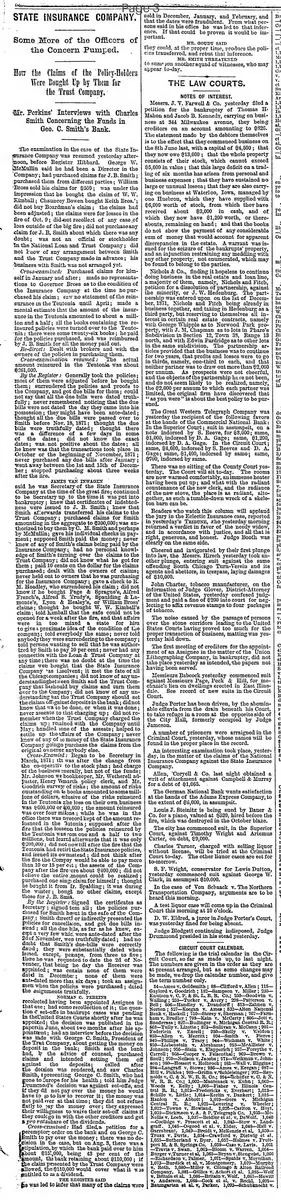
STATE INSURANCE COMPANY.
Some More of the Officers of the Concern Pumped.
How the Claims of the Policy-Holders Were Bought Up by Them for the Trust Company.
Mr. Perkins' Interviews with Charles Smith Concerning the Funds in Geo. C. Smith's Bank.
The examination in the case of the State Insurance Company was resumed yesterday afternoon, before Register Hibbard. George W. McMullin said he had been a Director in the Company; had purchased claims for J.B. Smith; purchased them from different parties: William Bross sold his claims for $500; was under the impression that he bought the claim of W. W. Kimball; Chauncey Bowen bought Keith Bros.'; did not buy Boardman's claim: the claims had been adjusted; the claims were for losses in the fire of Oct. 9; did not recollect of any case of loss outside of the big fire; did not purchase any claim for J. B. Smith about which there was any doubt: was not an official or stockholder in the National Loan and Trust Company; did not know of any arrangement between Smith and the Trust Company made in advance; his business with Smith was not arranged yet.
Cross-examined: Purchased claims for himself in January and after: made no representations to Governor Bross as to the condition of the Insurance Company at the time he purchased his claim: saw no statement of the reinsurance in the Teutonia until April; made a mental estimate that the amount of the insurance in the Teutonia amounted to about a million and a half; all the books containing the reinsured policies were turned over to the Teutonia: there were some twenty-six books: he paid for the policies purchased, and was reimbursed by J. B. Smith for all the money paid out.
Re-direct: Dealt with brokers and with the owners of the policies in purchasing them.
Cross-examination resumed: The actual amount reinsured in the Teutonia was about $261,000.
By the Register: Generally took the policies; most of them were adjusted before he bought them; surrendered the policies and proofs to the Company, and got due bills for them: could not say that all the due bills were dated truthfully: never remembered noticing that the due bills were not dated the day they came into his possession: they might have been ante-dated: thought all the due bills were passed over to Smith before Nov. 18, 1871; thought the due bills were truthfully dated; thought there was a difference of a few days in some of the dates; did not know the exact dates; was not positive about the dates; all he knew was that the transactions took place in October or the beginning of November, 1871: never purchased any due bills after January; went away between the 1st and 15th of December; stopped purchasing about three weeks after the fire.
JAMES VAN TAGEN said he was Secretary of the State Insurance Company at the time of the great fire: continued to be Secretary up to the time it was put into bankruptcy: knew that certificates of indebtedness were issued to J. B. Smith; knew that Smith afterwards transferred his claims to the Trust Company; purchased claims for Smith amounting in the aggregate to $100,000; was authorized to buy them by C. M. Smith and perhaps by McMullin; gave his individual checks in payment; supposed Smith paid the money; never knew of any of Smith's claims being paid by the Insurance Company; had no personal knowledge of Smith's turning over the claims to the Trust Company; did not know what he got for them; paid 10 cents on the dollar for the claims purchased; dealt with the owners of claims; never held out to owners that he was purchasing for the Insurance Company; gave a check to R. M. Hoadley, who surrendered his claim: did not know if he bought Page & Sprague's. Alfred French's, Alfred S. Trudy's, Spaulding & Lamonte's, Lyon & Healey's, or William Bross claims; thought he bought W. W. Kimball's claim; told Kimball that the safe could not be opened for a week after the fire, and that affairs were in too mixed a state for him to give a proximate idea of the condition of the company; told everybody the same; never told anybody they were surrendering to the company; told persons wanting to sell that he was authorized by Smith to pay 10 per cent; never had any connection with the Loan & Trust Company at any time; there was no doubt at the time the claims were bought that the State Insurance Company was insolvent; it met the fate of all the Chicago companies; did not know of any understanding between Smith and the Trust Company that he should buy claims and turn them over to the Company; did not know of any understanding that the Trust Company should set the claims off against deposits in the bank; did not know that was to be done, or when it was done; never assented to that charging up; did not remember when the Trust Company charged the claims up; remained with the Company until May: handled none of the assets; helped to settle up the affairs of the Company; never knew of any of the money of the State Insurance Company going to purchase the claims from the original owners or anybody else.
Cross-Examined: Began to be Secretary in March, 1871; that was after the change from the co-operative to the stock plan; had charge of the business generally, but not of the funds: Mr. Johnson was bookkeeper, Mr. Wetherell adjuster, Henry Warnish policy clerk, and Mr. Goodrich surveyor of risks: the amount of risks outstanding on the books amounted to some millions of dollars, exclusive of the risks reinsured in the Teutonia; the loss on their own business was $600,000 or $700,000; the amount reinsured was over four millions: while he was in the office there was no record kept of the amount reinsured in the Teutonia: supposed after the fire that the losses on the policies reinsured by the Teutonia was from one and a half to two millions, but learned afterwards that it was only $200,000: did not know till after the fire that the Teutonia had retired the State Insurance policies, and issued its own instead; did not think after the fire the Company would be able to pay more than 10 or 15 per cent; the assets of the Company after the fire were about $100,000; did not believe the entire amount could be realized; purchased one single claim for himself; thought he bought it from Mr. Spalding; it was during the winter; bought no other claims, except those for J. B. Smith.
By the Register: Signed the certificates as Secretary; signed them all; the policies purchased for Smith had in the safe of the Company; Smith direct or indirectly presented the policies for cancellation, and got due bills instead; all the due bills, as far as he knew, except a very few which were ante-dated after the 2d of November, were truthfully dated; had no doubt that Smith's due-bills were correctly dated; they were substantially dated when issued, except, perhaps, from three to five; then he was requested to date the 2d of November, that being the day the Receiver was appointed; was certain none of them were dated in December; none of them were ant-dated more than six days; took an assignment when the policies were purchased; dated the assignments truthfully.
NORMAN C. PERKINS recollected having been appointed Assignee in that case: had some recollection of it; the question of set-offs in bankrupt cases was pending in the United States Courts shortly after he was appointed; the decision was published in the papers in June, about two months after his appointment; had an interview before the decision was made with George C. Smith, President of the Trust Company, about getting the money on deposit in the bank; Smith said the bank had, by the advice of counsel, purchased claims and intended setting them off against the deposits: called after the decision was rendered, and saw Charles Smith, representing George C. Smith, who had gone to Europe for his health; told him Judge Drummond's decision was against set-offs, and if they did not pay over the money he would have to go to law to recover it; the money was not paid over at that time; they did not refuse flatly to pay the money over; they expressed their willingness to waive their set-off claims if they could go in with the other creditors and get a pro rata share of the dividends.
Cross-examined: Had filed a petition for a peremptory order on the bank and on George C. Smith to pay over the money; there was no decision in the case, but on Aug. 5, there was a stipulation, by which the bank paid over to him about $15,000, being 43 per cent of the amount, the bank retaining about $10,000; if the claim presented by the Trust Company were allowed, the $10,000 would cover what it was entitled to as a dividend.
THE REGISTER SAID he was led to infer that many of the claims were sold in December, January, and February, and that the dates were fraudulent. From what persons said in his office he was led to that inference. If that could be proven it would be important.
MR. GOUDY SAID they could, at the proper time, produce the policies transferred, and rebut that inference.
MR. SMITH THREATENED to summon another squad of witnesses, who may appear to-day.
Some More of the Officers of the Concern Pumped.
How the Claims of the Policy-Holders Were Bought Up by Them for the Trust Company.
Mr. Perkins' Interviews with Charles Smith Concerning the Funds in Geo. C. Smith's Bank.
The examination in the case of the State Insurance Company was resumed yesterday afternoon, before Register Hibbard. George W. McMullin said he had been a Director in the Company; had purchased claims for J.B. Smith; purchased them from different parties: William Bross sold his claims for $500; was under the impression that he bought the claim of W. W. Kimball; Chauncey Bowen bought Keith Bros.'; did not buy Boardman's claim: the claims had been adjusted; the claims were for losses in the fire of Oct. 9; did not recollect of any case of loss outside of the big fire; did not purchase any claim for J. B. Smith about which there was any doubt: was not an official or stockholder in the National Loan and Trust Company; did not know of any arrangement between Smith and the Trust Company made in advance; his business with Smith was not arranged yet.
Cross-examined: Purchased claims for himself in January and after: made no representations to Governor Bross as to the condition of the Insurance Company at the time he purchased his claim: saw no statement of the reinsurance in the Teutonia until April; made a mental estimate that the amount of the insurance in the Teutonia amounted to about a million and a half; all the books containing the reinsured policies were turned over to the Teutonia: there were some twenty-six books: he paid for the policies purchased, and was reimbursed by J. B. Smith for all the money paid out.
Re-direct: Dealt with brokers and with the owners of the policies in purchasing them.
Cross-examination resumed: The actual amount reinsured in the Teutonia was about $261,000.
By the Register: Generally took the policies; most of them were adjusted before he bought them; surrendered the policies and proofs to the Company, and got due bills for them: could not say that all the due bills were dated truthfully: never remembered noticing that the due bills were not dated the day they came into his possession: they might have been ante-dated: thought all the due bills were passed over to Smith before Nov. 18, 1871; thought the due bills were truthfully dated; thought there was a difference of a few days in some of the dates; did not know the exact dates; was not positive about the dates; all he knew was that the transactions took place in October or the beginning of November, 1871: never purchased any due bills after January; went away between the 1st and 15th of December; stopped purchasing about three weeks after the fire.
JAMES VAN TAGEN said he was Secretary of the State Insurance Company at the time of the great fire: continued to be Secretary up to the time it was put into bankruptcy: knew that certificates of indebtedness were issued to J. B. Smith; knew that Smith afterwards transferred his claims to the Trust Company; purchased claims for Smith amounting in the aggregate to $100,000; was authorized to buy them by C. M. Smith and perhaps by McMullin; gave his individual checks in payment; supposed Smith paid the money; never knew of any of Smith's claims being paid by the Insurance Company; had no personal knowledge of Smith's turning over the claims to the Trust Company; did not know what he got for them; paid 10 cents on the dollar for the claims purchased; dealt with the owners of claims; never held out to owners that he was purchasing for the Insurance Company; gave a check to R. M. Hoadley, who surrendered his claim: did not know if he bought Page & Sprague's. Alfred French's, Alfred S. Trudy's, Spaulding & Lamonte's, Lyon & Healey's, or William Bross claims; thought he bought W. W. Kimball's claim; told Kimball that the safe could not be opened for a week after the fire, and that affairs were in too mixed a state for him to give a proximate idea of the condition of the company; told everybody the same; never told anybody they were surrendering to the company; told persons wanting to sell that he was authorized by Smith to pay 10 per cent; never had any connection with the Loan & Trust Company at any time; there was no doubt at the time the claims were bought that the State Insurance Company was insolvent; it met the fate of all the Chicago companies; did not know of any understanding between Smith and the Trust Company that he should buy claims and turn them over to the Company; did not know of any understanding that the Trust Company should set the claims off against deposits in the bank; did not know that was to be done, or when it was done; never assented to that charging up; did not remember when the Trust Company charged the claims up; remained with the Company until May: handled none of the assets; helped to settle up the affairs of the Company; never knew of any of the money of the State Insurance Company going to purchase the claims from the original owners or anybody else.
Cross-Examined: Began to be Secretary in March, 1871; that was after the change from the co-operative to the stock plan; had charge of the business generally, but not of the funds: Mr. Johnson was bookkeeper, Mr. Wetherell adjuster, Henry Warnish policy clerk, and Mr. Goodrich surveyor of risks: the amount of risks outstanding on the books amounted to some millions of dollars, exclusive of the risks reinsured in the Teutonia; the loss on their own business was $600,000 or $700,000; the amount reinsured was over four millions: while he was in the office there was no record kept of the amount reinsured in the Teutonia: supposed after the fire that the losses on the policies reinsured by the Teutonia was from one and a half to two millions, but learned afterwards that it was only $200,000: did not know till after the fire that the Teutonia had retired the State Insurance policies, and issued its own instead; did not think after the fire the Company would be able to pay more than 10 or 15 per cent; the assets of the Company after the fire were about $100,000; did not believe the entire amount could be realized; purchased one single claim for himself; thought he bought it from Mr. Spalding; it was during the winter; bought no other claims, except those for J. B. Smith.
By the Register: Signed the certificates as Secretary; signed them all; the policies purchased for Smith had in the safe of the Company; Smith direct or indirectly presented the policies for cancellation, and got due bills instead; all the due bills, as far as he knew, except a very few which were ante-dated after the 2d of November, were truthfully dated; had no doubt that Smith's due-bills were correctly dated; they were substantially dated when issued, except, perhaps, from three to five; then he was requested to date the 2d of November, that being the day the Receiver was appointed; was certain none of them were dated in December; none of them were ant-dated more than six days; took an assignment when the policies were purchased; dated the assignments truthfully.
NORMAN C. PERKINS recollected having been appointed Assignee in that case: had some recollection of it; the question of set-offs in bankrupt cases was pending in the United States Courts shortly after he was appointed; the decision was published in the papers in June, about two months after his appointment; had an interview before the decision was made with George C. Smith, President of the Trust Company, about getting the money on deposit in the bank; Smith said the bank had, by the advice of counsel, purchased claims and intended setting them off against the deposits: called after the decision was rendered, and saw Charles Smith, representing George C. Smith, who had gone to Europe for his health; told him Judge Drummond's decision was against set-offs, and if they did not pay over the money he would have to go to law to recover it; the money was not paid over at that time; they did not refuse flatly to pay the money over; they expressed their willingness to waive their set-off claims if they could go in with the other creditors and get a pro rata share of the dividends.
Cross-examined: Had filed a petition for a peremptory order on the bank and on George C. Smith to pay over the money; there was no decision in the case, but on Aug. 5, there was a stipulation, by which the bank paid over to him about $15,000, being 43 per cent of the amount, the bank retaining about $10,000; if the claim presented by the Trust Company were allowed, the $10,000 would cover what it was entitled to as a dividend.
THE REGISTER SAID he was led to infer that many of the claims were sold in December, January, and February, and that the dates were fraudulent. From what persons said in his office he was led to that inference. If that could be proven it would be important.
MR. GOUDY SAID they could, at the proper time, produce the policies transferred, and rebut that inference.
MR. SMITH THREATENED to summon another squad of witnesses, who may appear to-day.
What sub-type of article is it?
Crime Story
Deception Fraud
Historical Event
What themes does it cover?
Deception
Crime Punishment
Justice
What keywords are associated?
Insurance Fraud
Chicago Fire
Claim Purchasing
State Insurance
Trust Company
Bankruptcy Examination
What entities or persons were involved?
George W. Mcmullin
J.B. Smith
James Van Tagen
Norman C. Perkins
George C. Smith
Register Hibbard
Where did it happen?
Chicago
Story Details
Key Persons
George W. Mcmullin
J.B. Smith
James Van Tagen
Norman C. Perkins
George C. Smith
Register Hibbard
Location
Chicago
Event Date
October 9, 1871
Story Details
Examination reveals officers of the State Insurance Company, insolvent after the Great Chicago Fire, purchased policyholders' claims at 10 cents on the dollar through J.B. Smith, who transferred them to the National Loan and Trust Company to offset deposits; witnesses testify on transactions, dates, and lack of prior arrangements.