Thank you for visiting SNEWPapers!
Sign up free
Literary
August 7, 1821
The Rhode Island American, And General Advertiser
Providence, Providence County, Rhode Island
What is this article about?
Essay by Cincinnatus (attributed to William Plumer) critiques American farmers' preference for large, under-cultivated farms inherited from settlers, advocating smaller, intensively managed plots for greater profitability and independence, with examples from Massachusetts and New Hampshire. Dated July 21, 1821.
Merged-components note: Continuation of agricultural essay across pages; relabeled from letter_to_editor to literary as it fits essay format.
Clippings
1 of 2
OCR Quality
95%
Excellent
Full Text
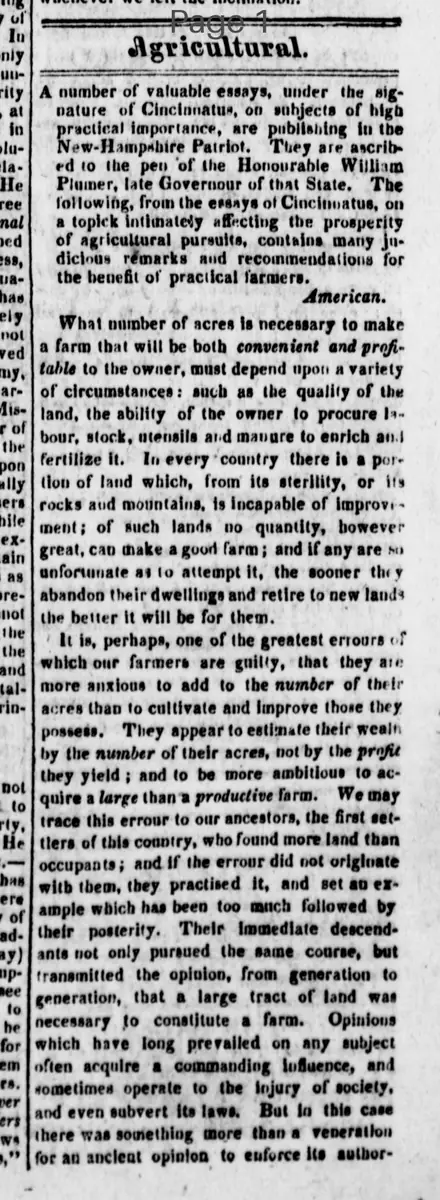
Agricultural.
A number of valuable essays, under the signature of Cincinnatus, on subjects of high practical importance, are publishing in the New-Hampshire Patriot. They are ascribed to the pen of the Honourable William Plumer, late Governor of that State. The following, from the essays of Cincinnatus, on a topic intimately affecting the prosperity of agricultural pursuits, contains many judicious remarks and recommendations for the benefit of practical farmers.
American.
What number of acres is necessary to make a farm that will be both convenient and profitable to the owner, must depend upon a variety of circumstances: such as the quality of the land, the ability of the owner to procure labour, stock, utensils and manure to enrich and fertilize it. In every country there is a portion of land which, from its sterility, or its rocks and mountains, is incapable of improvement: of such lands no quantity, however great, can make a good farm; and if any are so unfortunate as to attempt it, the sooner they abandon their dwellings and retire to new lands the better it will be for them.
It is, perhaps, one of the greatest errors of which our farmers are guilty, that they are more anxious to add to the number of their acres than to cultivate and improve those they possess. They appear to estimate their wealth by the number of their acres, not by the profit they yield; and to be more ambitious to acquire a large than a productive farm. We may trace this error to our ancestors, the first settlers of this country, who found more land than occupants; and if the error did not originate with them, they practised it, and set an example which has been too much followed by their posterity. Their immediate descendants not only pursued the same course, but transmitted the opinion, from generation to generation, that a large tract of land was necessary to constitute a farm. Opinions which have long prevailed on any subject often acquire a commanding influence, and sometimes operate to the injury of society, and even subvert its laws. But in this case there was something more than a veneration for an ancient opinion to enforce its authority. The first inhabitants of a new settled township, even in our own times, can, by a mode of clearing lands unknown to our first ancestors, raise an abundant crop without manure and with less labour than on cultivated farms; but to continue that course, though only for a few years, much more land is required than farmers can permanently cultivate, and yet that quantity they think necessary for a farm.
The evils resulting from the opinion that a large tract of land is requisite for a farm, are such as will justify me in urging the farmer to devote some time to the examination of the subject. "Our ancestors," says a well-informed writer in the Massachusetts Agricultural Repository, "found a wilderness unoccupied except by savages. Those who fixed themselves in the country, when land was cheap, naturally estimated their riches by the number, rather than by the productive power of their acres. Two, three, or four hundred acres were bought at first, to be the extent of a location suitable for a farm. Afterwards, when in the course of time, population became increased, and lands divided, the ideas of farmers settled down to the opinion, that from eighty to an hundred and fifty acres was about the number sufficient for an independent support of a family. Upon less than eighty acres, though a man might find ways and means to live, yet it was thought he could hardly expect greatly to thrive. Accordingly the first effect of thriving among men of that size, was generally evinced by the purchase of more land, as the best criterion to themselves and assurance to their neighbours of their success in life. After these purchases were made at the risk of embarrassment by debt, and almost always to the real injury of such farmers, whose surplus capital, or even their borrowed capital, would have been generally much better employed, rather than in the purchase of more acres.
With respect to men possessing only thirty or forty acres, they scarcely ventured to call their possessions by the name of a farm, so little is such an extent of land in general estimation, entitled to the use of that term. If they attempted to live and bring up a family upon them, they for the most part looked to other employment for their support;—turning mechanics or hiring themselves out, at the most valuable season of the year, to their richer neighbours, or abandoning their farms to tenants, and taking leases of farms, comprehending a greater extent of land, and so much better calculated to give that full employment to their activity, which, to their mistaken apprehension, a farm of thirty or forty acres of land did not afford. Until of late years, opinions and conduct of this kind were almost universal. Even at this day, we know men, active, intelligent and industrious, possessed of this extent of land, who are labouring for others, or taking the charge of their neighbours' concerns, upon the avowed reason, that they cannot support their families upon thirty or forty acres! Yet their lands are good. The owners are industrious, intelligent, possessed of a strong desire of wealth and independence.— But they do not realize the actual efficiency of the soil. Undoubtedly there are many honourable exceptions to the observation we are now about to make; as a general truth, however it may be asserted, that the farmers of Massachusetts are yet to learn the immense productive power of a perfectly cultivated acre. Instead of seeking riches in augmenting the number of their acres, let them be sought in better modes of husbandry. As a general truth, we believe it may be expected that every farmer in Massachusetts possessed of one hundred acres of land, might divide them fairly, by quantity and quality, into thirds, and by a suitable cultivation, make either third more productive than his whole hundred acres are at present. This is the operation, at which those interested in the agriculture of Massachusetts, ought chiefly to aim—to make farmers realize what cultivation can effect, and to teach the modes, by which the productive power of the soil can best be elicited.
"In Europe, men possessed of thirty or forty acres of good arable land, are thought rich; they often keep fifteen or twenty head of cattle; raise food proportionate to such an amount of stock; and support themselves and their families well and independently." But it should be observed that such persons seldom have pastures for their cattle—they soil them—that is, feed them on green fodder which they cut and carry into their barns and sheds.
Instead of transcribing the account which that writer gives of the products of a perfectly cultivated acre in England; or the net profits which that volume relates of such an acre in Massachusetts (more than two hundred dollars) I will state a case which has fallen under my own observation in New-Hampshire. I know a farmer who owns only fourteen acres of land; but to its cultivation and improvement, he has devoted his time and labour with great industry, and hired labour equal to that of one man for three or four months in a year. From the products of that farm he has maintained and supported his family, consisting of from five to seven persons, in a very decent and comfortable manner, and saved a surplus of fifty dollars a year. In the meantime he has kept his buildings in good repair, and at the end of each year his lands and his fences were of more value than at its commencement.
I am sensible that some farmers who own ten times as much land as this man possesses, when they compare their income with his, will be inclined to doubt the correctness of my statement; but they may be assured it is in no part exaggerated. The whole of this farmer's success proceeded from his economy, care and industry. He has been particularly attentive to making and collecting manure, and ploughing and improving his land. His labour was all performed in due season—and he lost nothing for want of care and attention.— All his labour and expenditures were devoted to what was useful and necessary. Such a farmer lives with more ease, enjoys more happiness, and feels more independent, than he whose large ill-cultivated farm affords him but scarcely sufficient to live, pay his taxes, hired men, and satisfy the claims of his mechanics, tradesmen and other creditors.
As to the size of a farm, I think I may safely lay it down as a general rule, that its extent ought not to exceed the quantity of labour which the owner can profitably expend upon it. If he has more land than this, it will be unproductive, and instead of enriching, it will impoverish him. It is labour that constitutes the farmer's profit; but many expend their labour on so large a surface that they receive little or no profit from either their labour or land. Instead of improving their land, they simply gather in what an ill-cultivated and much exhausted soil yields. The disposition of their labour resembles a vast sheet of water flowing in a sluggish course over a flat country on an extended bed, which neither fertilizes the soil, nor answers any useful purpose to man. The same sheet of water confined within narrow limits would fit the stream for mills, for manufacturing establishments, and for other useful purposes. In like manner, if the same labour which farmers usually expend on their farms, was applied to much smaller portions of the soil, it would prove a source of unfailing profit; and they would no longer complain of their inability to hire labourers.
In censuring farmers for the misapplication of labour, a full portion of the reproach attaches to myself. I am a farmer; I live on a farm; but I know, by dear-bought experience, that I have lost a very considerable portion of the labour I have hired, by the single circumstance of attempting to cultivate too much land.
CINCINNATUS.
July 21, 1821.
A number of valuable essays, under the signature of Cincinnatus, on subjects of high practical importance, are publishing in the New-Hampshire Patriot. They are ascribed to the pen of the Honourable William Plumer, late Governor of that State. The following, from the essays of Cincinnatus, on a topic intimately affecting the prosperity of agricultural pursuits, contains many judicious remarks and recommendations for the benefit of practical farmers.
American.
What number of acres is necessary to make a farm that will be both convenient and profitable to the owner, must depend upon a variety of circumstances: such as the quality of the land, the ability of the owner to procure labour, stock, utensils and manure to enrich and fertilize it. In every country there is a portion of land which, from its sterility, or its rocks and mountains, is incapable of improvement: of such lands no quantity, however great, can make a good farm; and if any are so unfortunate as to attempt it, the sooner they abandon their dwellings and retire to new lands the better it will be for them.
It is, perhaps, one of the greatest errors of which our farmers are guilty, that they are more anxious to add to the number of their acres than to cultivate and improve those they possess. They appear to estimate their wealth by the number of their acres, not by the profit they yield; and to be more ambitious to acquire a large than a productive farm. We may trace this error to our ancestors, the first settlers of this country, who found more land than occupants; and if the error did not originate with them, they practised it, and set an example which has been too much followed by their posterity. Their immediate descendants not only pursued the same course, but transmitted the opinion, from generation to generation, that a large tract of land was necessary to constitute a farm. Opinions which have long prevailed on any subject often acquire a commanding influence, and sometimes operate to the injury of society, and even subvert its laws. But in this case there was something more than a veneration for an ancient opinion to enforce its authority. The first inhabitants of a new settled township, even in our own times, can, by a mode of clearing lands unknown to our first ancestors, raise an abundant crop without manure and with less labour than on cultivated farms; but to continue that course, though only for a few years, much more land is required than farmers can permanently cultivate, and yet that quantity they think necessary for a farm.
The evils resulting from the opinion that a large tract of land is requisite for a farm, are such as will justify me in urging the farmer to devote some time to the examination of the subject. "Our ancestors," says a well-informed writer in the Massachusetts Agricultural Repository, "found a wilderness unoccupied except by savages. Those who fixed themselves in the country, when land was cheap, naturally estimated their riches by the number, rather than by the productive power of their acres. Two, three, or four hundred acres were bought at first, to be the extent of a location suitable for a farm. Afterwards, when in the course of time, population became increased, and lands divided, the ideas of farmers settled down to the opinion, that from eighty to an hundred and fifty acres was about the number sufficient for an independent support of a family. Upon less than eighty acres, though a man might find ways and means to live, yet it was thought he could hardly expect greatly to thrive. Accordingly the first effect of thriving among men of that size, was generally evinced by the purchase of more land, as the best criterion to themselves and assurance to their neighbours of their success in life. After these purchases were made at the risk of embarrassment by debt, and almost always to the real injury of such farmers, whose surplus capital, or even their borrowed capital, would have been generally much better employed, rather than in the purchase of more acres.
With respect to men possessing only thirty or forty acres, they scarcely ventured to call their possessions by the name of a farm, so little is such an extent of land in general estimation, entitled to the use of that term. If they attempted to live and bring up a family upon them, they for the most part looked to other employment for their support;—turning mechanics or hiring themselves out, at the most valuable season of the year, to their richer neighbours, or abandoning their farms to tenants, and taking leases of farms, comprehending a greater extent of land, and so much better calculated to give that full employment to their activity, which, to their mistaken apprehension, a farm of thirty or forty acres of land did not afford. Until of late years, opinions and conduct of this kind were almost universal. Even at this day, we know men, active, intelligent and industrious, possessed of this extent of land, who are labouring for others, or taking the charge of their neighbours' concerns, upon the avowed reason, that they cannot support their families upon thirty or forty acres! Yet their lands are good. The owners are industrious, intelligent, possessed of a strong desire of wealth and independence.— But they do not realize the actual efficiency of the soil. Undoubtedly there are many honourable exceptions to the observation we are now about to make; as a general truth, however it may be asserted, that the farmers of Massachusetts are yet to learn the immense productive power of a perfectly cultivated acre. Instead of seeking riches in augmenting the number of their acres, let them be sought in better modes of husbandry. As a general truth, we believe it may be expected that every farmer in Massachusetts possessed of one hundred acres of land, might divide them fairly, by quantity and quality, into thirds, and by a suitable cultivation, make either third more productive than his whole hundred acres are at present. This is the operation, at which those interested in the agriculture of Massachusetts, ought chiefly to aim—to make farmers realize what cultivation can effect, and to teach the modes, by which the productive power of the soil can best be elicited.
"In Europe, men possessed of thirty or forty acres of good arable land, are thought rich; they often keep fifteen or twenty head of cattle; raise food proportionate to such an amount of stock; and support themselves and their families well and independently." But it should be observed that such persons seldom have pastures for their cattle—they soil them—that is, feed them on green fodder which they cut and carry into their barns and sheds.
Instead of transcribing the account which that writer gives of the products of a perfectly cultivated acre in England; or the net profits which that volume relates of such an acre in Massachusetts (more than two hundred dollars) I will state a case which has fallen under my own observation in New-Hampshire. I know a farmer who owns only fourteen acres of land; but to its cultivation and improvement, he has devoted his time and labour with great industry, and hired labour equal to that of one man for three or four months in a year. From the products of that farm he has maintained and supported his family, consisting of from five to seven persons, in a very decent and comfortable manner, and saved a surplus of fifty dollars a year. In the meantime he has kept his buildings in good repair, and at the end of each year his lands and his fences were of more value than at its commencement.
I am sensible that some farmers who own ten times as much land as this man possesses, when they compare their income with his, will be inclined to doubt the correctness of my statement; but they may be assured it is in no part exaggerated. The whole of this farmer's success proceeded from his economy, care and industry. He has been particularly attentive to making and collecting manure, and ploughing and improving his land. His labour was all performed in due season—and he lost nothing for want of care and attention.— All his labour and expenditures were devoted to what was useful and necessary. Such a farmer lives with more ease, enjoys more happiness, and feels more independent, than he whose large ill-cultivated farm affords him but scarcely sufficient to live, pay his taxes, hired men, and satisfy the claims of his mechanics, tradesmen and other creditors.
As to the size of a farm, I think I may safely lay it down as a general rule, that its extent ought not to exceed the quantity of labour which the owner can profitably expend upon it. If he has more land than this, it will be unproductive, and instead of enriching, it will impoverish him. It is labour that constitutes the farmer's profit; but many expend their labour on so large a surface that they receive little or no profit from either their labour or land. Instead of improving their land, they simply gather in what an ill-cultivated and much exhausted soil yields. The disposition of their labour resembles a vast sheet of water flowing in a sluggish course over a flat country on an extended bed, which neither fertilizes the soil, nor answers any useful purpose to man. The same sheet of water confined within narrow limits would fit the stream for mills, for manufacturing establishments, and for other useful purposes. In like manner, if the same labour which farmers usually expend on their farms, was applied to much smaller portions of the soil, it would prove a source of unfailing profit; and they would no longer complain of their inability to hire labourers.
In censuring farmers for the misapplication of labour, a full portion of the reproach attaches to myself. I am a farmer; I live on a farm; but I know, by dear-bought experience, that I have lost a very considerable portion of the labour I have hired, by the single circumstance of attempting to cultivate too much land.
CINCINNATUS.
July 21, 1821.
What sub-type of article is it?
Essay
What themes does it cover?
Agriculture Rural
Moral Virtue
What keywords are associated?
Agriculture
Farm Size
Cultivation
New Hampshire
William Plumer
Cincinnatus
Productive Farming
Labor Efficiency
What entities or persons were involved?
Cincinnatus (Ascribed To The Honourable William Plumer)
Literary Details
Author
Cincinnatus (Ascribed To The Honourable William Plumer)
Subject
On The Size Of Farms And Their Cultivation For Prosperity
Key Lines
What Number Of Acres Is Necessary To Make A Farm That Will Be Both Convenient And Profitable To The Owner, Must Depend Upon A Variety Of Circumstances: Such As The Quality Of The Land, The Ability Of The Owner To Procure Labour, Stock, Utensils And Manure To Enrich And Fertilize It.
It Is, Perhaps, One Of The Greatest Errors Of Which Our Farmers Are Guilty, That They Are More Anxious To Add To The Number Of Their Acres Than To Cultivate And Improve Those They Possess.
As To The Size Of A Farm, I Think I May Safely Lay It Down As A General Rule, That Its Extent Ought Not To Exceed The Quantity Of Labour Which The Owner Can Profitably Expend Upon It.