Thank you for visiting SNEWPapers!
Sign up free
Letter to Editor
September 30, 1817
Daily National Intelligencer
Washington, District Of Columbia
What is this article about?
A letter from 'Lautaro' to Henry Clay urges U.S. recognition and aid for South American independence struggles, contrasting them with European despotism and emphasizing shared interests in liberty. Republished from Richmond Enquirer in 1817, it argues against U.S. neutrality.
Clipping
OCR Quality
98%
Excellent
Full Text
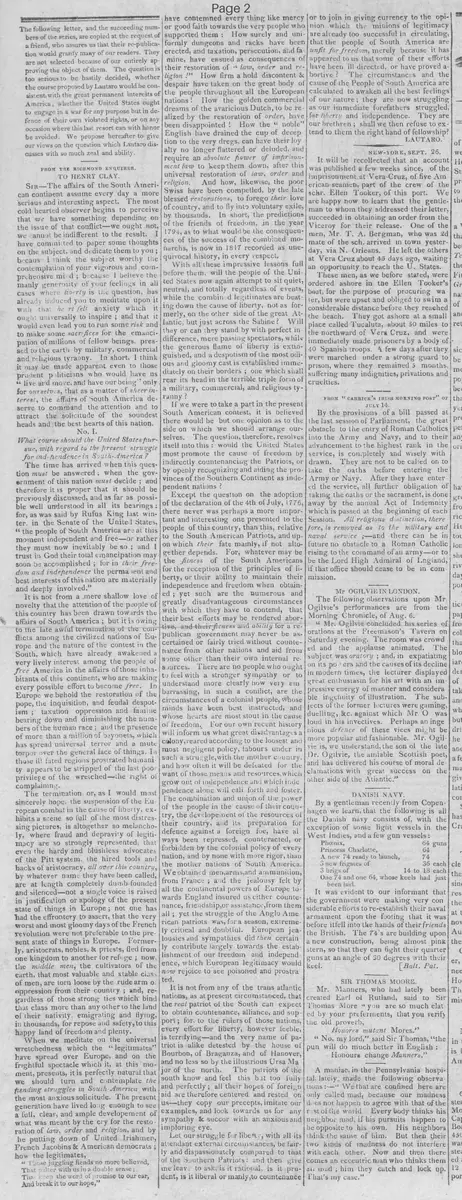
The following letter, and the succeeding numbers of the series, are copied at the request of a friend, who assures us that their re-publication would gratify many of our readers. They are not selected because of our entirely approving the object of them. The question is too serious to be hastily decided, whether the course proposed by Lautaro would be consistent with the great permanent interests of America; whether the United States ought to engage in a war for any purpose but in defence of their own violated rights, or on any occasion where this last resort can with honor be avoided. We propose hereafter to give our views on the question which Lautaro discusses with so much zeal and ability.
FROM THE RICHMOND ENQUIRER.
TO HENRY CLAY.
Sir--The affairs of the South American continent assume every day a more serious and interesting aspect. The most cold hearted observer begins to perceive that we have something depending on the issue of that conflict—we ought not, we cannot be indifferent to the result. I have committed to paper some thoughts on the subject, and dedicate them to you; because I think the subject worthy the contemplation of your vigorous and comprehensive mind; because I believe the manly generosity of your feelings in all cases where liberty is the question, has already induced you to meditate upon it with that heart felt anxiety which it ought universally to inspire; and that it would even lead you to run some risk and to make some sacrifices for the emancipation of millions of fellow beings, pressed to the earth by military, commercial and religious tyranny. In short, I think it may be made apparent even to those prudent politicians who would have us "live and move, and have our being" only for ourselves, that as a matter of sheer interest, the affairs of South America deserve to command the attention and to attract the solicitude of the soundest heads and the best hearts of this nation.
No. I.
What course should the United States pursue, with regard to the present struggle for independence in South-America?
The time has arrived when this question must be answered; when the government of this nation must decide; and therefore it is proper that it should be previously discussed, and as far as possible well understood in all its bearings: for, as was said by Rufus King last winter, in the Senate of the United States "the people of South America are at this moment independent and free—or rather they must now inevitably be so; and I trust in God their total emancipation may soon be accomplished; for in their freedom and independence the permanent and best interests of this nation are materially and deeply involved."
It is not from a mere shallow love of novelty that the attention of the people of this country has been drawn towards the affairs of South America; but it is owing to the late awful termination of the conflicts among the civilized nations of Europe and the nature of the contest in the South, which have already awakened a very lively interest among the people of free America in the affairs of those inhabitants of this continent, who are making every possible effort to become free. In Europe we behold the restoration of the pope, the inquisition, and feudal despotism; taxation oppression and famine bearing down and diminishing the numbers of the human race; and the presence of more than a million of bayonets, which has spread universal terror and a mute torpor over the general face of things. In those ill fated regions prostrated humanity appears to be stripped of the last poor privilege of the wretched—the right of complaining.
The termination or, as I would most sincerely hope, the suspension of the European combat in the cause of liberty, exhibits a scene so full of the most distressing pictures, is altogether so melancholy, where fraud and depravity of legitimacy are so strongly represented, that even the hardy and blustering advocates of the Pitt system, the hired tools and hacks of aristocracy, all over this country, by whatever name they have been called, are at length completely dumb-founded and silenced—not a single voice is raised in justification or apology of the present state of things in Europe; not one has had the effrontery to assert, that the very worst and most gloomy days of the French revolution were not preferable to the present state of things in Europe. Formerly, aristocrats, nobles, & priests, fled from one kingdom to another for refuge; now, the middle men, the cultivators of the earth, that most valuable and stable class of men, are torn loose by the rude arm of oppression from their country; and, regardless of those strong ties which bind that class more than any other to the land of their nativity, emigrating and flying in thousands, for repose and safety, to this happy land of freedom and plenty.
When we meditate on the universal wretchedness which the "legitimates" have spread over Europe, and on the frightful spectacle which it, at this moment, presents, it is perfectly natural that we should turn and contemplate the pending struggles in South America with the most anxious solicitude. The present generation have lived long enough to see a full, clear, and ample developement of what was meant by the cry for the restoration of law, order and religion, and by the putting down of United Irishmen, French Jacobins & American democrats; how the legitimates,
"Those juggling fiends no more believed,
That palter with us in a double sense;
That keep the word of promise to our ear,
And break it to our hope,"
have contemned every thing like mercy or good faith towards the very people who supported them: How surely and uniformly dungeons and racks have been erected, and taxation, persecution, and famine, have ensued as consequences of their restoration of "law, order and religion!" How firm a hold discontent & despair have taken on the great body of the people throughout all the European nations! How the golden commercial dreams of the avaricious Dutch, to be realized by the restoration of order, have been disappointed! How the "noble" English have drained the cup of deception to the very dregs, can have their loyalty no longer flattered or deluded, and require an absolute power of imprisonment law to keep them down, after this universal restoration of law, order and religion. And how, likewise, the poor Swiss have been compelled, by the late blessed restorations, to forego their love of country, and to fly into voluntary exile, by thousands. In short, the predictions of the friends of freedom, in the year 1794, as to what would be the consequences of the success of the combined monarchs, is now in 1817 recorded as unequivocal history, in every respect.
With all these impressive lessons full before them, will the people of the United States now again attempt to sit quiet, neutral, and totally regardless of events, while the combined legitimates are beating down the cause of liberty, not as formerly, on the other side of the great Atlantic, but just across the Sabine? Will they or can they stand by with perfect indifference, mere passing spectators, whilst the generous flame of liberty is extinguished, and a despotism of the most odious and gloomy cast is established immediately on their borders; one which shall rear its head in the terrible triple form of a military, commercial, and religious tyranny?
If we were to take a part in the present South American contest, it is believed there would be but one opinion as to the side on which we should arrange ourselves. The question, therefore, resolves itself into this: would the United States most promote the cause of freedom by indirectly countenancing the Patriots, or by openly recognizing and aiding the provinces of the Southern Continent as independent nations?
Except the question on the adoption of the declaration of the 4th of July, 1776, there never was perhaps a more important and interesting one presented to the people of this country, than this, relative to the South American Patriots, and upon which their fate mainly, if not altogether depends. For, whatever may be the fitness of the South Americans for the reception of the principles of liberty, or their ability to maintain their independence and freedom when obtained; yet such are the numerous and greatly disadvantageous circumstances with which they have to contend, that their best efforts may be rendered abortive, and their fitness and ability for a republican government may never be ascertained or fairly tried without countenance from other nations and aid from some other than their own internal resources. There are no people who ought to feel with a stronger sympathy or to understand more clearly how very embarrassing, in such a conflict, are the circumstances of a colonial people, whose minds have been best instructed, and whose hearts are most stout in the cause of freedom. For our own recent history will inform us what great disadvantages a colony, reared according to the loosest and most negligent policy, labours under in such a struggle, with the mother country, and how often it will be defeated for the want of those means and resources, which grow out of independence and which independence alone will call forth and foster. The combination and union of the power of the people in the cause of their country, the developement of the resources of their country, and its preparation for defence against a foreign foe, have always been repressed, counteracted, or forbidden by the colonial policy of every nation, and by none with more rigor, than the mother nations of South America.
We obtained men, arms, and ammunition, from France; and the jealousy felt by all the continental powers of Europe towards England insured us either countenance, friendship, or assistance, from them all; yet the struggle of the Anglo American patriots was, for a season, extremely critical and doubtful. European jealousies and sympathies did then certainly contribute largely towards the establishment of our freedom and independence, which European legitimacy would now rejoice to see poisoned and prostrated.
It is not from any of the trans atlantic nations, as at present circumstanced, that the real patriot of the South can expect to obtain countenance, alliance, and support; for, to the rulers of those nations, every effort for liberty, however feeble, is terrifying—and the very name of patriot is alike detested by the house of Bourbon, of Braganza, and of Hanover, and no less so by the illustrious Ursa Major of the north. The patriots of the south know and feel this but too fully and perfectly; all their hopes of foreign aid are therefore centered and rested on us—they copy our precepts, imitate our examples, and look towards us for any sympathy & succor with an anxious and imploring eye.
Let our struggle for liberty, with all its attendant external circumstances, be fairly and dispassionately compared to that of the Southern Patriots: and then give me leave to ask, is it rational, is it prudent, is it liberal or manly, to countenance or to join in giving currency to the opinion which the minions of legitimacy are already too successful in circulating that the people of South America are unfit for freedom, merely because it has appeared to us that some of their efforts have been ill directed, or have proved abortive? The circumstances and the cause of the People of South America are calculated to awaken all the best feelings of our nature: they are now struggling as our immediate forefathers struggled for liberty and independence. They are our brethren: shall we then refuse to extend to them the right hand of fellowship?
LAUTARO.
NEW-YORK, SEPT. 26.
FROM THE RICHMOND ENQUIRER.
TO HENRY CLAY.
Sir--The affairs of the South American continent assume every day a more serious and interesting aspect. The most cold hearted observer begins to perceive that we have something depending on the issue of that conflict—we ought not, we cannot be indifferent to the result. I have committed to paper some thoughts on the subject, and dedicate them to you; because I think the subject worthy the contemplation of your vigorous and comprehensive mind; because I believe the manly generosity of your feelings in all cases where liberty is the question, has already induced you to meditate upon it with that heart felt anxiety which it ought universally to inspire; and that it would even lead you to run some risk and to make some sacrifices for the emancipation of millions of fellow beings, pressed to the earth by military, commercial and religious tyranny. In short, I think it may be made apparent even to those prudent politicians who would have us "live and move, and have our being" only for ourselves, that as a matter of sheer interest, the affairs of South America deserve to command the attention and to attract the solicitude of the soundest heads and the best hearts of this nation.
No. I.
What course should the United States pursue, with regard to the present struggle for independence in South-America?
The time has arrived when this question must be answered; when the government of this nation must decide; and therefore it is proper that it should be previously discussed, and as far as possible well understood in all its bearings: for, as was said by Rufus King last winter, in the Senate of the United States "the people of South America are at this moment independent and free—or rather they must now inevitably be so; and I trust in God their total emancipation may soon be accomplished; for in their freedom and independence the permanent and best interests of this nation are materially and deeply involved."
It is not from a mere shallow love of novelty that the attention of the people of this country has been drawn towards the affairs of South America; but it is owing to the late awful termination of the conflicts among the civilized nations of Europe and the nature of the contest in the South, which have already awakened a very lively interest among the people of free America in the affairs of those inhabitants of this continent, who are making every possible effort to become free. In Europe we behold the restoration of the pope, the inquisition, and feudal despotism; taxation oppression and famine bearing down and diminishing the numbers of the human race; and the presence of more than a million of bayonets, which has spread universal terror and a mute torpor over the general face of things. In those ill fated regions prostrated humanity appears to be stripped of the last poor privilege of the wretched—the right of complaining.
The termination or, as I would most sincerely hope, the suspension of the European combat in the cause of liberty, exhibits a scene so full of the most distressing pictures, is altogether so melancholy, where fraud and depravity of legitimacy are so strongly represented, that even the hardy and blustering advocates of the Pitt system, the hired tools and hacks of aristocracy, all over this country, by whatever name they have been called, are at length completely dumb-founded and silenced—not a single voice is raised in justification or apology of the present state of things in Europe; not one has had the effrontery to assert, that the very worst and most gloomy days of the French revolution were not preferable to the present state of things in Europe. Formerly, aristocrats, nobles, & priests, fled from one kingdom to another for refuge; now, the middle men, the cultivators of the earth, that most valuable and stable class of men, are torn loose by the rude arm of oppression from their country; and, regardless of those strong ties which bind that class more than any other to the land of their nativity, emigrating and flying in thousands, for repose and safety, to this happy land of freedom and plenty.
When we meditate on the universal wretchedness which the "legitimates" have spread over Europe, and on the frightful spectacle which it, at this moment, presents, it is perfectly natural that we should turn and contemplate the pending struggles in South America with the most anxious solicitude. The present generation have lived long enough to see a full, clear, and ample developement of what was meant by the cry for the restoration of law, order and religion, and by the putting down of United Irishmen, French Jacobins & American democrats; how the legitimates,
"Those juggling fiends no more believed,
That palter with us in a double sense;
That keep the word of promise to our ear,
And break it to our hope,"
have contemned every thing like mercy or good faith towards the very people who supported them: How surely and uniformly dungeons and racks have been erected, and taxation, persecution, and famine, have ensued as consequences of their restoration of "law, order and religion!" How firm a hold discontent & despair have taken on the great body of the people throughout all the European nations! How the golden commercial dreams of the avaricious Dutch, to be realized by the restoration of order, have been disappointed! How the "noble" English have drained the cup of deception to the very dregs, can have their loyalty no longer flattered or deluded, and require an absolute power of imprisonment law to keep them down, after this universal restoration of law, order and religion. And how, likewise, the poor Swiss have been compelled, by the late blessed restorations, to forego their love of country, and to fly into voluntary exile, by thousands. In short, the predictions of the friends of freedom, in the year 1794, as to what would be the consequences of the success of the combined monarchs, is now in 1817 recorded as unequivocal history, in every respect.
With all these impressive lessons full before them, will the people of the United States now again attempt to sit quiet, neutral, and totally regardless of events, while the combined legitimates are beating down the cause of liberty, not as formerly, on the other side of the great Atlantic, but just across the Sabine? Will they or can they stand by with perfect indifference, mere passing spectators, whilst the generous flame of liberty is extinguished, and a despotism of the most odious and gloomy cast is established immediately on their borders; one which shall rear its head in the terrible triple form of a military, commercial, and religious tyranny?
If we were to take a part in the present South American contest, it is believed there would be but one opinion as to the side on which we should arrange ourselves. The question, therefore, resolves itself into this: would the United States most promote the cause of freedom by indirectly countenancing the Patriots, or by openly recognizing and aiding the provinces of the Southern Continent as independent nations?
Except the question on the adoption of the declaration of the 4th of July, 1776, there never was perhaps a more important and interesting one presented to the people of this country, than this, relative to the South American Patriots, and upon which their fate mainly, if not altogether depends. For, whatever may be the fitness of the South Americans for the reception of the principles of liberty, or their ability to maintain their independence and freedom when obtained; yet such are the numerous and greatly disadvantageous circumstances with which they have to contend, that their best efforts may be rendered abortive, and their fitness and ability for a republican government may never be ascertained or fairly tried without countenance from other nations and aid from some other than their own internal resources. There are no people who ought to feel with a stronger sympathy or to understand more clearly how very embarrassing, in such a conflict, are the circumstances of a colonial people, whose minds have been best instructed, and whose hearts are most stout in the cause of freedom. For our own recent history will inform us what great disadvantages a colony, reared according to the loosest and most negligent policy, labours under in such a struggle, with the mother country, and how often it will be defeated for the want of those means and resources, which grow out of independence and which independence alone will call forth and foster. The combination and union of the power of the people in the cause of their country, the developement of the resources of their country, and its preparation for defence against a foreign foe, have always been repressed, counteracted, or forbidden by the colonial policy of every nation, and by none with more rigor, than the mother nations of South America.
We obtained men, arms, and ammunition, from France; and the jealousy felt by all the continental powers of Europe towards England insured us either countenance, friendship, or assistance, from them all; yet the struggle of the Anglo American patriots was, for a season, extremely critical and doubtful. European jealousies and sympathies did then certainly contribute largely towards the establishment of our freedom and independence, which European legitimacy would now rejoice to see poisoned and prostrated.
It is not from any of the trans atlantic nations, as at present circumstanced, that the real patriot of the South can expect to obtain countenance, alliance, and support; for, to the rulers of those nations, every effort for liberty, however feeble, is terrifying—and the very name of patriot is alike detested by the house of Bourbon, of Braganza, and of Hanover, and no less so by the illustrious Ursa Major of the north. The patriots of the south know and feel this but too fully and perfectly; all their hopes of foreign aid are therefore centered and rested on us—they copy our precepts, imitate our examples, and look towards us for any sympathy & succor with an anxious and imploring eye.
Let our struggle for liberty, with all its attendant external circumstances, be fairly and dispassionately compared to that of the Southern Patriots: and then give me leave to ask, is it rational, is it prudent, is it liberal or manly, to countenance or to join in giving currency to the opinion which the minions of legitimacy are already too successful in circulating that the people of South America are unfit for freedom, merely because it has appeared to us that some of their efforts have been ill directed, or have proved abortive? The circumstances and the cause of the People of South America are calculated to awaken all the best feelings of our nature: they are now struggling as our immediate forefathers struggled for liberty and independence. They are our brethren: shall we then refuse to extend to them the right hand of fellowship?
LAUTARO.
NEW-YORK, SEPT. 26.
What sub-type of article is it?
Persuasive
Political
Reflective
What themes does it cover?
Politics
Military War
Constitutional Rights
What keywords are associated?
South American Independence
Us Foreign Policy
Henry Clay
European Legitimacy
Colonial Struggle
Liberty Aid
Rufus King
Lautaro Series
What entities or persons were involved?
Lautaro
Henry Clay
Letter to Editor Details
Author
Lautaro
Recipient
Henry Clay
Main Argument
the united states should openly recognize and aid the south american provinces as independent nations to promote freedom, rather than remaining neutral, as their success aligns with american interests and principles of liberty against european despotism.
Notable Details
Quotes Rufus King From U.S. Senate
References European Restorations Of 1815 And Their Consequences
Shakespeare Quote On 'Juggling Fiends'
Compares South American Struggle To American Revolution
Mentions 1817 Context And Predictions From 1794