Thank you for visiting SNEWPapers!
Sign up free
Story
September 25, 1932
Atlanta Daily World
Atlanta, Fulton County, Georgia
What is this article about?
Eddie Tolan recounts his journey to double gold in 100m and 200m sprints at 1932 Los Angeles Olympics, crediting experience and confidence over mere speed, after failing in 1928 trials due to stage fright.
Clipping
OCR Quality
75%
Good
Full Text
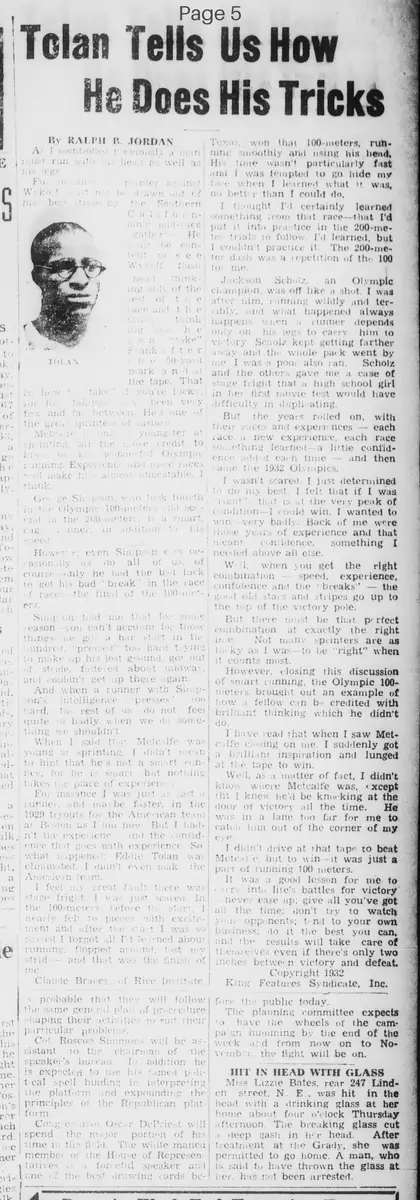
Tolan Tells Us How He Does His Tricks
By Ralph B. Jordan
Eddie Tolan, the little brown streak from the University of Michigan who won the 100 and 200 meters for America at the recent Olympic Games in Los Angeles, is back home now, and talking about his sensational double victory. And what he has to say is mighty interesting to all followers of track and field sports.
Eddie is a firm believer in the theory that brains are just as important as brawn in winning races. He says that the difference between a good sprinter and a great one is largely a matter of knowing how to run smart. And he ought to know, for he has demonstrated beyond all question that he is one of the greatest sprinters of all time.
Eddie gives a lot of the credit for his Olympic success to his coach at Michigan, but he is quick to add that experience and another thing which cannot be bought or taught—natural ability—had a lot to do with it.
He thinks George Simpson, who took fourth in the Olympic 100-meters and second in the 200-meters, is a smart runner, other qualities in addition to his speed. However, even Simpson occasionally has bad luck, as do all of us of course; only he had the bad luck to get his bad break in the face of the race, the final of the 100 meters.
Simpson told me that for some reason you can't account for, the things he does. But start in the hundred yard dash with the sudden pressure's ton hand heaving to make up his lost ground, got out a stride, faltered about midway and couldn't get up there again. And when a runner with Simpson's intelligence presses onward, the rest of us do not feel quite so badly when we do something we shouldn't.
When I said that Metcalfe was young at sprinting, I didn't mean to hint that he is not a sprinter, for he is. But nothing takes the place of experience. For instance, I was just as fast, if not faster, in the 1928 tryouts for the American team at Boston as I am now. But I hadn't the experience and the coolness that goes with experience. So what happened? Eddie Tolan was eliminated. I didn't even make the American team.
I feel many great faults; there was stage fright. I was just scared. In the 100-meters, before the start, I nearly fell to pieces with excitement, and after the start I was so shaken I forgot all I learned about running, flopped around like a third - and that was the finish of me.
Claude Bracy of Rice Institute, Tex., won that 100-meters, running smoothly and using his head. His time wasn't particularly fast and I was tempted to go hide my face when I learned what it was, no better than I could do.
I thought I'd certainly learned something from that race—that I'd put it into practice in the 200-meter trials to follow. I'd learned, but I couldn't practice it. The 200-meter dash was a repetition of the 100 to me.
Jackson Scholz, an Olympic champion, was off like a shot. I was after him, running wildly and terribly, and what happened always happens when a runner depends only on his legs to carry him to victory: Scholz kept getting farther away and the whole pack went by me. I was a poor also-ran.
Scholz and the others gave me a case of stage fright that a high school girl in her first movie test would have difficulty in duplicating.
But the years rolled on, with their races and experiences - each race new experience, each race something learned - a little confidence added each time - and then came the 1932 Olympics.
I wasn't scared. I just determined to do my best. I felt that if I was right at the very peak of condition I would win. I wanted to win very badly. Back of me were those years of experience and that earned confidence, something I needed above all else.
When you get the right combination - speed, experience, confidence and the breaks - the flag of stars and stripes go up to the top of the victory pole.
But there must be that perfect combination at exactly the right time. Not many sprinters are as lucky as I was - to be right when it counts most.
However, in closing this discussion of smart running, the Olympic 100-meters brought out an example of how a fellow can be credited with brilliant thinking which he didn't do.
I have read that when I saw Metcalfe coming on me, I suddenly got a brilliant inspiration and lunged at the tape to win.
Well, as a matter of fact, I didn't know where Metcalfe was, except that I knew he'd be knocking at the door of victory all the time. He was in a lane too far for me to catch him out of the corner of my eye. I didn't drive at that tape to beat Metcalfe but to win - it was just a part of running 100 meters.
It was a good lesson for me to learn in life's battles: for victory never ease up, give all you've got all the time, don't try to watch your opponents; tend to your own business, do it the best you can, and the results will take care of themselves even if there's only two inches between victory and defeat.
Copyright 1932 King Features Syndicate, Inc.
By Ralph B. Jordan
Eddie Tolan, the little brown streak from the University of Michigan who won the 100 and 200 meters for America at the recent Olympic Games in Los Angeles, is back home now, and talking about his sensational double victory. And what he has to say is mighty interesting to all followers of track and field sports.
Eddie is a firm believer in the theory that brains are just as important as brawn in winning races. He says that the difference between a good sprinter and a great one is largely a matter of knowing how to run smart. And he ought to know, for he has demonstrated beyond all question that he is one of the greatest sprinters of all time.
Eddie gives a lot of the credit for his Olympic success to his coach at Michigan, but he is quick to add that experience and another thing which cannot be bought or taught—natural ability—had a lot to do with it.
He thinks George Simpson, who took fourth in the Olympic 100-meters and second in the 200-meters, is a smart runner, other qualities in addition to his speed. However, even Simpson occasionally has bad luck, as do all of us of course; only he had the bad luck to get his bad break in the face of the race, the final of the 100 meters.
Simpson told me that for some reason you can't account for, the things he does. But start in the hundred yard dash with the sudden pressure's ton hand heaving to make up his lost ground, got out a stride, faltered about midway and couldn't get up there again. And when a runner with Simpson's intelligence presses onward, the rest of us do not feel quite so badly when we do something we shouldn't.
When I said that Metcalfe was young at sprinting, I didn't mean to hint that he is not a sprinter, for he is. But nothing takes the place of experience. For instance, I was just as fast, if not faster, in the 1928 tryouts for the American team at Boston as I am now. But I hadn't the experience and the coolness that goes with experience. So what happened? Eddie Tolan was eliminated. I didn't even make the American team.
I feel many great faults; there was stage fright. I was just scared. In the 100-meters, before the start, I nearly fell to pieces with excitement, and after the start I was so shaken I forgot all I learned about running, flopped around like a third - and that was the finish of me.
Claude Bracy of Rice Institute, Tex., won that 100-meters, running smoothly and using his head. His time wasn't particularly fast and I was tempted to go hide my face when I learned what it was, no better than I could do.
I thought I'd certainly learned something from that race—that I'd put it into practice in the 200-meter trials to follow. I'd learned, but I couldn't practice it. The 200-meter dash was a repetition of the 100 to me.
Jackson Scholz, an Olympic champion, was off like a shot. I was after him, running wildly and terribly, and what happened always happens when a runner depends only on his legs to carry him to victory: Scholz kept getting farther away and the whole pack went by me. I was a poor also-ran.
Scholz and the others gave me a case of stage fright that a high school girl in her first movie test would have difficulty in duplicating.
But the years rolled on, with their races and experiences - each race new experience, each race something learned - a little confidence added each time - and then came the 1932 Olympics.
I wasn't scared. I just determined to do my best. I felt that if I was right at the very peak of condition I would win. I wanted to win very badly. Back of me were those years of experience and that earned confidence, something I needed above all else.
When you get the right combination - speed, experience, confidence and the breaks - the flag of stars and stripes go up to the top of the victory pole.
But there must be that perfect combination at exactly the right time. Not many sprinters are as lucky as I was - to be right when it counts most.
However, in closing this discussion of smart running, the Olympic 100-meters brought out an example of how a fellow can be credited with brilliant thinking which he didn't do.
I have read that when I saw Metcalfe coming on me, I suddenly got a brilliant inspiration and lunged at the tape to win.
Well, as a matter of fact, I didn't know where Metcalfe was, except that I knew he'd be knocking at the door of victory all the time. He was in a lane too far for me to catch him out of the corner of my eye. I didn't drive at that tape to beat Metcalfe but to win - it was just a part of running 100 meters.
It was a good lesson for me to learn in life's battles: for victory never ease up, give all you've got all the time, don't try to watch your opponents; tend to your own business, do it the best you can, and the results will take care of themselves even if there's only two inches between victory and defeat.
Copyright 1932 King Features Syndicate, Inc.
What sub-type of article is it?
Biography
Personal Triumph
What themes does it cover?
Triumph
Fortune Reversal
Moral Virtue
What keywords are associated?
Olympic Sprinting
Eddie Tolan
Stage Fright
Smart Running
1932 Olympics
Ralph Metcalfe
George Simpson
What entities or persons were involved?
Eddie Tolan
George Simpson
Ralph Metcalfe
Claude Bracy
Jackson Scholz
Where did it happen?
Los Angeles Olympics
Story Details
Key Persons
Eddie Tolan
George Simpson
Ralph Metcalfe
Claude Bracy
Jackson Scholz
Location
Los Angeles Olympics
Event Date
1932
Story Details
Eddie Tolan explains his Olympic victories through smart running, experience, and confidence gained from past failures like stage fright in 1928 trials, emphasizing focus on personal performance over watching competitors.