Thank you for visiting SNEWPapers!
Sign up free
Morning Herald
New York, New York County, New York
What is this article about?
This editorial celebrates the arrival of steamships Great Western and Sirius in New York, highlighting their transformative impact on transatlantic commerce, Anglo-American relations, and social exchange. It praises British interest and potential military benefits but sharply criticizes the Great Western's officers for rudeness and disorder, except for Captain Hoskins and Mr. Mathews, urging reforms for public visits.
Merged-components note: Both components discuss the arrival and implications of steamships, forming a continuous editorial on the topic.
Clipping
OCR Quality
Full Text
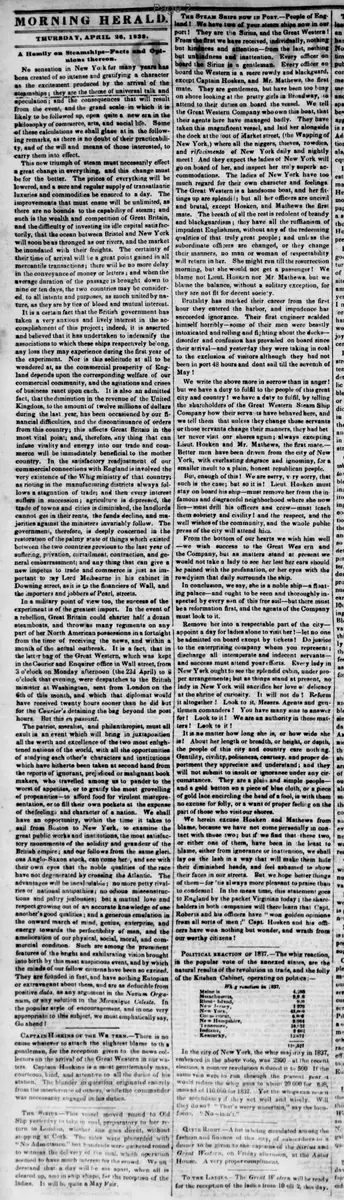
No sensation in New York for many years has been created of so intense and gratifying a character as the excitement produced by the arrival of the steamships; they are the theme of universal talk and speculation; and the consequences that will result from the event, and the grand scale in which it is likely to be followed up, open quite a new era in the philosophy of commerce, arts, and social life. Some of these calculations we shall glance at in the following remarks, as there is no doubt of their practicability, and of the will and means of those interested, to carry them into effect.
This new triumph of steam must necessarily effect a great change in everything, and this change must be for the better. The prices of everything will be lowered, and a sure and regular supply of transatlantic luxuries and commodities be ensured to a day. The improvements that must ensue will be unlimited, as there are no bounds to the capability of steam; and such is the wealth and competition of Great Britain, and the difficulty of investing its idle capital satisfactorily, that the ocean between Bristol and New York will soon be as thronged as our rivers, and the market be inundated with their freights. The certainty of their time of arrival will be a great point gained in all mercantile transactions; there will be no more delay in the conveyance of money or letters; and when the average duration of the passage is brought down to nine or ten days, the two countries may be considered, to all intents and purposes, as much united by nature, as they are by ties of blood and mutual interest.
It is a certain fact that the British government has taken a very anxious and lively interest in the accomplishment of this project; indeed, it is asserted and believed that it has undertaken to indemnify the associations to which these ships respectively belong, any loss they may experience during the first year of the experiment. Nor is this solicitude at all to be wondered at, as the commercial prosperity of England depends upon the corresponding welfare of our commercial community, and the agitations and crises of business react upon each. It is also an admitted fact, that the diminution in the revenue of the United Kingdom, to the amount of twelve millions of dollars during the last year, has been occasioned by our financial difficulties, and the discontinuance of orders from this country; this affects Great Britain in the most vital point; and, therefore, anything that can infuse vitality and energy into our trade and commerce will be immediately beneficial to the mother country. In the satisfactory readjustment of our commercial connections with England is involved the very existence of the Whig ministry of that country; as rioting in the manufacturing districts always follows a stagnation of trade; and then every interest suffers in succession; agriculture is depressed, the trade of towns and cities is diminished, the landlords cannot get in their rents, the funds decline, and majorities against the ministers invariably follow. The government, therefore, is deeply concerned in the restoration of the palmy state of things which existed between the two countries previous to the last year of suffering, privation, curtailment, contraction, and general embarrassment; and anything that can give a new impetus to trade and commerce is just as important to my Lord Melbourne in his cabinet in Downing street, as it is to the financiers of Wall, and the importers and jobbers of Pearl, streets.
In a military point of view too, the success of the experiment is of the greatest import. In the event of a rebellion, Great Britain could charter half a dozen steamboats, and throw as many regiments on any part of her North American possessions in a fortnight from the time of receiving the news, and within a month of the actual outbreak. It is a fact, that in the letter bag of the Great Western, which was kept in the Courier and Enquirer office in Wall street, from 3 o'clock on Monday afternoon (the 23d April) to 8 o'clock that evening, were despatches to the British minister at Washington, sent from London on the 6th of this month, and which that diplomat would have received twenty hours sooner than he did but for the Courier's detaining the bag beyond the post hours. But this en passant.
The patriot, moralist, and philanthropist, must all exult in an event which will bring in juxtaposition all the worth and excellence of the two most enlightened nations of the world, with all the opportunities of studying each other's characters and institutions which have hitherto been taken at second hand from the reports of ignorant, prejudiced or malignant book makers, who travelled among us to pander to the worst of appetites, or to gratify the most grovelling of propensities—to afford food for virulent misrepresentation, or to fill their own pockets at the expense of the feelings and character of a nation. We shall have an opportunity, within the time it takes to sail from Boston to New York, to examine the great public works and institutions, the most satisfactory monuments of the solidity and grandeur of the British empire; and our fellows from the same glorious Anglo-Saxon stock, can come here, and see with their own eyes that the noble qualities of the race have not degenerated by crossing the Atlantic. The advantages will be incalculable; no more petty rivalries or national antipathies; no odious misconstructions and paltry jealousies; but a mutual love and respect growing out of an accurate knowledge of one another's good qualities; and a generous emulation in the onward march of mind, genius, enterprise, and energy towards the perfectibility of man, and the amelioration of our physical, social, moral, and commercial condition. Such are among the prominent features of the bright and exhilarating vision brought into birth by this most auspicious event, and by which the minds of our fellow citizens have been so excited. They are founded in fact, and have nothing Utopian or extravagant about them, and are as deducible from positive data, as any argument in the Forum Organum, or any solution in the Mécanique Céleste. In the popular style of encouragement, and in one very appropriate to this subject, we most emphatically say, Go ahead!
Captain Hoskins of the Western.—There is no cause whatever to attach the slightest blame to this gentleman, for the reception given to the news collectors on the arrival of the Great Western in our waters. Captain Hoskins is a most gentlemanly man, courteous, kind, and attentive to all the duties of his station. The blunder in question originated entirely from the interference of others, while the commander was necessarily engaged in his duties.
The Sirius.—This vessel moved round to Old Slip yesterday to take in coal, preparatory to her return to London, whither she goes direct, without stopping at Cork. The rules were placarded with "No Admittance." but hundreds were gathered round to witness the delivery of the coal, which operation seemed to have much interest for the crowd. We understand that a day will be set apart, when all is cleared up, and in ship shape, for the reception of the ladies. It will be quite a May Fair.
The Steam Ships now in Port.—People of England! We have two of your steam ships now in our port! They are the Sirius, and the Great Western! From the first we have received, individually, nothing but kindness and attention—from the last, nothing but unkindness and inattention. Every officer on board the Sirius is a gentleman. Every officer on board the Western is a mere rowdy and blackguard, except Captain Hoskins, and Mr. Mathews, the first mate. They are gentlemen, but have been too busy on shore looking at the pretty girls in Broadway, to attend to their duties on board the vessel. We tell the Great Western Company who own this boat, that their agents here have managed badly. They have taken this magnificent vessel, and laid her alongside the dock at the foot of Market street, (the Wapping of New York,) where all the niggers, thieves, rowdies, and rifacimento of New York daily and nightly meet! And they expect the ladies of New York will go on board of her, and inspect her truly superb accommodations. The ladies of New York have too much regard for their own character and feelings.
The Great Western is a handsome boat, and her fittings up are splendid; but all her officers are uncivil and brutal, except Hoskins, and Mathews the first mate. The breath of all the rest is redolent of brandy and blackguardism; they have all the ruffianism of impudent Englishmen, without any of the redeeming qualities of that truly great people; and unless the subordinate officers are changed, or they change their manners, no man or woman of respectability will return in her. She might run till the resurrection morning, but she would not get a passenger! We blame not Lieut. Hoskins nor Mr. Mathews, but we blame the balance, without a solitary exception, for they are not fit for decent society.
Brutality has marked their career from the first hour they entered the harbor, and impudence has succeeded ignorance. Their first engineer scalded himself horribly—some of their men were beastly intoxicated and rolling and fighting about the decks—disorder and confusion has prevailed on board since their arrival—and yesterday they were taking in coal to the exclusion of visitors although they had not been in port 48 hours and don't sail till the seventh of May!
We write the above more in sorrow than in anger! but we have a duty to fulfil to the people of this great city and country! we have a duty to fulfil, by telling the shareholders of the Great Western Steam Ship Company how their servants have behaved here, and we tell them that unless they change those servants or those servants change their manners, they had better never visit our shores again; always excepting Lieut. Hoskins and Mr. Mathews, the first mate.—Better men have been driven from the city of New York, with everlasting disgrace and ignominy, for a smaller insult to a plain, honest republican people.
But, enough of this! We are sorry, very sorry, that such is the case: but so it is! Lieut. Hoskins must stay on board his ship—must remove her from the infamous and disgraceful neighborhood where she now lies—must drill his officers and crew—must teach them sobriety and civility! and the respect, and the well-wishes of the community, and the whole public press of the city will attend him. From the bottom of our hearts we wish him well—we wish success to the Great Western and the Company, but as matters stand at present we would not take a lady to see her lest her ears should be pained with the profanation, or her eyes with the rowdyism that daily surrounds the ship.
In conclusion, we say, she is a noble ship—a floating palace—and ought to be seen and thoroughly inspected by every son of this free soil—but there must be a reformation first, and the agents of the Company must look to it.
Remove her into a respectable part of the city—appoint a day for ladies alone to visit her!—let no one be admitted on board except by tickets! Do justice to the enterprising company whom you represent; discharge all intemperate and indecent servants—and success must attend your efforts. Every lady in New York ought to see the splendid cabin, under proper arrangements; but as things stand at present, no lady in New York will sacrifice her love of delicacy at the shrine of curiosity. It will not do! Reform it altogether! Look to it, Messrs. Agents and gentlemen commanders! You have many sins to answer for! Look to it! We are an authority in these matters! Look to it!
It is no matter how long she is, or how wide she is! About her length or breadth, or height, or depth, the people of this city and country care nothing. Gentility, civility, politeness, courtesy, and proper deportment they appreciate and understand; and they will not submit to insult or ignorance under any circumstances. They are a plain and simple people—and a gold button on a piece of blue cloth, or a piece of gold lace encircling the head of a fool, is with them no excuse for folly, or a want of proper feeling on the part of those who visit our shores.
We herein excuse Hoskins and Mathews from blame, because we have not come personally in contact with those two; but if we find that these two, or either one of them, have been in the least to blame, either from ignorance or inattention, we shall lay on the lash in a way that will make them hide their diminished heads, and feel ashamed to show their faces in our streets. But we hope better things of them—for 'tis always more pleasant to praise than to condemn! In the mean time, this statement goes to England by the packet Virginian today; the shareholders in both companies will there learn that Capt. Roberts and his officers have "won golden opinions from all sorts of men;" Capt. Hoskins and his officers have won nothing but wonder, and wrath from our worthy citizens!
What sub-type of article is it?
What keywords are associated?
What entities or persons were involved?
Editorial Details
Primary Topic
Impact Of Steamship Arrivals On Transatlantic Commerce And Relations
Stance / Tone
Enthusiastic Endorsement With Pointed Criticism Of Crew Conduct
Key Figures
Key Arguments