Thank you for visiting SNEWPapers!
Sign up free
Story
December 13, 1890
The Jersey City News
Jersey City, Hudson County, New Jersey
What is this article about?
The New Jersey Sanitary Association's 16th annual meeting in Trenton on Dec. 12-13, 1890, covered sanitation topics including pure water, microbes, house drains, construction, and death rates in NJ cities (avg. 19.2/1,000) and townships (10.9/1,000).
Clipping
OCR Quality
95%
Excellent
Full Text
STATE SANITARIANS.
Interesting Statistics of Sickness and Death Rates of Jersey Cities.
Special to the Jersey City News.
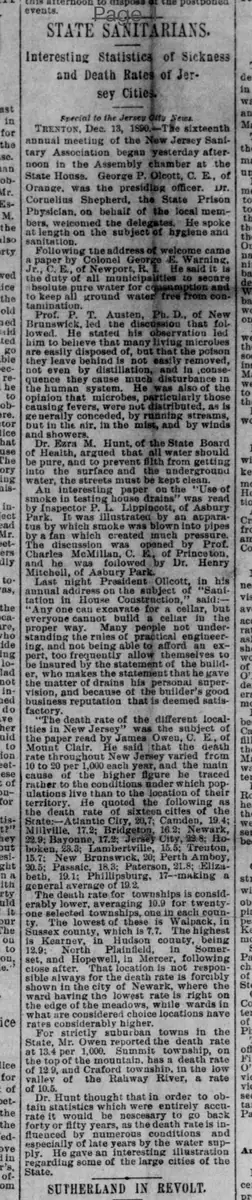
TRENTON, Dec. 13, 1890. The sixteenth annual meeting of the New Jersey Sanitary Association began yesterday afternoon in the Assembly chamber at the State House. George P. Olcott, C. E., of Orange, was the presiding officer. Dr. Cornelius Shepherd, the State Prison Physician, on behalf of the local members, welcomed the delegates. He spoke at length on the subject of hygiene and sanitation.
Following the address of welcome came a paper by Colonel George E. Waring, Jr., C. E., of Newport, R. I. He said it is the duty of all municipalities to secure absolute pure water for consumption and to keep all ground water free from contamination.
Prof. P. T. Austen, Ph. D., of New Brunswick, led the discussion that followed. He stated his observation led him to believe that many living microbes are easily disposed of, but that the poison they leave behind is not easily removed, not even by distillation, and in consequence they cause much disturbance in the human system. He was also of the opinion that microbes, particularly those causing fevers, were not distributed, as is generally conceded, by running streams, but in the air, in the mist, and by winds and showers.
Dr. Ezra M. Hunt, of the State Board of Health, argued that all water should be pure, and to prevent filth from getting into the surface and the underground water, the streets must be kept clean.
An interesting paper on the "Use of smoke in testing house drains" was read by Inspector P. L. Lippincott, of Asbury Park. It was illustrated by an apparatus by which smoke was blown into pipes by a fan which created much pressure.
The discussion was opened by Prof. Charles McMillan, C. E., of Princeton, and he was followed by Dr. Henry Mitchell, of Asbury Park.
Last night President Olcott, in his annual address on the subject of "Sanitation in House Construction," said:-
"Any one can excavate for a cellar, but everyone cannot build a cellar in the proper way. Many people not understanding the rules of practical engineering, and not being able to afford an expert, too frequently allow themselves to be insured by the statement of the builder, who makes the statement that he gave the matter of drains his personal supervision, and because of the builder's good business reputation that is deemed satisfactory."
The death rate of the different localities in New Jersey was the subject of the paper read by James Owen, C. E., of Montclair. He said that the death rate throughout New Jersey varied from 10 to 20 per 1,000 each year, and the main cause of the higher figure he traced rather to the conditions under which populations live than to the location of their territory. He quoted the following as the death rate of sixteen cities of the State:-Atlantic City, 20.7; Camden, 19.4; Millville, 17.2; Bridgeton, 16.2; Newark, 22.9; Bayonne, 17.2; Jersey City, 29.8; Hoboken, 23.8; Lambertville, 15.5; Trenton, 15.7; New Brunswick, 20; Perth Amboy, 20.5; Passaic, 18.3; Paterson, 21.8; Elizabeth, 19.1; Phillipsburg, 17--making a general average of 19.2.
The death rate for townships is considerably lower, averaging 10.9 for twenty-one selected townships, one in each county. The lowest of these is Walpack, in Sussex county, which is 7.7. The highest is Kearney, in Hudson county, being 12.9; North Plainfield, in Somerset, and Hopewell, in Mercer, following close after. That location is not responsible always for the death rate is forcibly shown in the city of Newark, where the ward having the lowest rate is right on the edge of the meadows, while wards in what are considered choice locations have rates considerably higher.
For strictly suburban towns in the State, Mr. Owen reported the death rate at 13.4 per 1,000. Summit township, on the top of the mountain, has a death rate of 12.9, and Cranford township, in the low valley of the Rahway River, a rate of 10.5.
Dr. Hunt thought that in order to obtain statistics which were entirely accurate it would be necessary to go back forty or fifty years, as the death rate is influenced by numerous conditions and especially of late years by the water supply. He gave an interesting illustration regarding some of the large cities of the State.
Interesting Statistics of Sickness and Death Rates of Jersey Cities.
Special to the Jersey City News.
TRENTON, Dec. 13, 1890. The sixteenth annual meeting of the New Jersey Sanitary Association began yesterday afternoon in the Assembly chamber at the State House. George P. Olcott, C. E., of Orange, was the presiding officer. Dr. Cornelius Shepherd, the State Prison Physician, on behalf of the local members, welcomed the delegates. He spoke at length on the subject of hygiene and sanitation.
Following the address of welcome came a paper by Colonel George E. Waring, Jr., C. E., of Newport, R. I. He said it is the duty of all municipalities to secure absolute pure water for consumption and to keep all ground water free from contamination.
Prof. P. T. Austen, Ph. D., of New Brunswick, led the discussion that followed. He stated his observation led him to believe that many living microbes are easily disposed of, but that the poison they leave behind is not easily removed, not even by distillation, and in consequence they cause much disturbance in the human system. He was also of the opinion that microbes, particularly those causing fevers, were not distributed, as is generally conceded, by running streams, but in the air, in the mist, and by winds and showers.
Dr. Ezra M. Hunt, of the State Board of Health, argued that all water should be pure, and to prevent filth from getting into the surface and the underground water, the streets must be kept clean.
An interesting paper on the "Use of smoke in testing house drains" was read by Inspector P. L. Lippincott, of Asbury Park. It was illustrated by an apparatus by which smoke was blown into pipes by a fan which created much pressure.
The discussion was opened by Prof. Charles McMillan, C. E., of Princeton, and he was followed by Dr. Henry Mitchell, of Asbury Park.
Last night President Olcott, in his annual address on the subject of "Sanitation in House Construction," said:-
"Any one can excavate for a cellar, but everyone cannot build a cellar in the proper way. Many people not understanding the rules of practical engineering, and not being able to afford an expert, too frequently allow themselves to be insured by the statement of the builder, who makes the statement that he gave the matter of drains his personal supervision, and because of the builder's good business reputation that is deemed satisfactory."
The death rate of the different localities in New Jersey was the subject of the paper read by James Owen, C. E., of Montclair. He said that the death rate throughout New Jersey varied from 10 to 20 per 1,000 each year, and the main cause of the higher figure he traced rather to the conditions under which populations live than to the location of their territory. He quoted the following as the death rate of sixteen cities of the State:-Atlantic City, 20.7; Camden, 19.4; Millville, 17.2; Bridgeton, 16.2; Newark, 22.9; Bayonne, 17.2; Jersey City, 29.8; Hoboken, 23.8; Lambertville, 15.5; Trenton, 15.7; New Brunswick, 20; Perth Amboy, 20.5; Passaic, 18.3; Paterson, 21.8; Elizabeth, 19.1; Phillipsburg, 17--making a general average of 19.2.
The death rate for townships is considerably lower, averaging 10.9 for twenty-one selected townships, one in each county. The lowest of these is Walpack, in Sussex county, which is 7.7. The highest is Kearney, in Hudson county, being 12.9; North Plainfield, in Somerset, and Hopewell, in Mercer, following close after. That location is not responsible always for the death rate is forcibly shown in the city of Newark, where the ward having the lowest rate is right on the edge of the meadows, while wards in what are considered choice locations have rates considerably higher.
For strictly suburban towns in the State, Mr. Owen reported the death rate at 13.4 per 1,000. Summit township, on the top of the mountain, has a death rate of 12.9, and Cranford township, in the low valley of the Rahway River, a rate of 10.5.
Dr. Hunt thought that in order to obtain statistics which were entirely accurate it would be necessary to go back forty or fifty years, as the death rate is influenced by numerous conditions and especially of late years by the water supply. He gave an interesting illustration regarding some of the large cities of the State.
What sub-type of article is it?
Historical Event
Curiosity
What themes does it cover?
Moral Virtue
What keywords are associated?
Sanitary Association
Death Rates
New Jersey Cities
Hygiene
Sanitation
Microbes
Water Purity
What entities or persons were involved?
George P. Olcott
Dr. Cornelius Shepherd
Colonel George E. Waring Jr.
Prof. P. T. Austen
Dr. Ezra M. Hunt
Inspector P. L. Lippincott
Prof. Charles Mcmillan
Dr. Henry Mitchell
James Owen
Where did it happen?
Trenton, New Jersey
Story Details
Key Persons
George P. Olcott
Dr. Cornelius Shepherd
Colonel George E. Waring Jr.
Prof. P. T. Austen
Dr. Ezra M. Hunt
Inspector P. L. Lippincott
Prof. Charles Mcmillan
Dr. Henry Mitchell
James Owen
Location
Trenton, New Jersey
Event Date
1890 12 13
Story Details
The sixteenth annual meeting of the New Jersey Sanitary Association in Trenton featured discussions on hygiene, pure water supply, microbes in disease transmission, smoke testing for drains, sanitation in house construction, and death rates in New Jersey cities and townships, averaging 19.2 per 1,000 in cities and 10.9 in townships.