Thank you for visiting SNEWPapers!
Sign up free
Story
February 18, 1937
The Bismarck Tribune
Bismarck, Mandan, Burleigh County, Morton County, North Dakota
What is this article about?
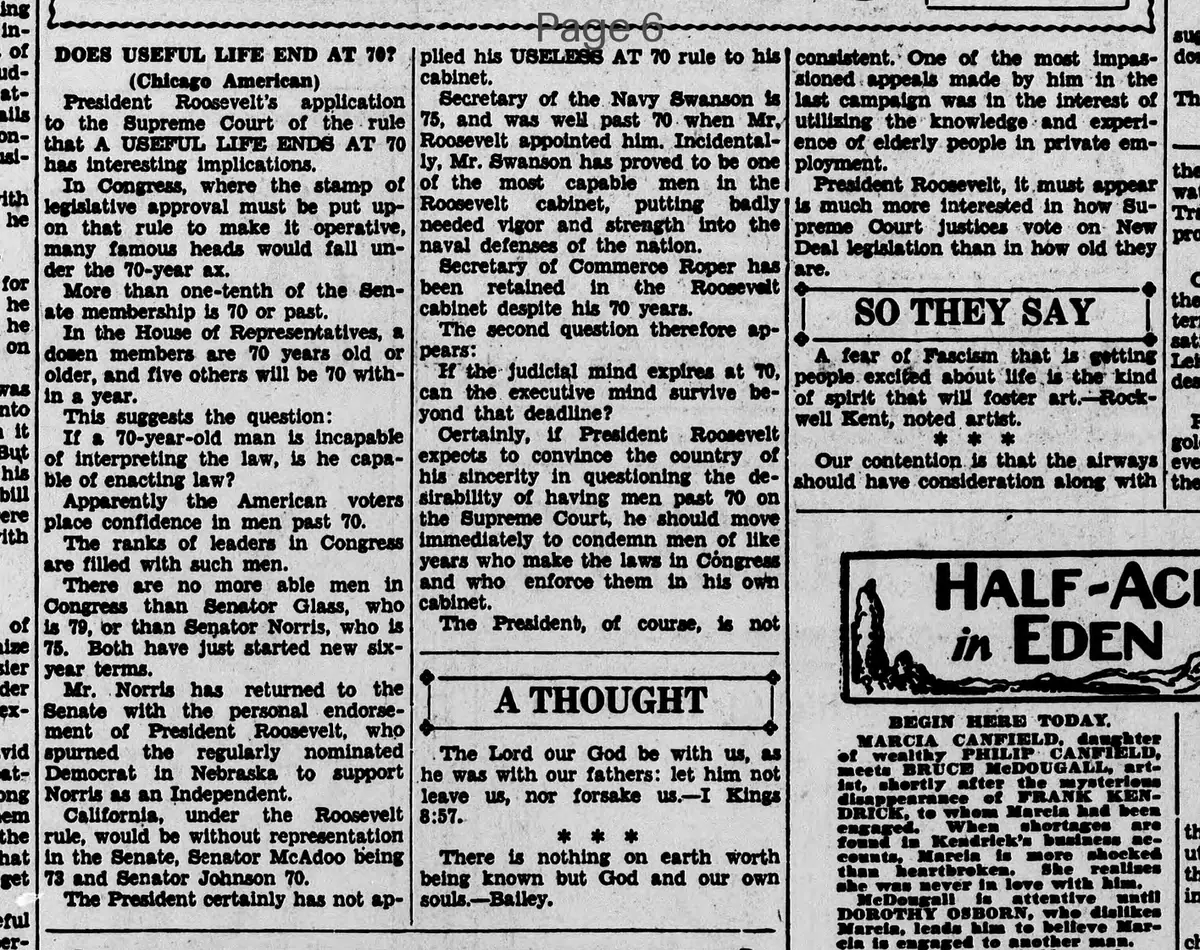
Editorial critiques President Roosevelt's implied age limit of 70 for Supreme Court justices, highlighting inconsistencies as many Senators, Representatives, and Cabinet members exceed that age while remaining effective.
Clipping
OCR Quality
95%
Excellent
Full Text
DOES USEFUL LIFE END AT 70?
(Chicago American)
President Roosevelt's application to the Supreme Court of the rule that A USEFUL LIFE ENDS AT 70 has interesting implications.
In Congress, where the stamp of legislative approval must be put upon that rule to make it operative, many famous heads would fall under the 70-year ax.
More than one-tenth of the Senate membership is 70 or past.
In the House of Representatives, a dozen members are 70 years old or older, and five others will be 70 within a year.
This suggests the question:
If a 70-year-old man is incapable of interpreting the law, is he capable of enacting law?
Apparently the American voters place confidence in men past 70.
The ranks of leaders in Congress are filled with such men.
There are no more able men in Congress than Senator Glass, who is 79, or than Senator Norris, who is 75. Both have just started new six-year terms.
Mr. Norris has returned to the Senate with the personal endorsement of President Roosevelt, who spurned the regularly nominated Democrat in Nebraska to support Norris as an Independent.
California, under the Roosevelt rule, would be without representation in the Senate, Senator McAdoo being 73 and Senator Johnson 70.
The President certainly has not applied his USELESS AT 70 rule to his cabinet.
Secretary of the Navy Swanson is 75, and was well past 70 when Mr. Roosevelt appointed him. Incidentally, Mr. Swanson has proved to be one of the most capable men in the Roosevelt cabinet, putting badly needed vigor and strength into the naval defenses of the nation.
Secretary of Commerce Roper has been retained in the Roosevelt cabinet despite his 70 years.
The second question therefore appears:
If the judicial mind expires at 70, can the executive mind survive beyond that deadline?
Certainly, if President Roosevelt expects to convince the country of his sincerity in questioning the desirability of having men past 70 on the Supreme Court, he should move immediately to condemn men of like years who make the laws in Congress and who enforce them in his own cabinet.
The President, of course, is not consistent. One of the most impassioned appeals made by him in the last campaign was in the interest of utilising the knowledge and experience of elderly people in private employment.
President Roosevelt, it must appear is much more interested in how Supreme Court justices vote on New Deal legislation than in how old they are.
(Chicago American)
President Roosevelt's application to the Supreme Court of the rule that A USEFUL LIFE ENDS AT 70 has interesting implications.
In Congress, where the stamp of legislative approval must be put upon that rule to make it operative, many famous heads would fall under the 70-year ax.
More than one-tenth of the Senate membership is 70 or past.
In the House of Representatives, a dozen members are 70 years old or older, and five others will be 70 within a year.
This suggests the question:
If a 70-year-old man is incapable of interpreting the law, is he capable of enacting law?
Apparently the American voters place confidence in men past 70.
The ranks of leaders in Congress are filled with such men.
There are no more able men in Congress than Senator Glass, who is 79, or than Senator Norris, who is 75. Both have just started new six-year terms.
Mr. Norris has returned to the Senate with the personal endorsement of President Roosevelt, who spurned the regularly nominated Democrat in Nebraska to support Norris as an Independent.
California, under the Roosevelt rule, would be without representation in the Senate, Senator McAdoo being 73 and Senator Johnson 70.
The President certainly has not applied his USELESS AT 70 rule to his cabinet.
Secretary of the Navy Swanson is 75, and was well past 70 when Mr. Roosevelt appointed him. Incidentally, Mr. Swanson has proved to be one of the most capable men in the Roosevelt cabinet, putting badly needed vigor and strength into the naval defenses of the nation.
Secretary of Commerce Roper has been retained in the Roosevelt cabinet despite his 70 years.
The second question therefore appears:
If the judicial mind expires at 70, can the executive mind survive beyond that deadline?
Certainly, if President Roosevelt expects to convince the country of his sincerity in questioning the desirability of having men past 70 on the Supreme Court, he should move immediately to condemn men of like years who make the laws in Congress and who enforce them in his own cabinet.
The President, of course, is not consistent. One of the most impassioned appeals made by him in the last campaign was in the interest of utilising the knowledge and experience of elderly people in private employment.
President Roosevelt, it must appear is much more interested in how Supreme Court justices vote on New Deal legislation than in how old they are.
What sub-type of article is it?
Historical Event
Curiosity
What themes does it cover?
Justice
Social Manners
What keywords are associated?
Age Limit
Supreme Court
Congress
Roosevelt Cabinet
Political Inconsistency
Senior Politicians
What entities or persons were involved?
President Roosevelt
Senator Glass
Senator Norris
Senator Mcadoo
Senator Johnson
Secretary Swanson
Secretary Roper
Where did it happen?
Washington, D.C.
Story Details
Key Persons
President Roosevelt
Senator Glass
Senator Norris
Senator Mcadoo
Senator Johnson
Secretary Swanson
Secretary Roper
Location
Washington, D.C.
Story Details
The article questions the consistency of President Roosevelt's stance on age limits for Supreme Court justices at 70, noting that many elderly members of Congress and his cabinet continue to serve effectively, suggesting the rule is more about political alignment than age.