Thank you for visiting SNEWPapers!
Sign up free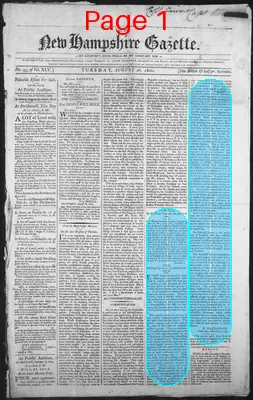
Story
August 26, 1800
The New Hampshire Gazette
Portsmouth, Rockingham County, New Hampshire
What is this article about?
Dr. Benjamin Waterhouse reports successful cow-pox inoculations on his children in Cambridge, describing the disease's transmission from cows to humans and its protective effect against smallpox, based on Dr. Edward Jenner's research in England.
Clipping
OCR Quality
95%
Excellent
Full Text
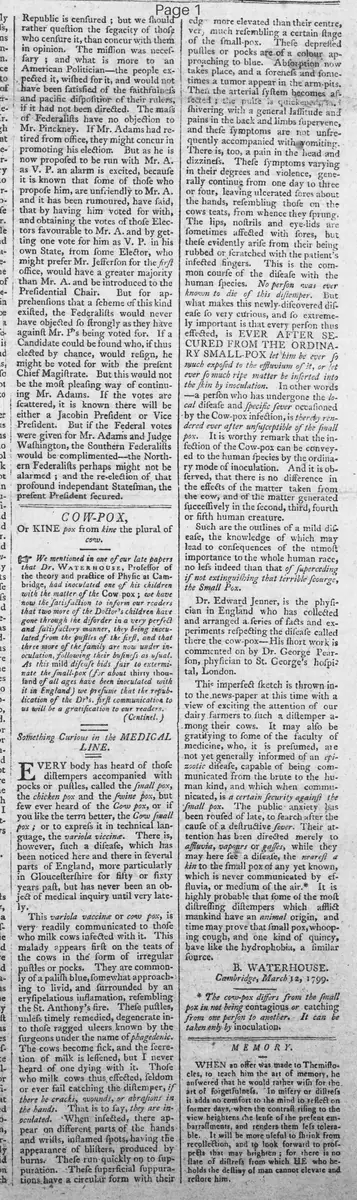
COW-POX,
Or KINE-POX from kine the plural of
cow.
We mentioned in one of our late papers
that Dr. Waterhouse, Professor of
the theory and practice of Physic at Cam-
bridge, had inoculated one of his children
with the matter of the Cow pox ; we have
now the satisfaction to inform our readers
that two more of the Doctor's children have
gone through the disorder in a very perfect
and satisfactory manner, they being inocu-
lated from the pustules of the first, and that
three more of the family are now under in-
oculation, following their business as usual.
As this mild disease bids fair to extermi-
nate the small-pox (for about thirty thou-
sand of all ages have been inoculated with
it in England) we presume that the republication of the Dr's. first communication to
us will be a gratification to our readers.
(Centinel.)
Something Curious in the MEDICAL
LINE.
Everybody has heard of those
ditempers accompanied with
pocks or pustules, called the small pox,
the chicken pox and the swine pox, but
few ever heard of the Cow pox, or if
you like the term better, the Cow small
pox ; or to express it in technical lan-
guage, the variola vaccinae. There is,
however, such a disease, which has
been noticed here and there in several
parts of England, more particularly
in Gloucestershire for fifty or sixty
years past, but has never been an ob-
ject of medical inquiry until very late-
ly.
This variola vaccinae or cow pox, is
very readily communicated to those
who milk cows infected with it. This
malady appears first on the teats of
the cows in the form of irregular
pustules or pocks. They are common-
ly of a pallish blue, somewhat approach-
ing to livid, and surrounded by an
erysipelatous inflammation, resembling
the St. Anthony's fire. These pustules,
unless timely remedied, degenerate in-
to those ragged ulcers known by the
surgeons under the name of phagedenic.
The cows become sick, and the secre-
tion of milk is lessened, but I never
heard of one dying with it. Those
who milk cows thus affected, seldom
or ever fail catching the distemper, if
there be cracks, wounds, or abrasions in
the hands. That is to say, they are in-
oculated. When infected, there ap-
pear on different parts of the hands
and wrists, inflamed spots, having the
appearance of blisters, produced by
burns. These run quickly on to sup-
puration. These superficial suppura-
tions have a circular form with their
edges more elevated than their centre
over, much resembling a certain stage
of the small-pox. These depressed
pustules or pocks are of a colour ap-
proaching to blue. Absorption now
takes place, and a soreness and some-
times a tumor appear in the arm-pits.
Then the arterial system becomes af-
fected ; the pulse is quickened grai
shivering with a general lassitude and
pains in the back and limbs supervene,
and these symptoms are not un fre-
quently accompanied with vomiting.
There is, too, a pain in the head and
dizziness. These symptoms varying
in their degrees and violence, gene-
rally continue from one day to three
or four, leaving ulcerated sores about
the hands, resembling those on the
cows teats, from whence they sprung.
The lips, nostrils and eye-lids are
sometimes affected with sores, but
these evidently arise from their being
rubbed or scratched with the patient's
infected fingers. This is the com-
mon course of the disease with the
human species. No person was ever
known to die of this distemper. But
what makes this newly-discovered di-
sease so very curious, and so extreme-
ly important is that every person thus
affected, is EVER AFTER SE-
CURED FROM THE ORDINA-
RY SMALL-POX let him be ever
much exposed to the effluvium of it, or yet
ever so much ripe matter be inserted into
the skin by inoculation. In other words
—a person who has undergone the lo-
cal disease and specific fever occasioned
by the Cow-pox infection, is thereby ren-
dered ever after unsusceptible of the small
pox. It is worthy remark that the in-
fection of the Cow-pox can be convey-
ed to the human species by the ordina-
ry mode of inoculation. And it is ob-
served, that there is no difference in
the effects of the matter taken from
the cow, and of the matter generated
successively in the second, third, fourth
or fifth human creature.
Such are the outlines of a mild di-
sease, the knowledge of which may
lead to consequences of the utmost
importance to the whole human race,
no less indeed than that of superseding
if not extinguishing that terrible scourge,
the Small Pox.
Dr. Edward Jenner, is the physi-
cian in England who has collected
and arranged a series of facts and ex-
periments respecting the disease called
there the cow-pox—His short work is
commented on by Dr. George Pear-
son, physician to St. George's hospi-
tal, London.
This imperfect sketch is thrown in-
to the news-paper at this time with a
view of exciting the attention of our
dairy farmers to such a distemper a-
mong their cows. It may also be
gratifying to some of the faculty of
medicine, who, it is presumed, are
not yet generally informed of an epi-
zootic disease, capable of being com-
municated from the brute to the hu-
man kind, and which when commu-
nicated, is a certain security against the
small pox. The public anxiety has
been roused of late, to search after the
cause of a destructive fever. Their at-
tention has been directed merely to
effluvia, vapours or gases, while they
may here see a disease, the nearest a
kin to the small pox of any yet known,
which is never communicated by ef-
fluvia, or medium of the air. * It is
highly probable that some of the most
distressing distempers which afflict
mankind have an animal origin, and
time may prove that small pox, whoop-
ing cough, and one kind of quincy,
have like the hydrophobia, a similar
source.
B. WATERHOUSE.
Cambridge, March 12, 1799.
* The cow-pox differs from the small
pox in not being contagious or catching
from one person to another.— It can be
taken only by inoculation
Or KINE-POX from kine the plural of
cow.
We mentioned in one of our late papers
that Dr. Waterhouse, Professor of
the theory and practice of Physic at Cam-
bridge, had inoculated one of his children
with the matter of the Cow pox ; we have
now the satisfaction to inform our readers
that two more of the Doctor's children have
gone through the disorder in a very perfect
and satisfactory manner, they being inocu-
lated from the pustules of the first, and that
three more of the family are now under in-
oculation, following their business as usual.
As this mild disease bids fair to extermi-
nate the small-pox (for about thirty thou-
sand of all ages have been inoculated with
it in England) we presume that the republication of the Dr's. first communication to
us will be a gratification to our readers.
(Centinel.)
Something Curious in the MEDICAL
LINE.
Everybody has heard of those
ditempers accompanied with
pocks or pustules, called the small pox,
the chicken pox and the swine pox, but
few ever heard of the Cow pox, or if
you like the term better, the Cow small
pox ; or to express it in technical lan-
guage, the variola vaccinae. There is,
however, such a disease, which has
been noticed here and there in several
parts of England, more particularly
in Gloucestershire for fifty or sixty
years past, but has never been an ob-
ject of medical inquiry until very late-
ly.
This variola vaccinae or cow pox, is
very readily communicated to those
who milk cows infected with it. This
malady appears first on the teats of
the cows in the form of irregular
pustules or pocks. They are common-
ly of a pallish blue, somewhat approach-
ing to livid, and surrounded by an
erysipelatous inflammation, resembling
the St. Anthony's fire. These pustules,
unless timely remedied, degenerate in-
to those ragged ulcers known by the
surgeons under the name of phagedenic.
The cows become sick, and the secre-
tion of milk is lessened, but I never
heard of one dying with it. Those
who milk cows thus affected, seldom
or ever fail catching the distemper, if
there be cracks, wounds, or abrasions in
the hands. That is to say, they are in-
oculated. When infected, there ap-
pear on different parts of the hands
and wrists, inflamed spots, having the
appearance of blisters, produced by
burns. These run quickly on to sup-
puration. These superficial suppura-
tions have a circular form with their
edges more elevated than their centre
over, much resembling a certain stage
of the small-pox. These depressed
pustules or pocks are of a colour ap-
proaching to blue. Absorption now
takes place, and a soreness and some-
times a tumor appear in the arm-pits.
Then the arterial system becomes af-
fected ; the pulse is quickened grai
shivering with a general lassitude and
pains in the back and limbs supervene,
and these symptoms are not un fre-
quently accompanied with vomiting.
There is, too, a pain in the head and
dizziness. These symptoms varying
in their degrees and violence, gene-
rally continue from one day to three
or four, leaving ulcerated sores about
the hands, resembling those on the
cows teats, from whence they sprung.
The lips, nostrils and eye-lids are
sometimes affected with sores, but
these evidently arise from their being
rubbed or scratched with the patient's
infected fingers. This is the com-
mon course of the disease with the
human species. No person was ever
known to die of this distemper. But
what makes this newly-discovered di-
sease so very curious, and so extreme-
ly important is that every person thus
affected, is EVER AFTER SE-
CURED FROM THE ORDINA-
RY SMALL-POX let him be ever
much exposed to the effluvium of it, or yet
ever so much ripe matter be inserted into
the skin by inoculation. In other words
—a person who has undergone the lo-
cal disease and specific fever occasioned
by the Cow-pox infection, is thereby ren-
dered ever after unsusceptible of the small
pox. It is worthy remark that the in-
fection of the Cow-pox can be convey-
ed to the human species by the ordina-
ry mode of inoculation. And it is ob-
served, that there is no difference in
the effects of the matter taken from
the cow, and of the matter generated
successively in the second, third, fourth
or fifth human creature.
Such are the outlines of a mild di-
sease, the knowledge of which may
lead to consequences of the utmost
importance to the whole human race,
no less indeed than that of superseding
if not extinguishing that terrible scourge,
the Small Pox.
Dr. Edward Jenner, is the physi-
cian in England who has collected
and arranged a series of facts and ex-
periments respecting the disease called
there the cow-pox—His short work is
commented on by Dr. George Pear-
son, physician to St. George's hospi-
tal, London.
This imperfect sketch is thrown in-
to the news-paper at this time with a
view of exciting the attention of our
dairy farmers to such a distemper a-
mong their cows. It may also be
gratifying to some of the faculty of
medicine, who, it is presumed, are
not yet generally informed of an epi-
zootic disease, capable of being com-
municated from the brute to the hu-
man kind, and which when commu-
nicated, is a certain security against the
small pox. The public anxiety has
been roused of late, to search after the
cause of a destructive fever. Their at-
tention has been directed merely to
effluvia, vapours or gases, while they
may here see a disease, the nearest a
kin to the small pox of any yet known,
which is never communicated by ef-
fluvia, or medium of the air. * It is
highly probable that some of the most
distressing distempers which afflict
mankind have an animal origin, and
time may prove that small pox, whoop-
ing cough, and one kind of quincy,
have like the hydrophobia, a similar
source.
B. WATERHOUSE.
Cambridge, March 12, 1799.
* The cow-pox differs from the small
pox in not being contagious or catching
from one person to another.— It can be
taken only by inoculation
What sub-type of article is it?
Medical Curiosity
Extraordinary Event
Historical Event
What themes does it cover?
Recovery
Triumph
Moral Virtue
What keywords are associated?
Cowpox
Inoculation
Smallpox Prevention
Vaccination
Jenner
Waterhouse
Medical Discovery
What entities or persons were involved?
Dr. Waterhouse
Dr. Edward Jenner
Dr. George Pearson
Where did it happen?
Cambridge; Gloucestershire, England
Story Details
Key Persons
Dr. Waterhouse
Dr. Edward Jenner
Dr. George Pearson
Location
Cambridge; Gloucestershire, England
Event Date
March 12, 1799
Story Details
Dr. Waterhouse inoculates his children with cow-pox, a mild disease from infected cows that protects against smallpox. Detailed description of symptoms in cows and humans, its non-contagious nature, and propagation through inoculation. Credits Jenner's research; about 30,000 inoculated in England.