Thank you for visiting SNEWPapers!
Sign up free
Alexandria Gazette
Alexandria, Alexandria County, District Of Columbia
What is this article about?
Investigation into the 1825 murder of Miss Cunningham near Port Deposit, Maryland, focusing on suspect George Stebbing, arrested for possessing her ring. Details include his alibi, witness accounts of a suspicious man, and testimony about the ring and a handkerchief linked to the victim.
Clipping
OCR Quality
Full Text
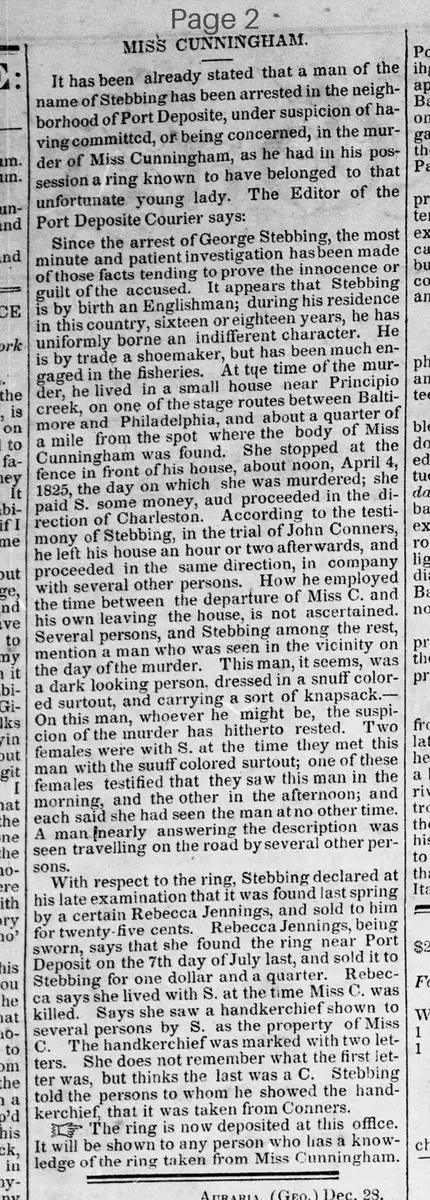
It has been already stated that a man of the name of Stebbing has been arrested in the neighborhood of Port Deposite, under suspicion of having committed, or being concerned, in the murder of Miss Cunningham, as he had in his possession a ring known to have belonged to that unfortunate young lady. The Editor of the Port Deposite Courier says:
Since the arrest of George Stebbing, the most minute and patient investigation has been made of those facts tending to prove the innocence or guilt of the accused. It appears that Stebbing is by birth an Englishman; during his residence in this country, sixteen or eighteen years, he has uniformly borne an indifferent character. He is by trade a shoemaker, but has been much engaged in the fisheries. At the time of the murder, he lived in a small house near Principio creek, on one of the stage routes between Baltimore and Philadelphia, and about a quarter of a mile from the spot where the body of Miss Cunningham was found. She stopped at the fence in front of his house, about noon, April 4, 1825, the day on which she was murdered; paid S. some money, and proceeded in the direction of Charleston. According to the testimony of Stebbing, in the trial of John Conners, he left his house an hour or two afterwards, and proceeded in the same direction, in company with several other persons. How he employed the time between the departure of Miss C. and his own leaving the house, is not ascertained. Several persons, and Stebbing among the rest, mention a man who was seen in the vicinity on the day of the murder. This man, it seems, was a dark looking person, dressed in a snuff colored surtout, and carrying a sort of knapsack. On this man, whoever he might be, the suspicion of the murder has hitherto rested. Two females testified that they saw this man in the morning, and the other in the afternoon; and each said she had seen the man at no other time. One of these females were with S. at the time they met this man with the snuff colored surtout. A man nearly answering the description was seen travelling on the road by several other persons.
With respect to the ring, Stebbing declared at his late examination that it was found last spring by a certain Rebecca Jennings, and sold to him for twenty-five cents. Rebecca Jennings, being sworn, says that she found the ring near Port Deposit on the 7th day of July last, and sold it to Stebbing for one dollar and a quarter. Rebecca ca says she lived with S. at the time Miss C. was killed. Says she saw a handkerchief shown to several persons by S. as the property of Miss C. The handkerchief was marked with two letters. She does not remember what the first letter was, but thinks the last was a C. Stebbing told the persons to whom he showed the handkerchief, that it was taken from Conners.
The ring is now deposited at this office. It will be shown to any person who has a knowledge of the ring taken from Miss Cunningham.
What sub-type of article is it?
What themes does it cover?
What keywords are associated?
What entities or persons were involved?
Where did it happen?
Story Details
Key Persons
Location
Neighborhood Of Port Deposite, Near Principio Creek, Stage Route Between Baltimore And Philadelphia
Event Date
April 4, 1825
Story Details
George Stebbing arrested for possessing Miss Cunningham's ring after her murder on April 4, 1825, near his home. Investigation reveals his indifferent character, alibi with others, sightings of a suspicious dark man in snuff-colored coat, and Rebecca Jennings' testimony on finding and selling the ring to him; he also showed her handkerchief marked with a C, claiming it from Conners.