Thank you for visiting SNEWPapers!
Sign up free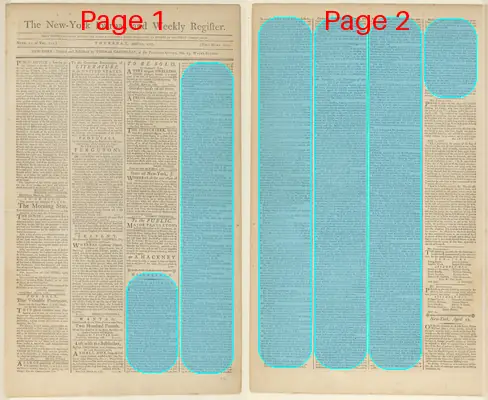
The New York Journal, And Weekly Register
New York, New York County, New York
What is this article about?
Detailed proceedings of the New York House of Assembly from March 21-28, 1787, covering passage of bills on debts, taxes, estates, militia, university establishment, and debates on trespass act repeal and Vermont independence.
Merged-components note: Continuation of House of Assembly proceedings across page break, forming a single coherent article on legislative debates.
Clippings
1 of 2
OCR Quality
Full Text
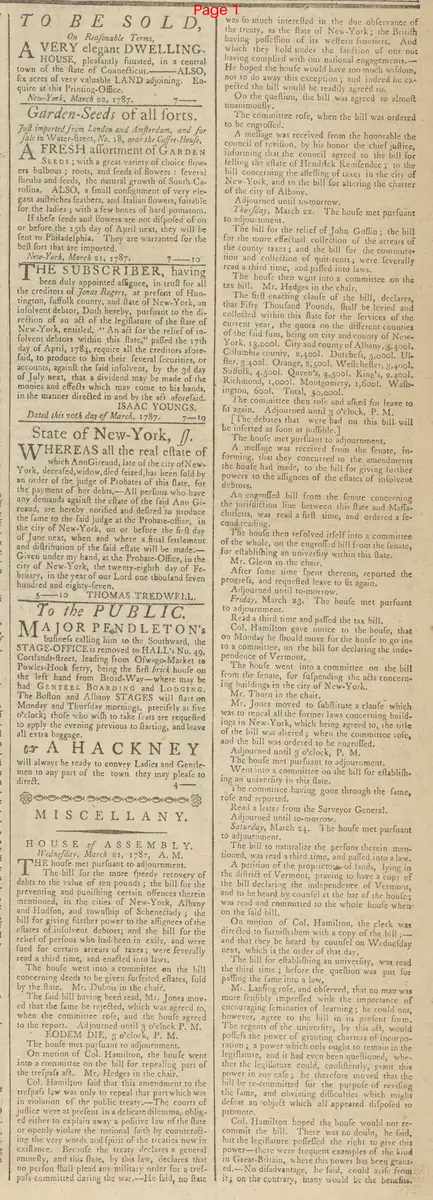
HOUSE Of ASSEMBLY.
Wednesday, March 21, 1787, A. M.
The house met pursuant to adjournment.
The bill for the more speedy recovery of debts to the value of ten pounds; the bill for the preventing and punishing certain offences therein mentioned, in the cities of New-York, Albany and Hudson, and township of Schenectady; the bill for giving further power to the assignees of the estates of insolvent debtors; and the bill for the relief of persons who had been in exile, and were sued for certain arrears of taxes; were severally read a third time, and enacted into laws.
The house went into a committee on the bill concerning deeds to be given forfeited estates, sold by the state. Mr. Dubois in the chair.
The said bill having been read, Mr. Jones moved that the same be rejected, which was agreed to.
when the committee rose, and the house agreed to the report. Adjourned until 3 o'clock P. M.
EODEM DIE, 3 o'clock, P. M.
The house met pursuant to adjournment.
On motion of Col. Hamilton, the house went into a committee on the bill for repealing part of the trespass act. Mr. Hedges in the chair.
Col. Hamilton said that this amendment to the trespass law was only to repeal that part which was in violation of the public treaty.-The courts of justice were at present in a delicate dilemma, obliged either to explain away a positive law of the state or openly violate the national faith by counteracting the very words and spirit of the treaties now in existence. Because the treaty declares a general amnesty, and this state, by this law, declares that no person shall plead any military order for a trespass committed during the war.-He said, no state was so much interested in the due observance of the treaty. as the state of New-York: the British having possession of its western frontiers. And which they hold under the sanction of our not having complied with our national engagements.-
He hoped the house would have too much wisdom, not to do away this exception: and indeed he expected the bill would be readily agreed to.
On the question, the bill was agreed to almost unanimously.
The committee rose, when the bill was ordered to be engrossed.
A message was received from the honorable the council of revision, by his honor the chief justice, informing that the council agreed to the bill for selling the estate of Hendrick Rensselaer: to the bill concerning the assessing of taxes in the city of New York, and to the bill for altering the charter of the city of Albany.
Adjourned until to-morrow.
Thursday, March 22. The house met pursuant to adjournment.
The bill for the relief of John Goslin; the bill for the more effectual collection of the arrears of the county taxes; and the bill for the commutation and collection of quit-rents; were severally read a third time, and passed into laws.
The house then went into a committee on the tax bill. Mr. Hedges in the chair.
The first enacting clause of the bill, declares, that Fifty Thousand Pounds, shall be levied and collected within this state for the services of the current year, the quota on the different counties of the said sum. being on city and county of New-York, 13,000l. City and county of Albany, 5,400l. Columbia county, 2,400l. Dutchess, 5,000l. Ulster, 3,400l. Orange, 2,500l. Westchester, 3,400l. Suffolk, 4,500l. Queen's, 4,500l. King's, 2,400l. Richmond, 1,000l. Montgomery, 1,600l. Washington, 600l. Total, 50,000l.
The committee then rose and asked for leave to sit again. Adjourned until 3 o'clock, P. M.
The debates that were had on this bill will be inserted as soon as possible.]
The house met pursuant to adjournment.
A message was received from the senate, informing, that they concurred to the amendments the house had made, to the bill for giving further powers to the assignees of the estates of insolvent debtors.
An engrossed bill from the senate concerning the jurisdiction line between this state and Massachusetts, was read a first time, and ordered a second reading.
The house then resolved itself into a committee of the whole, on the engrossed bill from the senate, for establishing an university within this state.
Mr. Glenn in the chair.
After some time spent thereon, reported the progress, and requested leave to sit again.
Adjourned until to-morrow.
Friday, March 23. The house met pursuant to adjournment.
Read a third time and passed the tax bill.
Col. Hamilton gave notice to the house, that on Monday he should move for the house to go into a committee, on the bill for declaring the independence of Vermont.
The house went into a committee on the bill from the senate. for suspending the acts concerning buildings in the city of New. York.
Mr. Thorn in the chair.
Mr. Jones moved to substitute a clause which was to repeal all the former laws concerning buildings in New-York, which being agreed to, the title of the bill was altered : when the committee rose, and the bill was ordered to be engrossed.
Adjourned until 3 o'clock, P. M.
The house met pursuant to adjournment,
Went into a committee on the bill for establishing an university in this state.
The committee having gone through the same,
rose and reported.
Read a letter from the Surveyor General.
Adjourned until to-morrow.
Saturday, March 24. The house met pursuant to adjournment.
The bill to naturalize the persons therein mentioned, was read a third time, and passed into a law.
A petition of the proprietors of lands, lying in the district of Vermont, praying to have a copy of the bill declaring the independence of Vermont, and to be heard by counsel at the bar of the house;
was read and committed to the whole house when on the said bill.
On motion of Col. Hamilton, the clerk was directed to furnish them with a copy of the bill;-
and that they be heard by counsel on Wednesday next, which is the order of that day.
The bill for establishing an university, was read the third time ; before the question was put for passing the same into a law.
Mr. Lansing rose, and observed, that no man was more sensibly impressed with the importance of encouraging seminaries of learning; he could not, however, agree to the bill in its present form.
The regents of the university, by this act, would possess the power of granting charters of incorporation; a power which only ought to remain in the legislature, and it had even been questioned, whether the legislature could, consistently, grant this power in any case; he therefore moved that the bill be re-committed for the purpose of revising the same, and obviating difficulties which might defeat an object which all appeared disposed to promote.
Col. Hamilton hoped the house would not re-commit the bill. There was no doubt, he said, but the legislature possessed the right to give this power-there were frequent examples of the kind in Great-Britain, where this power has been granted.-No disadvantage. he said. could arise from it; on the contrary, many would be the benefits.
He therefore wished the bill might be finished—as no doubts existed with him, of the power—and the propriety of the legislature granting those privileges which were mentioned in the bill.
Mr. Laning confessed, that he was not prepared to go into a discussion of the merits of this question, as it had only occurred to him on the last reading of the bill, this was not attributable to inattention, but to his unavoidable absence in the former stages of the bill.—It was certain, however, that this bill gave such extraordinary powers as he could not consent to delegate, and such as the gentleman (Mr. Hamilton) could not give instances of being exercised in this state, or the British government.
In England charters had been granted to corporations with power to create subordinate companies; but these were limited in their objects and circumscribed to particular posts.—In the present instance we give a power which pervades the whole state, whereby charters of incorporation may be created throughout the same.—If at any time charters are necessary, and application be made to the legislature, they will always grant the same if they should think it necessary. He had another objection to the bill, as it stood the regents of the university would be possessed of all the public lands which had been reserved for public schools in the unsettled parts of the state: and the state cannot thereafter take it from them without an infringement of the charter. He had not, said, the remotest idea of rejecting the bill, he only wished it to be committed to remove those objections he had spoken of.
The house agreed to recommit the bill.
Several petitions and memorials were here read. Among which was, a petition from a number of inhabitants of Cambray, concerning the commutation of quit-rents, was read, and on motion not committed, as the law lately passed would relieve them.
The bill for selling the estate of Richard Maitland, deceased, was read a third time, and passed into a law.
Mr. C. Livingston, from the committee to whom was referred the petition of Charles McEvers, and others his creditors, reported, that the prayer of the petition ought to be granted and a bill brought in for that purpose.
On the suggestion that the house were not sufficiently informed to proceed on this business, the committee took back the report.
Mr. Havens, from the committee to whom was referred the petition of a number of inhabitants of the north western part of the state, praying to be erected into a new county, reported, that the consideration of the same should be postponed to some future meeting of the legislature. Agreed to.
Mr. Dongan, from the committee to whom was referred the petition of Concklin, and others, respecting a paper manufactory, reported, that the same ought to be taken into consideration when on the import bill. Agreed to.
Mr. Havens, from the committee to whom was referred the petition of John Murray, jun. respecting money due the state from Lindley Murray, reported, that the prayer of the petition ought not to be granted.
Mr. Schenck, from the committee to whom was referred the petition of G. Van Waggener, and Thomas Durie, reported, that in the opinion of the committee, the prayer of the petition ought not to be granted, unless properly recommended by the United States in Congress assembled:
Which report was agreed to.
Adjourned until Monday morning.
Monday, March 26. The house met pursuant to adjournment.
On motion of Mr. Laning, the house went into a committee on the militia law.
Mr. Sickles in the chair.
This bill was amended so as to take away the allowance heretofore provided for paying the militia when on duty for four days, at one time.
That all the fines which shall arise from delinquency, shall be applied for the benefit of the regiment in which they may be incurred, and collected, subject to the disposal of the field officers of said regiment.
That in the city of New-York, the field-officers of a regiment, may appoint grenade companies in the same, and officer the same from the officers of said regiment, on the application of forty of the men; provided that none belong to the infantry.
And, that excepting the city of New-York and the city of Albany, the council of appointment shall appoint such officers to command companies, that reside within the district of the said company.
The petition from the Quakers, which stood referred to this committee, was called for and read.
Mr. Harper did not know what was meant by this petition;—who is it from? A set of people who call themselves Christians, do we not also call ourselves Christians. They talk of not fighting,—this is against their consciences;—but who is to protect them in their privileges. Some of us must, and they certainly ought to bear their proportion of the expense.
Mr. Paine was of the same opinion.
On the question, it was determined, that the prayer thereof should not be granted.
The committee then rose and reported the bill.
The bill was ordered to be engrossed, and the title amended.
A message was delivered from the council of revision, with a resolution of concurrence to the bill, authorizing the mayor, recorder, and aldermen of New-York, to raise money by tax.
And the bill giving further powers to the assignees of the estates of insolvent debtors.
Went into a committee of the whole, on the bill concerning judgment bonds, given for confiscated estates, &c. Mr. Glenn in the chair.
The bill having been gone through, and a clause added, for the relief of Hannah Fisher,
Mr. Malcolm made a motion to annex to the said bill, a clause for the relief of Miles Sherbrook.
On this question some objections were made, and the same arguments offered, as when the report of the committee was agreed to, excepting that some gentlemen thought it an improper bill to add the clause to, in particular Mr. Taylor, who said, he would vote against the clause being added to this bill, although he was willing to give Mr. Sherbrook, relief, and thought it ought to be extended to him.
A division being called on the question.
For the Affirmative, 30, and Negative, 22.
The committee rose and reported the bill.
On motion, Messieurs Laning, Denning, and Taylor, were appointed a committee to examine the accounts between this state and the United States, and to report the same to the house.
Adjourned until to-morrow.
Tuesday, March 27. The house met pursuant to adjournment.
The bill for dividing the lands, called the Oneida Purchase, was read the third time, and passed into a law.
The remainder of this day's proceedings will be noticed in their order of completion.
Wednesday, March 28. The house met pursuant to adjournment; when the bill for dividing the lands, called the Oneida Purchase, and the bill supplementary to the act for regulating the militia, were severally read a third time, and passed into laws.
The order of the day was then called for, when on motion of Col. Hamilton, Mr. Harrison, the counsel for the petitioners against the bill for declaring the Independence of Vermont, was admitted within the bar of the house, and addressed the chair as follows:
Mr. Speaker, and Gentlemen of the HOUSE of ASSEMBLY.
I HAVE the honor to appear before you this day in my professional capacity, as counsel for the petitioners against the bill now depending before this honorable house, authorizing the delegates of this state in Congress to accede and confirm the independence of that district of country commonly called Vermont.
Upon this occasion, I am an advocate for a numerous and respectable body of citizens, who from that character, and the relation in which they stand to the community at large, have the fairest and most unquestionable right to the protection of the state.
The social compact, to which all the members of society are parties, and by which all of them are bound, was first formed to preserve the rights and properties of each, by the united strength of the whole; and this sacred compact must suffer the grossest violation, whenever the rights and properties even of the meanest individual are sacrificed without the most pressing and apparent necessity.
My clients, sir, consider the present bill as fatally calculated to deprive them, without necessity, of all those advantages which they ought to derive from the character of citizens, with respect to their property in the north eastern part of the state.
They trust therefore that the wisdom and justice of the legislature, will be exerted in its rejection; and though they have thought it necessary to bring their objections to the bill before this honorable house, in the manner that is now adopted, yet it must be apparent, that they have depended so much upon the discernment of their judges, and the goodness of their cause, as to be little anxious with regard to the abilities of their counsel.
I hope, sir, however, you and this honorable house, will be convinced that diffident as I am of my abilities, I should not have presumed to come before you, if I was not fully in sentiment upon this occasion, that the interest of my clients and the public are the same.—I flatter myself, sir, that my sincerity will not be questioned, when I assure you that it is my most ardent wish (not to prevent, but) to promote every measure tending to the permanent happiness of a country in which I received my existence; to which I have been repeatedly indebted for great indulgencies, and in which all my future expectations are centered.
I proceed now to state those reasons which in the opinion of the petitioners ought to prevent the bill in question from being passed into a law.—
They consider it as unconstitutional, impolitic and destructive to the property of themselves and many of their citizens. With respect to the two first grounds of objection, in all probability they would have been left entirely to the consideration of the legislature, if the petitioners had not found that their private interests were materially affected; but they trust there can be no impropriety in endeavouring to shew that a measure so injurious to them is at the same time inconsistent with the constitution, and repugnant to the maxims of sound policy.
The constitution, sir, of this state, has expressly declared the counties of Cumberland, Gloucester, and Charlotte, compose the eastern district; and has directed that they shall be represented in our senate and assembly. As they are constituent and essential members of the body politic, particularly recognized by the terms of our constitution, it is surely a question of importance whether the powers delegated by the people to their representatives, are such as will authorize them to mutilate the body by severing from it, limbs that are of such fair proportion and undoubted strength.—If the legislature can, without the consent of their constituents, separate for ever the bulk of the eastern district from the remainder of the state, by the same rule they may declare the southern district independent of the others, or reduce the state into as many distinct governments as there are counties within it—and thus this commonwealth, the citizens of which are bound together in political union, would like the hydra spring up into many monsters, all of whom would cherish different interests, and perhaps be armed for mutual destruction.
It is a maxim, sir, in our constitution, that no authority can be exercised over the people of this state, but such as shall be derived from and granted by them; and this maxim, as it is the vital principle which pervades the whole frame, so it must ever be adhered to whilst any regard for our constitution shall subsist.—The legislature, sir, are authorized by the constitution to frame laws for the good government of the people, but as to any power of dismembering the state there is a total silence; and therefore it must be concluded, that the people have reserved this power to themselves, or that if it is delegated at all, it must be delegated to the Congress of the United States, to be only made use of when the events of war, and the necessities of the union shall render it absolutely necessary.
It is an awful thing, sir, to exclude a great number of citizens (many of whom may be anxious to live under the constitution) from the protection of the state; and that too for ever. When I said that many of them might be anxious to live under our constitution, I have said too little. It is a fact true beyond the possibility of contradiction, that a great proportion of the inhabitants in that district are sincerely attached to our government, and wish ardently for its protection. Under these circumstances, sir, if the legislature have even a doubt respecting the propriety of the measure, or its being constitutional, I am persuaded that they will avoid it.
Even in those cases, where full and absolute power is indisputably vested in the rulers, either by the terms of the constitution, or by implication—yet I say, even in those cases, it has been the opinion of the best informed writers, that a nation cannot lawfully cut off any of its members from the body, unless in a case of extreme necessity, if the public service requires it. Such are the ideas of the great Vattel, in his first book chap. 2d. The same masterly writer declares in the second chapter of the same book, that
"If a nation is obliged to preserve itself, it is not less obliged carefully to preserve all its members! The nation (says he) owes this to itself since the loss of even one of its members weakens it and is injurious to its own preservation. It owes this also to the members in particular, in consequence of the very act of association."
This honorable house, sir, if they are satisfied with respect to their constitutional powers, will undoubtedly consider whether such a case of extreme necessity exists at the present moment—if it exists, the petitioners are totally ignorant of it, and they contemplate the measure as big with political consequences of the most dangerous and destructive nature.
It has been alleged indeed as an argument for the present bill, that the inhabitants of Vermont (having assumed actual independence) are forming improper connections with British in Canada, which at some future period may be destructive to America. But how, sir, does this connection appear? What evidence can be found of it? Where has it ever existed, except in the lively imaginations of persons out of doors, who for particular purposes have wished to avail themselves of popular prejudices and excite popular alarms? I am persuaded that the report must have originated in this manner, and after it was once raised, I presume that it will be no reflection even upon discerning and distinguished patriots to suppose that their zeal for the honor and interests of their country may have disposed them to treat it with too much attention.
Can it be supposed, Sir, that Great Britain, at the eve of an expensive and unsuccessful war, after she has fully recognized the district of Vermont as lying within the bounds of the United States, should now have an idea that any important purpose may be answered with respect to the confederacy by forming an indirect connection with what is comparatively a small and insignificant corner of a single state?
Can it be supposed that the British government is so weak, so irrational, as to endanger the tranquility and safety of their remaining colonies for the sake of cultivating an intercourse with people from whom they can derive no consequential advantages, and whom they could not possibly support against the power of the union, without renewing all the horrors of war and incurring the most enormous and destructive expense.
I cannot, therefore, but treat the supposed connection between Vermont and the British government as a phantom originally raised for the sake of political prejudices, but which when carefully examined, will prove to be a mere phantom only.
If such a connection, however, actually subsists, it is the duty of good citizens to produce the evidence. The proof of such a connection would probably unite the sentiments of all the American states with respect to Vermont.—It could no longer then be a doubt, but she must be reduced to a sense of duty; and on the other hand, as the conduct of Great Britain would be highly reprehensible, it would become the business of our rulers to remonstrate and demand satisfaction upon it.
But, sir, if such a connection actually subsists between Canada and Vermont, can this honorable house be assured that the present bill will dissolve it? May we not rather suppose that their inland situation and proximity to the lakes may prompt them, for the sake of commerce, to form still closer connections with a foreign power, and will they not possess opportunities of doing mischief, much greater than they have at present, when in consequence of this bill they are admitted into the public councils, and become acquainted with all the secrets of the union?
It would be well for gentlemen to consider calmly and dispassionately what are the natural consequences of the measure, now in agitation.—If two or three counties of the state, upon an idea that they have separate interests from the rest of the community, may not only declare themselves independent, but by tampering with a foreign power may terrify the state into a recognition of their independence, who can pretend to ascertain the number of independent states that may start into existence in the remoter parts of our territory, or who can determine what they may be encouraged to attempt by so pernicious an example?
Already, sir, has that example operated in more than one instance, and it will undoubtedly operate again in proportion to the success with which Vermont may be crowned.—It appears to me therefore, that the safest and wisest course is to destroy the evil in its bud, to resist the disease in its first attacks before it has made any considerable progress, or the contagion has extended itself to the nobler parts of the political body.
I believe, sir, that experience will evince, both in public and private life, that a firm, generous and manly plan of conduct is the result of sound policy and will eventually be most successful. It was this firmness, this manly spirit that raised the Roman empire to the highest glory, and if we wish our country to be proportionably great and flourishing, we should ask ourselves what would have been the conduct of that people upon similar occasions?
Let their conduct during that dangerous war which they sustained with their Italian allies whom they refused to admit as citizens of Rome till they submitted at discretion, let their conduct with regard to Pyrrhus whom they refused to treat with as a friend till he had drawn his forces out of Italy, let their magnanimity upon a thousand other occasions speak what they would have done, if any inconsiderable part of their citizens had presumed to declare themselves a separate and independent state.
But it has been said, that Vermont in its present situation contributes nothing to the expenses of the union, at the same time, that the inhabitants of that country are continually increasing; as the lowness of taxes induces the people of the neighbouring states to emigrate thither.
The former part of this assertion we know to be true, and the latter we have reason to consider as a fact.
Mankind in general are disposed to place themselves in situations, where subsistence is most easily attained, and the demands of government are comparatively lightest.
The emigration to Vermont is a consequence also of the abundant population in the eastern states, and it must continue as long as the balance of population is against Vermont, and land is to be procured there upon moderate terms.
But, sir, although it must be admitted that the inhabitants of Vermont ought to pay their proportion of the public burdens, yet such is their remote and inland situation, and such the dearth of money among them, arising from that circumstance, and the want of external commerce, that this consideration alone is not of sufficient importance to make their admission into the union, be considered as an object.
Besides, sir, is it probable that the inhabitants of that district would render less advantage to the union if they were rated as a part of this state, than they would if they were considered as a separate and independent government? would they not on the contrary, be in a condition to defray a greater proportion of the public burdens, if they were eased of those particular expenses which must attend their internal government?
But even if the case was otherwise, it would undoubtedly be improper to sacrifice the honor and dignity of the state to such small and uncertain advantages.
(Concluded in our next.)
What sub-type of article is it?
What keywords are associated?
What entities or persons were involved?
Where did it happen?
Domestic News Details
Primary Location
New York
Event Date
March 21 28, 1787
Key Persons
Event Details
The New York House of Assembly convened over several days, passing bills on debt recovery, offenses in cities, insolvent debtors, tax relief for exiles, quit-rents, county taxes, naturalization, Oneida Purchase division, and militia regulation. Debates included repealing part of the trespass act to align with treaties, establishing a state university with regents' powers contested, and hearing counsel against Vermont independence bill, arguing unconstitutionality and policy risks.