Thank you for visiting SNEWPapers!
Sign up free
Editorial
September 18, 1846
New Hampshire Statesman And State Journal
Concord, Merrimack County, New Hampshire
What is this article about?
Editorial from Hartford Courant argues that the 1842 Whig tariff increased wages across industries like cotton, carpet, glass, and coal mining, reviving economy and employment in New England and beyond, citing data from 1841-1846.
Merged-components note: Tables provide supporting wage data embedded within the editorial article on 'The Wages of Labor' from the Hartford Courant; merging into single coherent editorial component.
Clipping
OCR Quality
75%
Good
Full Text
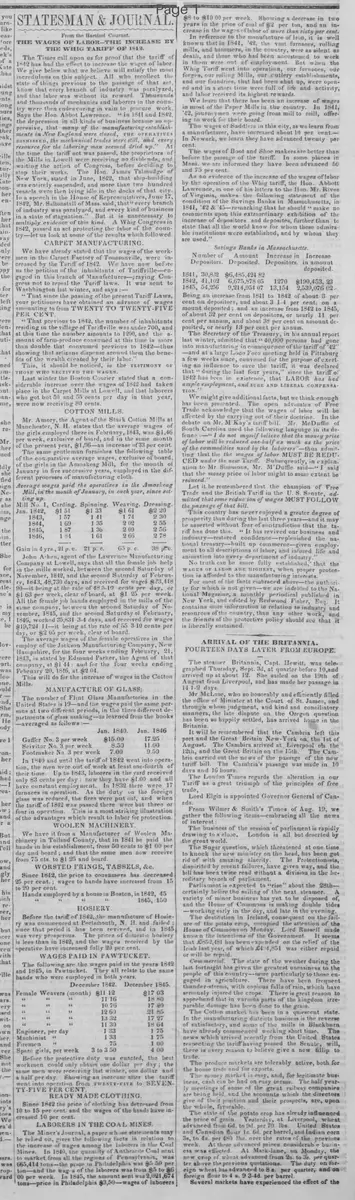
| Mill No. 1, | Carding. | Spinning. | Weaving. | Dressing. |
| Jan. 1842, | $1 51 | $1 33 | $1 61 | $2 20 |
| 1843, | 1 57 | 1 41 | 1 74 | 2 30 |
| 1844, | 1 69 | 1 35 | 2 02 | 2 55 |
| 1845, | 1 87 | 1 36 | 2 09 | 2 56 |
| 1846, | 1 84 | 1 61 | 2 66 | 2 78 |
STATESMAN & JOURNAL
From the Hartford Courant.
THE WAGES OF LABOR—THE INCREASE BY
THE WHIG TARIFF OF 1842.
The Times call upon us for proof that the tariff of
1842 has had the effect to increase the wages of labor.
We give below what we believe will satisfy the most
incredulous on this subject. All who recollect the
state of things previous to the passage of that act.
know that every branch of industry was paralyzed,
and that labor was without its reward. Thousands
and thousands of mechanics and laborers in the coun-
try were then endeavoring in vain to procure work.
Says the Hon. Abbot Lawrence. "In 1841 and 1842.
the depression in all kinds of business became so op-
pressive, that many of the manufacturing establish-
ments in New England were closed. The operatives
were dismissed, the mechanical trades were still, 'and every
resource for the laboring man seemed dried up." At
the time the tariff act was passed. the proprietors of
the Mills in Lowell were receiving no dividends, and
waiting the action of Congress, before deciding to
stop their works. The Hon. James Talmadge of
New York, stated in June, 1842, that ship-building
was entirely suspended, and more than two hundred
vessels were then lying idle in the docks of that city.
In a speech in the House of Representatives, June 17,
1842, Mr. Saltonstall of Mass. said, that "every branch
of industry was paralyzed, and every kind of business
in a state of stagnation." But it is unnecessary to
multiply evidence of this kind. A Whig Congress in
1842, passed an act protecting the labor of the coun-
try—let us look at some of the results which followed.
CARPET MANUFACTURING.
We have already stated that the wages of the work-
men in the Carpet Factory of Thompsonville, were in-
creased by the Tariff of 1842. We have now before
us the petition of the inhabitants of Tariffville—en-
gaged in this branch of Manufactures—praying Con-
gress not to repeal the Tariff laws. It was sent to
Washington last winter, and says:-
"That since the passing of the present Tariff Laws,
your petitioners have obtained an advance of wages
amounting to from TWENTY TO TWENTY-FIVE
PER CENT.
"That previous to 1842, the number of inhabitants
residing in the village of Tariffville was under 700, and
at this time the number amounts to 1200, and the a-
ount of farm-produce consumed at this time is more
than double that consumed previous to 1842—thus
showing that artizans dispense around them the bene-
fits of the wealth created by their labor.'
This, it should be noticed, is the testimony of
THOSE WHO RECEIVED THE WAGES.
Last winter the Boston Courier stated that a con-
siderable increase over the wages of 1842 had taken
place in the Carpet Mills at Lowell, and that laborers
who got but 50 and 55 cents per day in that year
were now receiving 80 cents.
COTTON MILLS.
Mr. Amory, the Agent of the Stark Cotton Mills at
Manchester, N. H. states that the average wages of
the girls employed there in February, 1843, was $1.46
per week, exclusive of board, and in the same month
of the present year, $1.96—an increase of 33 per cent.
The same gentleman furnishes the following table
of the comparative average wages, exclusive of board.
of the girls in the Amoskeag Mill, for the month of
January in five successive years, employed in the dif-
ferent processes of manufacturing cloth
Average wages paid the operatives in the Amoskeag
Mill, in the month of January, in each year, since set-
ting up.
Gain in 4 yrs, 21 p. c. 21 p. c.
G5 p. c.
38 p. c.
John Aiken, agent of the Lawrence Manufacturing
Company at Lowell, says that all the female job help
in the mills worked, between the second Saturday of
November, 1842, and the second Saturday of Februa-
ry, 1843, 48,730 days, and received for wages $23,418
90—it being at the rate of 48 5-10 cents per day, or
$1 63 per week, clear of board, at $1 25 per week.
All the female job hands employed in the mills of the
same company, between the second Saturday of No-
vember, 1845, and the second Saturday of February,
1846, worked 35,831 3-4 days, and received for wages
$19,724 11—it being at the rate of 55 3-10 cents per
day, or $2 05 per week, clear of board.
The average wages of the female operatives in the
employ of the Jackson Manufacturing Company, New
Hampshire, for the four weeks ending February, 21.
1843, is stated by Edmund Parker, the Agent of that
company, at $1 44: and for the four weeks ending
February 20, 1846, at $2 04.
This will do for the increase of wages in the Cotton
Mills.
MANUFACTURE OF GLASS:
The number of Flint Glass Manufactories in the
United States is 19—and the wages paid the same per-
sons at two different periods, in the three different de-
partments of glass making—as learned from the books
—averaged as follows:-
In 1840 and until the tariff of 1842 went into opera-
tion, the men were out of work at least one-fourth of
their time. Up to 1843, laborers in the yard received
only 83 cents per day : now they have $1.00 and all
have constant employment. In 1832 there were 17
furnaces in operation. As the duty on the foreign
glass was reduced, the fires were put out, and when
the tariff of 1842 was passed there were but three or
four in operation. This is a most striking illustration
of the advantages which result to labor for protection.
WOOLEN MACHINERY.
We have it from a Manufacturer of Woolen Ma-
chinery in Tolland County, that in 1841 he paid the
hands in his establishment, from 50 cents to $1 00 per
day and board; and that the same men now receive
from 75 cts. to $1 25 and board.
WORSTED FRINGE, TASSELS, &c.
Since 1842, the price to consumers has decreased
25 per cent. : wages to hands have increased from 15
to 20 per cent.
Hands employed by a house in Boston, in 1842, 45
66
1845, 150
HOSIERY
Before the tariff of 1842, the manufacture of Hosie-
ry was commenced at Portsmouth, N. H. and failed:
since that period it has been revived, and in 1845
was very prosperous. The prices of domestic hosiery
is less than in 1842, and the wages received by the
operative have increased fully 20 per cent.
WAGES PAID IN PAWTUCKET.
The following are the wages paid in the years 1842
and 1845, in Pawtucket. They all relate to the same
hands who were employed in both years.
December 1842. December 1845,
Before the protective duty was enacted, the best
workmen could only obtain one dollar per day; the
same men were receiving last winter, one dollar and
a half per day. Showing an increase after the tariff
went into operation from TWENTY-FIVE to SEVEN-
TY-FIVE PER CENT.
READY MADE CLOTHING.
Since 1842 the price of clothing has decreased from
10 to 15 per cent. and the wages of the hands have in-
creased 10 per cent.
LABORERS IN THE COAL MINES.
The Miner's Journal, a paper whose statements may
be relied on, gives the following facts in relation to
the increase of wages among the laborers in the Coal
Mines. In 1840, the quantity of Anthracite Coal sent
to market from all the regions of Pennsylvania, was
665,414 tons—the price in Philadelphia was $5 50 per
ton—and the wages of the laborers was from $5 to $6
00 per week. In 1845, the amount sent was 2,021,674
tons—price in Philadelphia $3,50—wages of laborers
$8 to $10 00 per week. Showing a decrease in two
years in the price of coal of $2 per ton, and an in-
crease in the wages of labor of more than sixty per cent.
In reference to the manufacture of Iron, it is well
known that in 1841, '42, the vast furnaces, rolling
mills, and hammers, in the country, were as silent as
death, and those who had been accustomed to work
in them were out of employment. But when the
Whig Tariff went into operation, our furnaces, our
forges, our rolling Mills, our cutlery establishments,
and our foundries, that had been shut up, were open-
ed and in a short time were full of life and activity,
and labor received its highest rewards.
We learn that there has been an increase of wages
in most of the Paper Mills in the country. In 1841.
'42, journeymen were going from mill to mill, offer-
ing to work for their board.
The wages of Saddlers in this city, as we learn from
a manufacturer, have increased about 10 per cent.—
In Newark, we learn they have advanced twenty per
cent.
The wages of Boot and Shoe makers are better than
before the passage of the tariff. In some places in
Mass. we are informed they have been advanced 50
and 75 per cent.
As an evidence of the increase of the wages of labor
by the operation of the Whig tariff, the Hon. Abbott
Lawrence, in one of his letters to the Hon. Mr. Rives
of Virginia, makes the following statement of the
condition of the Savings Banks in Massachusetts, in
1841, '42 & '45—remarking that he should "make no
comments upon this extraordinary exhibition of the
increase of depositors and deposits, further than to
state that all the world know for whom these admira-
ble institutions were established, and by whom they
are used.'
Savings Banks in Massachusetts.
Number of Amount Increase in Increase
Depositors. Deposited. Depositors. in amount
deposited.
1841, 30,832
$6,435,424 82
1842, 41,102
6,675,878 05
1270
$240,453. 23
1845, 54,256
9,214,954 07
13,154
2,539,076 02.
Being an increase from 1841 to 1842 of about 3 per
cent on depositors, and about 3 1-4 per cent. on a-
mount deposited; and an increase from 1842 to 1845,
of about 32 per cent on depositors, or nearly 11 per
cent per annum, and about 38 per cent on amount de-
posited, or nearly 13 per cent per annum.
The Secretary of the Treasury, in his annual report
last winter, admitted that "40,000 persons had gone
into manufacturing in consequence of the tariff of '42'—
and at a large Loco Foco meeting held in Pittsburg
a few weeks since, convened for the purpose of exerting
an influence to save the tariff, it was declared
that "during the last four years," since the tariff of
1842 has been in existence, that LABOR has had
ample employment, and SURE AND LIBERAL COMPENSA-
TION.
We might give additional facts, but we think enough
has been presented. The open advocates of Free
Trade acknowledge that the wages of labor will be
affected by the carrying out of their doctrine. In the
debate on Mr. McKay's tariff bill. Mr. McDuffie of
South Carolina used the following language in its de-
fence :—“I do not myself believe that the money price
of labor will be reduced one-half as much as the price
of the commodities used by the laborers”—thus admit-
ting that the wages of labor MUST BE REDU-
CED under the new Tariff. Subsequently, in explan-
ation to Mr Simmons, Mr. M'Duffie said—“I said
that the money price of labor might to some extent be
reduced."
Let it be remembered that the champion of Free
Trade and the British Tariff in the U. S. Senate, ad-
mitted that some reduction of wages MUST FOLLOW
the passage of that bill.
This country has never enjoyed a greater degree of
prosperity than during the last three years—and it may
be asserted without fear of contradiction that the ta-
riff has done this. "It has revived our business and
industry—restored confidence—replenished the na-
tional treasury—built up commerce—given employ-
ment to all descriptions of labor, and infused life and
animation into every department of industry.
No truth can be more fully established, that the
WAGES OF LABOR ARE HIGHEST, WHEN PROPER PROTEC-
TION is afforded to the manufacturing interests.
For most of the facts embraced above—the authori-
ty for which is not given—we are indebted to the Na-
tional Magazine, a monthly periodical published in
New York, and edited by Redwood Fisher, Esq. It
contains more information in relation to industry and
resources of the country, than any other work, and
the friends of the protective policy should see that it
is liberally sustained.
| Gaffler No. 3 per week | $15.00 | 17.25 |
| Seivitor No. 3 per week | 8.50 | 11.00 |
| Footmaker No. 3 per week | 7.00 | 9.50 |
| Female Weavers (month) | $11 12 | $17 03 |
| 11 | 11 16 | 18 80 |
| 11 | 10 76 | 17 80 |
| 11 | 12 60 | 21 85 |
| 11 | 13 32 | 17 27 |
| 11 | 11 30 | 18 64 |
| Engineer, per day | 1 33 | 1 75 |
| Machinist | 1 33 | 1 75 |
| Firemen | 75 | 1 00 |
| Spare girls per week | 3 to 350 | 4 00 |
What sub-type of article is it?
Economic Policy
Labor
Trade Or Commerce
What keywords are associated?
Whig Tariff 1842
Wages Increase
Labor Protection
Manufacturing Prosperity
Cotton Mills
Carpet Manufacturing
Economic Recovery
What entities or persons were involved?
Hon. Abbot Lawrence
Hon. James Talmadge
Mr. Saltonstall
Mr. Amory
John Aiken
Edmund Parker
Redwood Fisher
Editorial Details
Primary Topic
Increase In Wages Due To The Whig Tariff Of 1842
Stance / Tone
Strongly Supportive Of Protective Tariff And Its Benefits To Labor
Key Figures
Hon. Abbot Lawrence
Hon. James Talmadge
Mr. Saltonstall
Mr. Amory
John Aiken
Edmund Parker
Redwood Fisher
Key Arguments
Tariff Of 1842 Revived Paralyzed Industries And Increased Wages
Carpet Manufacturing Wages Up 20 25% Since 1842
Cotton Mills Wages Increased 33% From 1843 To 1846
Glass Manufacturing Provided Constant Employment And Higher Wages
Woolen Machinery Workers' Pay Rose From 50 Cents $1 To 75 Cents $1.25 Per Day
Hosiery Production Revived With 20% Wage Increase
Savings Banks Deposits And Depositors Grew Significantly Post 1842
Free Trade Would Reduce Wages, As Admitted By Proponents