Thank you for visiting SNEWPapers!
Sign up free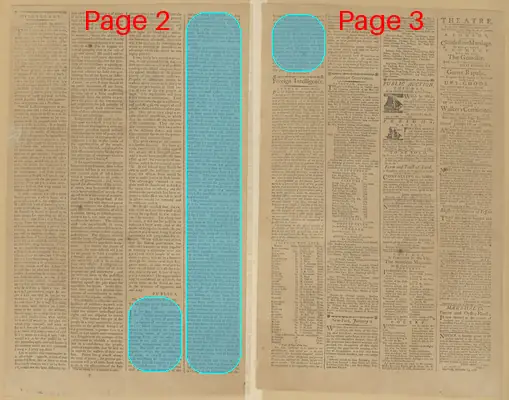
Editorial
January 2, 1788
The New York Journal, And Daily Patriotic Register
New York, New York County, New York
What is this article about?
The Federalist No. XXIX argues that a federal government must have a general power of taxation to fund military, civil expenses, and national debts, criticizing the weaknesses of the Articles of Confederation's requisition system and citing the Ottoman Empire as a cautionary example.
Merged-components note: Continuation of The Federalist No. XXIX across the page break, maintaining the same topic on the power of taxation in the federal government.
Clippings
1 of 2
OCR Quality
98%
Excellent
Full Text
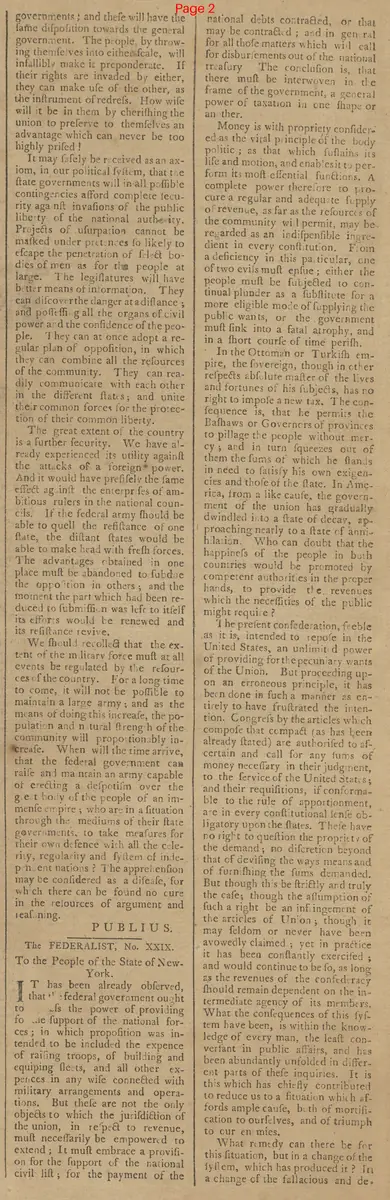
The FEDERALIST, No. XXIX.
To the People of the State of New-York.
It has been already observed, that a federal government ought to possess the power of providing for the support of the national forces; in which proposition was intended to be included the expense of raising troops, of building and equipping fleets, and all other expenses in any wise connected with military arrangements and operations. But these are not the only objects to which the jurisdiction of the union, in respect to revenue, must necessarily be empowered to extend; It must embrace a provision for the support of the national civil list; for the payment of the national debts contracted, or that may be contracted; and in general for all those matters which will call for disbursements out of the national treasury. The conclusion is, that there must be interwoven in the frame of the government, a general power of taxation in one shape or another.
Money is with propriety considered as the vital principle of the body politic; as that which sustains its life and motion, and enables it to perform its most essential functions. A complete power therefore to procure a regular and adequate supply of revenue, as far as the resources of the community will permit, may be regarded as an indispensable ingredient in every constitution. From a deficiency in this particular, one of two evils must ensue; either the people must be subjected to continual plunder as a substitute for a more eligible mode of supplying the public wants, or the government must sink into a fatal atrophy, and in a short course of time perish.
In the Ottoman or Turkish empire, the sovereign, though in other respects absolute master of the lives and fortunes of his subjects, has no right to impose a new tax. The consequence is, that he permits the Bashaws or Governors of provinces to pillage the people without mercy; and in turn squeezes out of them the sums of which he stands in need to satisfy his own exigencies and those of the state. In America, from a like cause, the government of the union has gradually dwindled into a state of decay, approaching nearly to a state of annihilation. Who can doubt that the happiness of the people in both countries would be promoted by competent authorities in the proper hands, to provide the revenues which the necessities of the public might require?
The present confederation, feeble as it is, intended to repose in the United States, an unlimited power of providing for the pecuniary wants of the Union. But proceeding upon an erroneous principle, it has been done in such a manner as entirely to have frustrated the intention. Congress by the articles which compose that compact (as has been already stated) are authorized to ascertain and call for any sums of money necessary in their judgment, to the service of the United States; and their requisitions, if conformable to the rule of apportionment, are in every constitutional sense obligatory upon the states. These have no right to question the propriety of the demand; no discretion beyond that of devising the ways and means of furnishing the sums demanded. But though this be strictly and truly the case; though the assumption of such a right be an infringement of the articles of Union; though it may seldom or never have been avowedly claimed; yet in practice it has been constantly exercised; and would continue to be so, as long as the revenues of the confederacy should remain dependent on the intermediate agency of its members. What the consequences of this system have been, is within the knowledge of every man, the least conversant in public affairs, and has been abundantly unfolded in different parts of these inquiries. It is this which has chiefly contributed to reduce us to a situation which affords ample cause, both of mortification to ourselves, and of triumph to our enemies.
Abusive system of quota and requisition: What substitute can there be imagined for this ignis fatuus in finance, but that of permitting the national government to raise its own revenues by the ordinary methods of taxation, authorized in every well ordered constitution of civil government? Ingenious men may declaim with plausibility on any subject; but no human ingenuity can point out any other expedient to rescue us from the inconveniences and embarrassments naturally resulting from defective supplies of the public treasury.
To the People of the State of New-York.
It has been already observed, that a federal government ought to possess the power of providing for the support of the national forces; in which proposition was intended to be included the expense of raising troops, of building and equipping fleets, and all other expenses in any wise connected with military arrangements and operations. But these are not the only objects to which the jurisdiction of the union, in respect to revenue, must necessarily be empowered to extend; It must embrace a provision for the support of the national civil list; for the payment of the national debts contracted, or that may be contracted; and in general for all those matters which will call for disbursements out of the national treasury. The conclusion is, that there must be interwoven in the frame of the government, a general power of taxation in one shape or another.
Money is with propriety considered as the vital principle of the body politic; as that which sustains its life and motion, and enables it to perform its most essential functions. A complete power therefore to procure a regular and adequate supply of revenue, as far as the resources of the community will permit, may be regarded as an indispensable ingredient in every constitution. From a deficiency in this particular, one of two evils must ensue; either the people must be subjected to continual plunder as a substitute for a more eligible mode of supplying the public wants, or the government must sink into a fatal atrophy, and in a short course of time perish.
In the Ottoman or Turkish empire, the sovereign, though in other respects absolute master of the lives and fortunes of his subjects, has no right to impose a new tax. The consequence is, that he permits the Bashaws or Governors of provinces to pillage the people without mercy; and in turn squeezes out of them the sums of which he stands in need to satisfy his own exigencies and those of the state. In America, from a like cause, the government of the union has gradually dwindled into a state of decay, approaching nearly to a state of annihilation. Who can doubt that the happiness of the people in both countries would be promoted by competent authorities in the proper hands, to provide the revenues which the necessities of the public might require?
The present confederation, feeble as it is, intended to repose in the United States, an unlimited power of providing for the pecuniary wants of the Union. But proceeding upon an erroneous principle, it has been done in such a manner as entirely to have frustrated the intention. Congress by the articles which compose that compact (as has been already stated) are authorized to ascertain and call for any sums of money necessary in their judgment, to the service of the United States; and their requisitions, if conformable to the rule of apportionment, are in every constitutional sense obligatory upon the states. These have no right to question the propriety of the demand; no discretion beyond that of devising the ways and means of furnishing the sums demanded. But though this be strictly and truly the case; though the assumption of such a right be an infringement of the articles of Union; though it may seldom or never have been avowedly claimed; yet in practice it has been constantly exercised; and would continue to be so, as long as the revenues of the confederacy should remain dependent on the intermediate agency of its members. What the consequences of this system have been, is within the knowledge of every man, the least conversant in public affairs, and has been abundantly unfolded in different parts of these inquiries. It is this which has chiefly contributed to reduce us to a situation which affords ample cause, both of mortification to ourselves, and of triumph to our enemies.
Abusive system of quota and requisition: What substitute can there be imagined for this ignis fatuus in finance, but that of permitting the national government to raise its own revenues by the ordinary methods of taxation, authorized in every well ordered constitution of civil government? Ingenious men may declaim with plausibility on any subject; but no human ingenuity can point out any other expedient to rescue us from the inconveniences and embarrassments naturally resulting from defective supplies of the public treasury.
What sub-type of article is it?
Constitutional
Taxation
Economic Policy
What keywords are associated?
Federal Taxation
Revenue Power
Confederation Weaknesses
National Debt
Public Treasury
Quota System
Requisitions
What entities or persons were involved?
Federal Government
Congress
Ottoman Empire
Bashaws
United States
Editorial Details
Primary Topic
Necessity Of Federal Taxation Power
Stance / Tone
Advocacy For Strong Federal Revenue Authority
Key Figures
Federal Government
Congress
Ottoman Empire
Bashaws
United States
Key Arguments
Federal Government Must Have Power To Tax For Military, Civil, And Debt Support
Money Is Vital To Government's Functions; Lack Leads To Plunder Or Atrophy
Ottoman Empire Example Shows Dangers Of No Direct Taxation Power
Articles Of Confederation's Requisition System Is Ineffective And Infringed Upon
Direct Federal Taxation Is The Only Reliable Substitute For Current System