Thank you for visiting SNEWPapers!
Sign up free
New Orleans Republican
New Orleans, Orleans County, Louisiana
What is this article about?
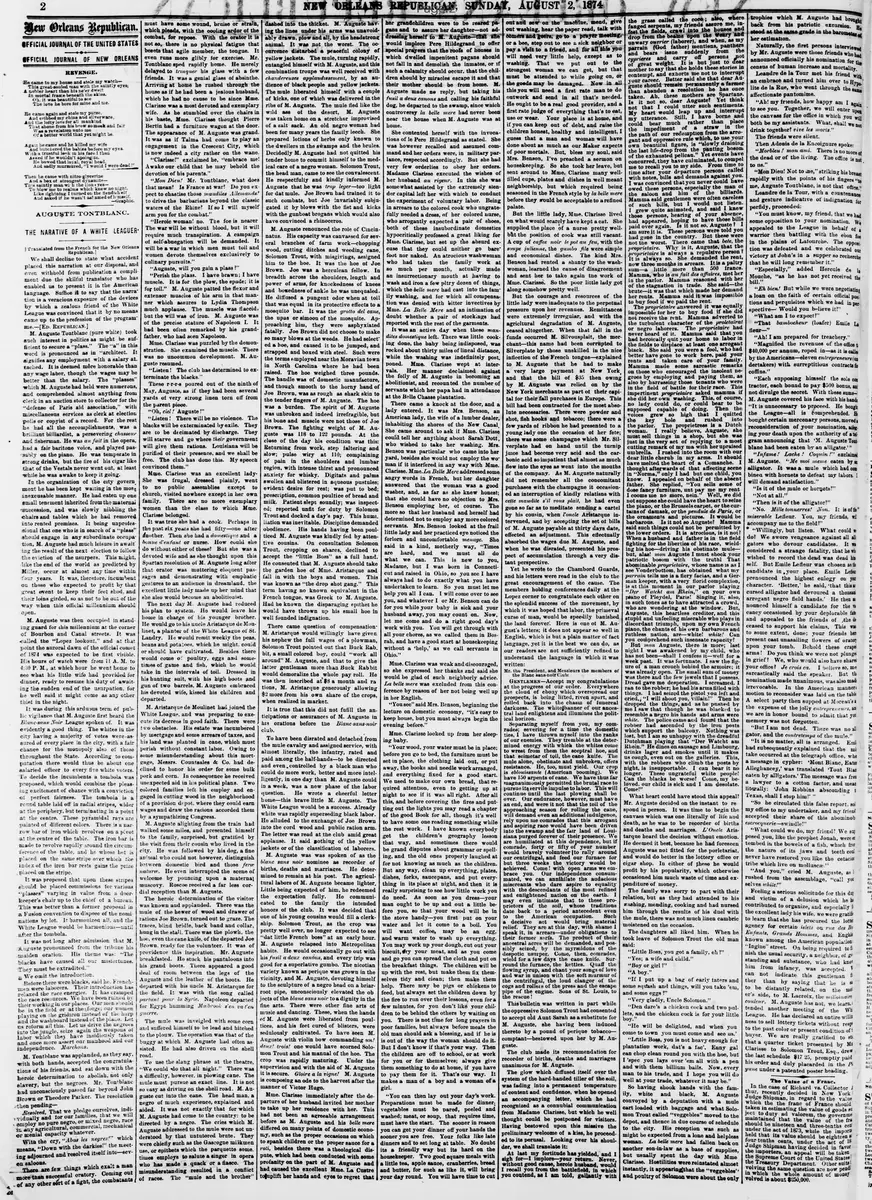
Satirical 1874 New Orleans tale of White League supporter M. Auguste Tontblanc's failed attempt at manual farm labor to oust black workers, leading to personal and family hardships and disillusionment with the movement's empty promises.
Clipping
OCR Quality
Full Text
Translated from the French for the New Orleans Republican.
We shall decline to state what accident placed this narration at our disposal, and even withhold from publication a compliment due the skilful translator who has enabled us to present it in the American language. Suffice it to say that the narration is a veracious exposure of the devices by which a zealous friend of the White League was convinced that it by no means came up to the profession of the programme.-[Ed. Republican.]
M. Auguste Tontblanc (pure white) took such interest in politics as might be sufficient to secure a "plass." The "a" in this word is pronounced as in architect. It signifies any employment with a salary attached. It is deemed more honorable than any wage labor, though the wages may be better than the salary. The "plasses" which M. Auguste had held were numerous, and comprehended almost anything from clerk in an auction store to collector for the "defense of Paris aid association," with miscellaneous services as clerk at election polls or copyist of a record. For the rest he had all the accomplishments, was a brilliant billiardist, a persevering chasseur and fisherman. He was au fait in the opera, had a fair baritone voice, and played passably on the piano. He was temperate in strong drinks, but the fire of his cigar, like that of the Vestals, never went out, at least while he was awake to keep it going.
In the organization of the city government he has been kept waiting in the most inexcusable manner. He had eaten up one small tenement inherited from the maternal succession, and was slowly nibbling the chairs and tables which he had removed into rented premises. It being unprofessional that one who is in search of a "plass" should engage in any subordinate occupation, M. Auguste had much leisure in awaiting the result of the next election to follow the eviction of the usurpers. This night, like the end of the world as predicted by Miller, occur at almost any time within four years. It was, therefore, incumbent on those who expected to profit by that great event to keep their feet shod, and their loins girded, so as not to be out of the way when this official millennium should open.
M. Auguste was then occupied in standing guard for this millennium at the corner of Bourbon and Canal streets. It was called the "Lopez lookout," and at that point the auroral dawn of the official comet of 1874 was expected to be first visible. His hours of watch were from 1 A. M. to 4:30 P. M., at which hour he went home to see what his little wife had provided for dinner, ready to resume his duty of awaiting the sudden end of the usurpation, for he well said it might come as any other thief in the night.
It was during this arduous term of public vigilance that M. Auguste first heard the Blanc-sans-Noir League spoken of. It was evidently a good thing. The whites in the city having a majority of votes were assured of every place in the city, with a fair chance for the monopoly also of those throughout the State. According to computation there would thus be about one salaried officer to every five white voters.
To decide the incumbents a tombola was proposed, which would combine the pleasing excitement of chance with a conviction of perfect fairness. The tombola is a round table laid off in radial stripes, wider at the periphery, but terminating in a point at the centre. These pyramidal rays are painted of different colors. There is a narrow bar of iron which revolves on a pivot at the centre of the table. The iron bar is made to revolve rapidly around the circumference of the table, and he whose bet is placed on the same stripe over which the index of the iron bar rests gains the prize placed on the stripe.
It was proposed that upon these stripes should be placed commissions for various "plasses" varying in value from a doorkeeper's chair up to the chief of a bureau. This was better than a former proposal in a Fusion convention to dispose of the nominations by lot. It harmonized all, and the White League would be harmonious-until after the tombola.
It was not long after admission that M. Auguste pronounced from the tribune his maiden oration.
His theme was: "The blacks have caused all our misfortunes. They must be extradited."
We omit the introduction. Before there were blacks, said he, Frenchmen were laborers. Their introduction has relaxed the race energies. It has cramped the race resources. We have been ruined by their working in our places. Our men should be in the field or at the forge; our women playing on the gridiron instead of the piano. Let us reform all this. Let us drive the negroes into the jungle, seize again the weapons of labor which they have insidiously taken, and once more assert our manhood and our independence. Marchons.
M. Tontblanc was applauded, as they say, with both hands, accepted the congratulations of his friends, and sat down with the heroic determination to abolish, not only slavery, but the negroes. M. Tontblanc had unconsciously passed far beyond John Brown or Theodore Parker. The resolution then pending-
Resolved, That we pledge ourselves, individually and for our families, that we will employ no pure negro, or mixed negro, race in any agricultural, commercial, mechanical or menial capacity whatever.
With the cry, "Abas les negres!" which means, "Down with the darkies!" the meeting adjourned and resolved itself into a sey-en saloons.
There are few things which exalt a man more than successful oratory. Coming out of any other sort of a fight, the combatants must have some wound, bruise or strain, which pleads, with the cooling ardor of the combat, for repose. With the orator it is not so, there is no physical fatigue that besets that agile member, the tongue. It even runs more glibly for exercise. M. Tontblanc sped rapidly home. He merely delayed to trinqueter his glass with a few friends. It was a genial glass of absinthe.
Arriving at home he rushed through the house as if he had been a jealous husband, which he had no cause to be since Mme. Clarisse was a most devoted and exemplary wife. As he stumbled over the chairs in his haste, Mme. Clarisse thought Pierre Bertin had a furniture wagon at the door.
The appearance of M. Auguste was grand. It was as if Talma had come to play an engagement in the Crescent City, which is now indeed a city rather on the wane.
"Clarisse!" exclaimed he. "Embrace me! Awake our child that he may behold the devotion of his parents."
"Mon Dieu! M. Tontblanc, what does that mean? Is France at war? Do you expect to chastise those maudits Allemands? To drive the barbarians beyond the classic waters of the Rhine? If so I will myself arm you for the combat."
"Heroic woman! No. The foe is nearer. The war will be without blood, but it will require much transpiration. A campaign of self-abnegation will be demanded. It will be a war in which men must toil and women devote themselves exclusively to culinary pursuits."
"Auguste, will you gain a plass?"
"Perish the plass. I have brawn; I have muscle. It is for the plow, the spade; it is for toil." M. Auguste patted the flexor and extensor muscles of his arm in that manner which assures to Lydia Thompson much applause. The muscle was flaccid but the will was of iron. M. Auguste was of the precise stature of Napoleon I. It had been often remarked by his grandfather, who had seen Napoleon.
Mme. Clarisse was puzzled by the demonstration. She examined the muscle. There was no uncommon development. M. Auguste resumed.
"Listen! The club has determined to exterminate the blacks."
These r-r-r-s poured out of the mouth of Auguste, as if they had been several yards of very strong linen torn off from the parent piece.
"Oh, ciel! Auguste!"
"Listen! There will be no violence. The blacks will be exterminated by exile. They are to be decimated by discharge. They will starve and go where their government will give them rations. Louisiana will be purified of their presence, and we shall be free. The club has done this. My speech convinced them."
Mme. Clarisse was an excellent lady. She was frugal, dressed plainly, went to no public assemblies except to church, visited nowhere except in her own family. There are no more exemplary women than the class to which Mme. Clarisse belonged.
It was true she had a cook. Perhaps in the past six years she had fifty-one after another. Then she had a domestique and a bonne d'enfant or nurse. How could she do without either of these? But she was a devoted wife and as she thought upon this Spartan resolution of M. Auguste long after that orator was muttering eloquent passages and demonstrating with emphatic gestures to an audience in dreamland, the excellent little lady made up her mind that she also would become an abolitionist.
The next day M. Auguste had reduced his plan to system. He would leave his home in charge of his younger brother. He would go to his uncle Aristarque de Moulinet, a planter of the White League of St. Landry. He would remit weekly the peas, beans and potatoes, which he might, could or should have cultivated. Besides there would come of poultry, eggs and sometimes of game and fish, which he would take in the intervals of toil. Dressed in his hunting suit, with his high boots and gun of two barrels, M. Auguste embraced his devoted wife, kissed his children and departed.
M. Aristarque de Moulinet had joined the White League, and was preparing to execute its decrees in good faith. There were two obstacles. His estate was incumbered by mortgage and some arrears of taxes, and his land was planted in cane, which must perish without constant labor. Owing to some misunderstanding about this mortgage, Messrs. Countsales & Co. had declined to honor his order for some bulk pork and corn. In consequence he received unexpected aid in his political plans. Two colored families left his employ and engaged in cutting wood in the neighborhood of a provision depot, where they could earn wages and draw the rations accorded them by a sympathizing Congress.
M. Auguste alighting from the train had walked some miles, and presented himself to the family, surprised, but gratified by the visit from their cousin who lived in the city. He was followed by his dog, a fine animal who could not, however, distinguish between domestic bird and those ferae naturae. He even interrupted the scene of welcome by pouncing upon a maternal muscovy. Roscoe received a far less cordial reception than M. Auguste.
The heroic determination of the visitor was known and applauded. There was the mule of the hewer of wood and drawer of rations Joe Brown, turned out to graze. The traces, blind bridle, back band and collar, hung in the stall. There was the plow, the hoe, even the cane knife, of the departed Joe Brown, ready for the volunteer. It was of providence this inspiration. M. Auguste breakfasted. He stuck his pantaloons into his grand boots. There appeared a good deal of room between the legs of the Auguste and the leather of the boots. He departed with his uncle M. Aristarque for the field. It was with the song called "Partant pour la Syrie." Napoleon departed for Egypt humming "Malbrook s'en va-t-en guerre."
The mule was inveigled with some corn and suffered himself to be led and hitched to the plow. The operation was that of the buggy at which M. Auguste had often assisted. He had also driven on the shell road.
To use the slang phrase at the theatre "We could do that all night." There was a difficulty, however, in plowing cane. The mule must pursue an exact line. It is not so easy as driving on the shell road. M. Auguste cut into the cane. The head man, a negro of much experience, explained and aided. It was not exactly that for which M. Auguste had come to the country: to be directed by a negro. The cries which M. Auguste addressed to the mule were not understood by that untutored brute. They were chiefly such as the Gascogne milkmen use, or epithets which the parquette sometimes employs to salute a singer in opera who has made a quack or a fiasco. The misunderstanding resulted in a conflict of races. The "mule and the brother" dashed into the thicket. M. Auguste having the lines under his arms was unavoidably drawn, plow and all, by the headstrong animal. It was not the worst. The occurrence disturbed a peaceful colony of yellow jackets. The mule, turning rapidly, entangled himself with M. Auguste, and this combination troupe was well received with chandelleuses applaudissements, by an audience of black people and yellow jackets.
The mule liberated himself with a couple of kicks, one of which was delivered in the ribs of M. Auguste. The mule fled like the wild ass of the desert. M. Auguste was taken home on a stretcher improvised of a salt sack. An old negro woman had been for many years the family leech. She prepared lotions of herbs only known to the dwellers in the swamps and the brules.
Decidedly M. Auguste had not quitted his tender home to commit himself to the medical care of a negro woman. Solomon Trout, the head man, came to see the convalescent. He respectfully and kindly informed M. Auguste that he was trop leger-too light for dat mule. Joe Brown had trained it to such combats, but Joe invariably subjugated it by blows with the fist and kicks with the gunboat brogans which would also have convinced a rhinoceros.
M. Auguste renounced the role of Cincinnatus. His capacity was canvassed for several branches of farm work-chopping wood, cutting ditches and weeding cane. Solomon Trout, with misgivings, assigned him to the hoe. It was the hoe of Joe Brown. Joe was a herculean fellow. In breadth across the shoulders, length and power of arms, for knockedness of knees and boredness of ankle he was unequaled. He diffused a pungent odor when at toil that was equal in its protective effects to a mosquito bar. It was the grotto del cane, the upas or simoon of the mosquito. Approaching him, they were asphyxiated fatally. Joe Brown did not choose to make so many blows at the weeds. He had selected a hoe, and caused it to be jumped, and strapped and boxed with steel. Such were the terms employed near the Moravian town in North Carolina where he had been raised. The hoe weighed three pounds. The handle was of domestic manufacture, and though smooth to the horny hand of Joe Brown, was as rough as shark skin to the tender fingers of M. Auguste. The hoe was a burden. The spirit of M. Auguste was unbroken and indeed irrefragible, but his bone and muscle were not those of Joe Brown. The fighting weight of M. Auguste was 118 to 122 pounds. At the close of the day his condition was this:
Returning from work, step faltering and slow; pulse wiry at 110; complaining of pain in the shoulders and lumbar region, with intense thirst and pronounced anxiety for whisky. Digitats and palms swollen and blistered in aqueous pustules; evident desire for rest; was put to bed: prescription, common poultice of bread and milk. Patient slept soundly: was inspected; reported unfit for duty by Solomon Trout and docked a day's pay. This humiliation was inevitable. Discipline demanded obedience. His hands having been poulticed M. Auguste was kindly fed by attentive cousins. On consultation Solomon Trout, cropping on shares, declined to accept the "little Boss" as a full hand. He consented that M. Auguste should take the garden hoe of Mme. Aristarque and fall in with the boys and women. This was known as "the drop shot gang."
This term having no known equivalent in the French tongue, was Greek to M. Auguste. Had he known the disparaging epithet he would have thrown up his small hoe in well founded indignation.
There came question of compensation. M. Aristarque would willingly have given his nephew the full wages of a plowman. Solomon Trout pointed out that Buck Rabbit, a small colored boy, could "work all around" M. Auguste, and that to give the latter gentleman more than Buck Rabbit would demoralize the whole pay roll. He was then inscribed at $3 a month and rations, M. Aristarque generously allowing $2 more from his own share of the crops, when realized in market.
It is true that this did not fulfill the anticipations or assurances of M. Auguste in his orations before the Blanc-sans-noir club.
To have been disrated and detached from the mule cavalry and assigned service, with almost literally, the infantry, rated and paid among the half-hands-to be directed and even controlled by a black man who could do more work, better and more intelligently, in one day than M. Auguste could in a week, was a new phase of the labor question. He wrote a cheerful letter home-this brave little M. Auguste. The White League would be a success. Already white was rapidly superseding black labor. He alluded to the exchange of Joe Brown into the cord wood and public ration army. The letter was read at the club amid great applause. It said nothing of the yellow jackets or of the classification of laborers. M. Auguste was spoken of as the blanc sans noir nominee as recorder of births, deaths and marriages. He determined to remain at his post. The agricultural labors of M. Auguste became lighter. Little being expected of him, he redeemed the expectation fully. He communicated to the family the intended honors of the club. It was decided that one of his young cousins would fill a clerkship. Solomon Trout, as the crop was pretty well over, no longer expected to see "dat little French boss" at an early hour.
M. Auguste relapsed into Metropolitan habits. He would occasionally go out with his fusil a deux canons, and every trip was good for a superlative gumbo. The nicotian variety known as perique was grown in the vicinity, and M. Auguste, devoting himself to the sculpture of a negro head on a briar-root pipe, unconsciously elevated the objects of the blanc sans noir to a dignity in the fine arts. There were other fine arts of music and dancing. These, when the hands of M. Auguste were liberated from poultices, and his feet cured of blisters, were sedulously cultivated. To have seen M. Auguste with violin bow commanding un! deux! trois! one would have scorned Solomon Trout and his manual of the hoe. The crop was rapidly maturing. Under the supervision and with the aid of M. Auguste it is secure. Gloire a la vigne! M. Auguste is composing an ode to the harvest after the manner of Victor Hugo.
Mme. Clarisse immediately after the departure of her husband invited her mother to take up her residence with her. This had not been an agreeable arrangement before as M. Auguste and his belle mere differed on many points of domestic economy, such as the proper occasions on which to spank children or the proper sauce for a roti, besides there was a theological dispute, which had been conducted with some profanity on the part of M. Auguste and had caused the excellent Mme. La Custre to uplift her hands and eyes to regret that her grandchildren were to be reared pagans and to assure her daughter-not addressing herself to M. Auguste-that she would implore Pere Hildegrand to offer special prayers that the roofs of houses in which dwelled impenitent pagans should not fall in and demolish the inmates, or if such a calamity should occur, that the children should by miracles escape it and that their mother should be from home. M. Auguste made no reply, but taking his fusil a deux canons and calling his faithful dog, he departed to the swamp, since which controversy la belle mere had never been near the house when M. Auguste was at home.
She contented herself with the invocations of le Pere Hildegrand as stated. She was however recalled and assumed command and her orders were, in military parlance, respected accordingly. But she had very few orderlies to obey her orders.
Madame Clarisse executed the wishes of her husband au rigueur. In this she was somewhat assisted by the extremely slender capital left her with which to conduct the experiment of voluntary labor. Being in arrears to the colored cook who ungratefully needed a dress, of her colored nurse, who arrogantly expected a pair of shoes, both of these insubordinate domestics hypocritically professed a great liking for Mme. Clarisse, but set up the absurd excuse that they could neither go barefoot nor naked. An atrocious washwoman who had taken the family work at so much per month, actually made an insurrectionary mouth at having to wash and iron a few paltry dozen of things, which the belle mere had cast into the family washing, and for which all compensation was denied with bitter invectives by Mme. La Belle Mere and an intimation of doubt whether a pair of stockings had reported with the rest of the garments.
It was an active day when these mandites domestique left. There was little cooking done, the baby being indisposed, was rocked about thirty miles of lineal distance, while the washing was indefinitely postponed. Mme. Clarisse wept at intervals. Her manner declaimed against the folly of M. Auguste in becoming an abolitionist, and recounted the number of servants which her papa had in attendance at the Belle Chasse plantation.
There came a knock at the door, and a lady entered. It was Mrs. Benson, an American lady, the wife of a lumber dealer, inhabiting the shores of the New Canal. She came around to ask if Mme. Clarisse could tell her anything about Sarah Dott, who wished to take her washing. Mrs. Benson was particular who came into her yard, besides she would not employ the woman if it interfered in any way with Mme. Clarisse. Mme. La Belle Mere addressed some angry words in French, but her daughter answered that the woman was a good washer, and, as far as she knew honest; that she could have no objection to Mrs. Benson employing her, of course. The more so that her husband and herself had determined not to employ any more colored servants. Mrs. Benson looked at the frail little lady and her practiced eye noticed the forlorn and uncomfortable menage. She said in a kind, motherly way,
"Times are hard, and we must all do what we can. This is new to you, Madame, but I was born in Connecticut and raised in Ohio, so you see I have always had to do exactly what you have undertaken to learn. So you must let me help you all I can. I will come over to see you, and whatever I or Mr. Benson can do for you while your baby is sick and your husband away, you may count on. Now, let me come and do a right good day's work with you. You will get through with all your chores, as we called them in Bosrab, and have a good start at housekeeping without a 'help,' as we call servants in Ohio."
Mme. Clarisse was weak and discouraged so she expressed her thanks and said she would be glad of such neighborly advice. La belle mere was excluded from this conference by reason of her not being well up in her English.
"You see" said Mrs. Benson, beginning the lecture on domestic economy, "it's easy to keep house, but you must always begin the evening before."
Mme. Clarisse looked up from her sleeping baby.
"Your wood, your water must be in place; before you go to bed, the furniture must be set in place, the clothing laid out, or put away, the books and needle work arranged, and everything fixed for a good start. We used to make our own bread, that required attention, even to getting up at night to see if it was all right. After all this, and before covering the fires and putting out the lights you may read a chapter of the good Book for all, though it's well to have some one reading something while the rest work. I have known everybody get the children's geography lesson that way, and sometimes there would be grand disputes about grammar or spelling, and the old ones properly laughed at for not knowing as much as the children. But any way, clean up everything, plates, dishes, forks, saucepans, and put everything in its place at night, and then it is really surprising to see how little work you do need. As soon as you dress-your man ought to be up and out a little before you, so that your wood will be in the stove handy-you first put on your water and let it come to a boil. You will want coffee, may be an egg, and warm water to wash up everything. You may work up your dough, cut out your biscuit, fry your meat, and as you come and go you can spread the cloth and put on the breakfast things. The children will be up with the rest, but make them fix themselves tidy and clean; then make them help. There may be pigs or chickens to feed, but always set the children down by the fire to run over their lessons, even for a few minutes, for you don't like your children to be behind the others by waiting on you. There is not time for long prayers in poor families, but always before meals the old man should ask a blessing, and if he is out of the way the woman should do it. But I don't know if that's your way. Then the children are off to school, or at work for you or for themselves; always give them something to do at home, if you have to pay them for it. That's our way. It makes a man of a boy and a woman of a girl.
"You can then lay out your day's work. Preparations must be made for dinner. Vegetables must be pared, peeled and washed; meat, or soup, that requires time, must have the start. The sooner in reason you can get your dinner off your hands the sooner you are free. Your folks like late dinners and to set long at table. No doubt its a friendly way but its hard on the housekeeper. Two good square meals with a little tea, apple sauce, cranberries, bread and butter, for such as like it, will bring your day round. You will have time to cut out and sew on the machine, mend, give out washing, hear the paper read, talk with comers and goers, go to a prayer meeting, or a bee, step out to see a sick neighbor or pay a visit to a friend, and for all this you will need very little help, except as to washing. That we put out to the strongest woman we can get, but that must be attended to while going on, or the goods may be damaged. Now in all this you will need a first rate man to do outwork and send in all that's needed. He ought to be a real good provider, and a first rate judge of everything that's to eat, use or wear. Your place is at home, and if you can keep out of debt, and raise the children honest, healthy and intelligent, I guess that a man and woman will have done about as much as our Maker expects of poor mortals. But, bless my soul, said Mrs. Benson, I've preached a sermon on housekeeping."
So she took her leave, but sent around to Mme. Clarisse many well-filled cups, plates and dishes in well meant neighborship, but which required being seasoned in the French style by la belle mere before they would be acceptable to a refined palate.
But the little lady, Mme. Clarisse lived on what would scarcely have kept a cat. She supplied the place of a nurse pretty well but the position of cook was still vacant. A cup of cafe noir le pot au feu, with the soupe julienne, the gumbo file were simple and economical dishes. The kind Mrs. Benson had rented a shanty to the wash-woman, learned the cause of disagreement and sent her to take again the work of Mme. Clarisse. So the poor little lady got along somehow pretty well.
But the courage and resources of the little lady were inadequate to the perpetual pressure upon her revenues. Remittances were extremely irregular, and with the agricultural degradation of M. Auguste, ceased altogether. When that fall in the funds occurred M. Silvousplait, the merchant-this name had been corrupted to Silverplate by those unskilled in the nice inflection of the French tongue-explained to M. Auguste that he had to make a very large payment at New York and that the bill of $35 then owing by M. Auguste was relied on by the New York merchants as part of their capital for their fall purchases in Europe. This bill had been contracted for the most absolute necessaries. There were powder and shot, fish hooks and tobacco; there were a few yards of ribbon he had presented to a young lady on the occasion of her fete; there was some champagne which Mr. Silverplate had on hand until the turnip juice had become very acid and the carbonic acid so impatient that almost as much flew into the eyes as went into the mouths of the company. As M. Auguste naturally did not remember all the concomitant purchases with the champagne it occasioned an interruption of kindly relations with cette maudite s'il vous plait, he had even gone so far as to meditate sending a cartel by his cousin, when l'oncle Aristarque intervened, and by accepting the set of bills of M. Auguste payable at thirty days date, effected an adjustment. This effectually absorbed the wages due M. Auguste, and when he was disrated, presented his prospect of accumulation through a very distant perspective.
Yet he wrote to the Chambord Guards, and his letters were read in the club to the great encouragement of the cause. The members holding conferences daily at the Lopez corner to congratulate each other on the splendid success of the movement, by which it was hoped that labor, the primeval curse of man, would be speedily banished the land forever. Here is one of M. Auguste's letters; it does not appear so well in English, which is but a plain matter of fact language, yet it is the best we can do, as our readers are not sufficiently refined to understand the language in which it was written:
Mr. the President, and Messieurs the members of the Blanc sans-noir Club:
GENTLEMEN-Accept my congratulations at the progress of our order. Everywhere the cloud of ebony which overspread our prospects, is being lifted, riven apart, and rolled back into the chasm of funereal darkness. The white banner of our ancestral land enlightens and illumines the political horizon.
Separating myself from you, my comrades; severing for a time the domestic ties, I have thrown myself into the ranks of our enemies. They tremble at the determined energy with which the whites come to wrest from them the sceptreal hoe, and that scimetar of toil, the cane knife. The mule alone, obstinate and unbroken, offers resistance. He, too, must yield. Our crop is eblouissante (American booming). We have 150 arpents of cane. We have thus far magnanimously permitted the brutal race to pursue its servile impulse to labor. This will continue until the last plowing shall be over. Our endurance, however, must have an end, and were it not that the toil of the approaching season for rolling the cane, will demand even an additional indulgence, rely upon me comrades that this arrogant and aspiring race would have been driven into the swamp and the fair land of Louisiana purged forever of their presence. We are humiliated at this dependence, but if comrade, forty or fifty of your number would bravely volunteer to rally around our centrifugal, and feed our furnace for but three weeks the victory would be achieved. Come! with open arms we em-brace you. Our independence consummated, we can annihilate the audacious miscreants who dare aspire to equality with the descendants of the most refined and enlightened nation on the earth. I may even intimate that to these proprietors of the soil, whose traditions date back to a period antecedent even to the American occupation.
Such a decisive act would bring material relief. They are at this day, with shame I speak it, in arrears-under obligations to their former serfs. The product of their ancestral acres will be demanded, and possibly seized, by the myrmidons of the despotic usurper. Come, then, comrades wield for a few days the cane knife. Surround the furnace, the kettles. Quaff the flowing syrup, and chant your songs of love and war in unison with the soft murmur of the centrifugal, the loud clangor of the cogs and rollers of the press and the escape pipe of the engine. Sons of St. Louis, to the rescue!
This bulletin was written in part while the oppressive Solomon Trout had consented to accept old Aunt Sarah as a substitute for M. Auguste, she having been induced thereto by a pound of perique tobacco-comptant-bestowed upon her by M. Auguste.
The club made its recommendation for recorder of births, deaths and marriages unanimous for M. Auguste. The glow which diffused itself over the system of the hard-handed tiller of the soil, was fading into a permanent temperature of content and confidence, when he opened an accompanying letter, which he had recognized as a connubial communication from Madame Clarisse, but which he well thought could be postponed for visitors. Having bestowed upon this missive the preliminary welcome of a kiss, he proceeded to its perusal. Looking over his shoulder, we shall translate it:
At last my fortitude has yielded, and I sigh for-I implore-your return. Never, without good cause, heroic husband, would I recall you from the battlefield, in which you contend, as I am told, gallantly with the grass called the cooo; also, where fanged serpents, my friends assure me, infest the fields, crawl into the houses and drop from the beams upon the weary and unwary ouvrier (laborer), and when, as my parrain (godfather) mentions, panthers and bears issue suddenly from the cyprieres and carry off persons not of great weight.
It is but just to dear mother to say that she holds these stories in contempt, and exhorts me not to interrupt your career. Better said she that dear Auguste should remain permanently a farmer than abandon a resolution he has once taken. Ah, these mothers are Spartans. Is it not so, dear Auguste? Yet think not that I could utter such sentiments. My heart would leap up and interrupt my utterance.
Still, I have borne and could bear much rather than place the path of our redemption from the arro-gant and oppressive rule which, to use your own beautiful figure, is "slowly draining the last life-drop from the panting bosom of the exhausted pelican." Yet events have concurred, they have culminated, to compel me to recall you to my side. From time to time after your departure persons called with notes, bills and demands against you. I was convinced that you never could have owed these persons, especially the man of the saloon and him of the billiards.
Mamma said gentlemen were often careless of such bills, but I would not listen. I grew quite animated, and said I knew those persons, hearing of your absence, had appeared, hoping to have those bills paid over again. Is it not so, Auguste? I am sure it is. These persons were told you had gone in the country. But these were not the worst.
There came that bete, the proprietaire. Why is it, Auguste, that the proprietaire is always a repulsive person? It is always so. She demanded the rent, now three months in arrears. It is a paltry sum-a little more than 500 francs.
Mamma, who is au fait des affaires, met her in the parlor. Mamma reasoned with her of the stagnation in trade. She said-the brute-it was that which made her demand her rents. Mamma said it was impossible to buy food if we paid the rent. The proprietaire answered it was equally impossible for her to buy food if she did not receive the rent. Mamma adverted to the turbulent character of the proletairat or negro laborers. The proprietaire had never heard of it. Mamma said that you had heroically quit your home to labor in the fields to displace at least one arrogant black. She said you were a fool, who had better have gone to work here, paid your rents and taken care of your family.
Mamma made some sarcastic remarks on those who encouraged the insolent negroes by employing and paying them, as also by harrassing those tenants who were in the field of battle for their race. This impertinent proprietaire asked mamma if she did her own washing. This, of course, no lady could do, or could bear to be supposed capable of doing. Then the voices grew so high that I quitted the keyhole and rushed into the parlor. The proprietress is a Dutch woman. I really believe, Auguste, she must sell things in a shop, but she was just in the very act of replying to a most cutting remark of my ma with her upraised umbrella. I rushed into the room with our dear little cherub in my arms. It should have melted the heart of a Comanche. I thought afterwards of that affecting scene in "Norma," only I had but one child, you know. I appealed on behalf of the absent father. She replied, "You sells some of dose fancy furniture, unt pay me my rent or I cooms me no more, nein."
Well, we did not suppose she could have the heart to seize the piano, or the Brussels carpet, or the curtains of damask, or the pendule de Paris, or the ornaments and pictures. It would be barbarous. Is it not so Auguste? Mamma said such things could not be permitted by the lower orders. It is atrocious, is it not? When a husband and father is in the field fighting for the liberties of his race, wielding his hoe-driving his obstinate mule-but, alas! mon Auguste I must shock your patriotic bosom with the truth! That abominable proprietaire, whose name is as I see Vonderbottom, has obtained what my parrain tells me is a fiery facias, and a German keeper, with a very florid complexion, is at this moment in our parlor playing "Der Watcht am Rhein," on your own piano of Pleyel, Paris! Singing it, also, in such tones as to have attracted a crowd, who are wondering at the window. But, Auguste, this heartless creditor, and this stupid and unfeeling miserable who plays in discordant triumph, upon my own French piano, the chants of his own barbarous and ruthless nation, are-white! white! Can you comprehend such insensate rapacity?
But mon Auguste, there is more; last night I was awakened by my child, who has not been-shall I confess it-well for a week past. It was fortunate. I saw the figure of a man crouch behind the armoire; it was already open. The small sum of money was there and the few jewels that I possess. Dread gave me desperation. I screamed. I ran to the robber: he had his arms filled with things. I had seized the pistol you left and cried, "I will shoot you, villain!" Then he dropped the things, and as he pushed by me I saw that though he was blacked to resemble a negro his hands and arms were white. The police came and found that the robber had ascended by the iron posts which support the balcony. Nothing was lost, but I am so unhappy with the dreadful Dutchman playing that "Der Watcht am Rhein." He dines on sausage and Limbourg, drinks lager and smokes until it makes us cough, even out on the galleries. This, with the robbers who climb the posts by night, is insupportable. I can bear it no longer. These ungrateful white people! Can the blacks be worse? Come, my beloved, our child is sick and I am desolate. Come!
What heart could have stood this appeal? M. Auguste decided on the instant to respond in person. It was time to begin the canvass which was one literally of life and death, as he was to be recorder of births and deaths and marriages. L'Oncle Aristarque heard the decision without emotion. He deemed it best, because he had foreseen Auguste was not fitted for the proletariat, and would do better in the lottery office or cigar shop. In either of these he would profit by his popularity, which otherwise occasioned him much waste of time and expenditure of money.
The family was sorry to part with their relation, but as they had attended to his washing, mending, cooking and had nursed him through the results of his duel with the mule, there was not much linen cambric moistened on the occasion. The daughters all liked him. When he took leave of Solomon Trout the old man said:
"Little Boss, you got a family, eh?"
"Yes; a wife and child."
"Boy or girl?"
"A boy."
"If I put up a bag of early taters and some squash and things, will you take 'em, and some eggs?"
"Very gladly, Uncle Solomon."
"Den dare's a chicken cock and two pullets, and the chicken cock is for your little boy."
"He will be delighted, and when you come to town you must come and see us."
"Little Boss, you is not heavy enough for plantation work, dat's a fac'. Enny gal can chop clean round you with the hoe, but I 'spec you lays over 'em all with a pen and with them billium balls. Now, every man to his trade, and I hope you will do well at your trade, whatever it may be."
So having shook hands with the family, white and black, M. Auguste convoyed by a deputation with a mule cart loaded with baggage and what Solomon Trout called "veggebles" moved to the depot, and thence in due course of schedule to the city. His reception was such as might be expected from a lone and helpless woman. La belle mere had fallen back on another son-in-law as a base of supplies, but usually spent the day with Mme. Clarisse. Hostilities were reinstated almost instantly, it appearing that the "veggebles" and poultry of Solomon were about the only trophies which M. Auguste had brought back from his patriotic excursion. He stood at the same grade in the barometer of her estimation.
Naturally, the first persons interviewed by Mr. Auguste were those friends who had announced officially his nomination for the census of human increase and mortality. Leandre de la Tour met his friend with an embrace and turned him over to Hypolite de la Rue, who went through the same affectionate pantomime.
"Ah! my friends, how happy am I again to see you. Together, we will enter upon the canvass for the office in which you will both be my assistants. What, shall we not drink together? Vive les morts."
The friends were silent.
Then Adonis de la Encoignure spoke:
"Morbleu! mon ami. There is no more of the dead or of the living. The office is not to us."
"Mon Dieu! Not to me," striking his breast rapidly with the points of his fingers "to me, Auguste Toutblanc, is not that office."
Leandre de la Tour, with a countenance and gesture indicative of indignation for perfidy, proceeded:
"You must know, my friend, that we had some opposition to your nomination. We appealed to the League in behalf of warrior then battling with the ebon fo in the plains of Lafourche. The opposition was defeated and we celebrated our victory at John's in a supper so recherche that he will long remember it."
"Especially," added Hercule de la Mouche, "as he has not yet received the bill."
"Eh bien! But while we were negotiating a loan on the faith of certain official positions and perquisites which we had in perspective-: Would you believe it?"
"What am I to expect?"
"That bambocheur (loafer) Emile Lafleur-"
"Ah! I am prepared for treachery."
"Magnified the revenues of the office to $40,000 per annum, roped in-as it is called by the Americans-eleven entrepreneurs (undertakers) with surreptitious contracts for coffins."
"Each supposing himself the sole contractor, each bound to pay $500 bonus, and not divulge the secret. With these sums-" M. Auguste covered his face with his hand.
"It is unnecessary to proceed. He bought the League-all is comprehended. He bought certain mercenary persons, moved a reconsideration of your nomination, alleging your death upon the authority of a telegram announcing that M. Auguste Toutblanc had been eaten by an alligator.'"
"Infame! Lache! Coquin!" exclaimed M. Auguste. "Me moi meme eaten by an alligator. It was a mule which had combined with hornets to defeat my labors. I will demand satisfaction."
"Is it of the mule or hornets?"
"Not at all."
"Then is it of the alligator?"
"No. Mille tonnerres! Non. It is of that miserable Lefleur. You, my friends, will accompany me to the field?"
"Willingly, but listen. What could we do? We swore vengeance against all alligators who devour candidates. It was considered a strange fatality, that he who wished to record the dead was dead himself. But Emile Lefleur was chosen as the candidate in your place. Emile Lefleur pronounced the highest eulogy on your character. 'Better,' he said, 'that this cursed alligator had devoured a thousand arrogant negro field hands.' He then announced himself a candidate for the vacancy occasioned by your deplorable fate and appealed to the friends of the deceased to support his claims. This was to some extent, done; your friends here present cast unasailing flowers of oratory upon your tomb. Behold these crapeaus! Do you think we were not plunged in grief? We, who would also have shared your office? Je crois ca. I believe so," me sarcastically said the speaker. But the nomination made unanimous, was also made irrevocable. In the American manner a motion to reconsider was laid on the table.
A select party then supped at Moreau's at the expense of the jolly entrepreneurs, and we are in honor bound to admit that your memory was not forgotten.
"But I am not dead. There was no alligator, and the contretemps of the mule."
"It is no matter, all is arranged. Emile had subsequently explained that the mistake occurred at the telegraph office, where a message in cypher: Mont Blanc, Eat Alleghancy.' was translated 'Tout Blanc eaten by alligators.' The message was from a lawyer to a cotton factor, and meant literally: John Robbins absconding to Texas, shall I stop him?'"
"So he circulated this false report, sold my office to my undertaker, and my friends accepted their share of this abominable escrocquerie-swindle!"
"What could we do, my friend? We supposed you, like the prophet Jonah, were entombed in the bowels of a fish, which from the nature of its jaws and teeth could never have restored you like the cetacio tribe which live on molluscae."
"And you," cried M. Auguste, as he rushed from the assemblage, "call yourselves white!"
Feeling a serious solicitude for this dupe and victim of a delusion which he had contributed to organize, and especially in the excellent lady his wife, we were gratified to learn that she has procured the lottery agency for certain islets on rue des Bons Enfants, Grands Hommes, and Engine known among the American population as "Ingine" street. On being required to furnish the usual security, a neighbor, of good standing and substance, who had known him from infancy, was accepted. We can not indicate this gentleman further than by saying that he is said to be distantly related, on the mother's side, to M. Lacroix, the millionaire couleur. M. Auguste has not, we learn, attended another meeting of the White League. He has declared an entire willingness to sell lottery tickets without respect to the past color or present condition of the buyer. We are really gratified to state that a quarter ticket presented by Mr. Clarisse to Solomon Trout, Esq., drew the last schedule $17.25, promptly paid his order and duly placarded in the Picayune under a patented poster heading.
What sub-type of article is it?
What themes does it cover?
What keywords are associated?
What entities or persons were involved?
Where did it happen?
Story Details
Key Persons
Location
New Orleans And St. Landry Parish, Louisiana
Event Date
1874
Story Details
M. Auguste Tontblanc, a job-seeking White Leaguer in New Orleans, delivers a speech advocating expulsion of blacks to reclaim labor. He attempts farm work on his uncle's plantation to replace black laborers but fails comically due to inexperience, injuries, and low productivity. His wife struggles at home without servants, facing debts and eviction. Disillusioned by hardships and betrayal in the League, he abandons the cause for a lottery agency job.