Thank you for visiting SNEWPapers!
Sign up free
The New Hampshire Gazette And Historical Chronicle
Portsmouth, Greenland, Rockingham County, New Hampshire
What is this article about?
An anonymous writer advocates for reinstating an excise tax on spirituous liquors in the province, similar to the 1732 act, as a fair, voluntary contribution on luxury that discourages excess, boosts trade balance, and generates revenue to offset the province tax. Proposes collection via quarterly oaths and penalties to ensure compliance without oppression.
Merged-components note: The second component continues directly from the first, completing the essay on excise taxes as a letter to the editor. The original label of the second was 'editorial', but the content fits 'letter_to_editor' better as it is a submitted essay.
Clippings
1 of 2
OCR Quality
Full Text
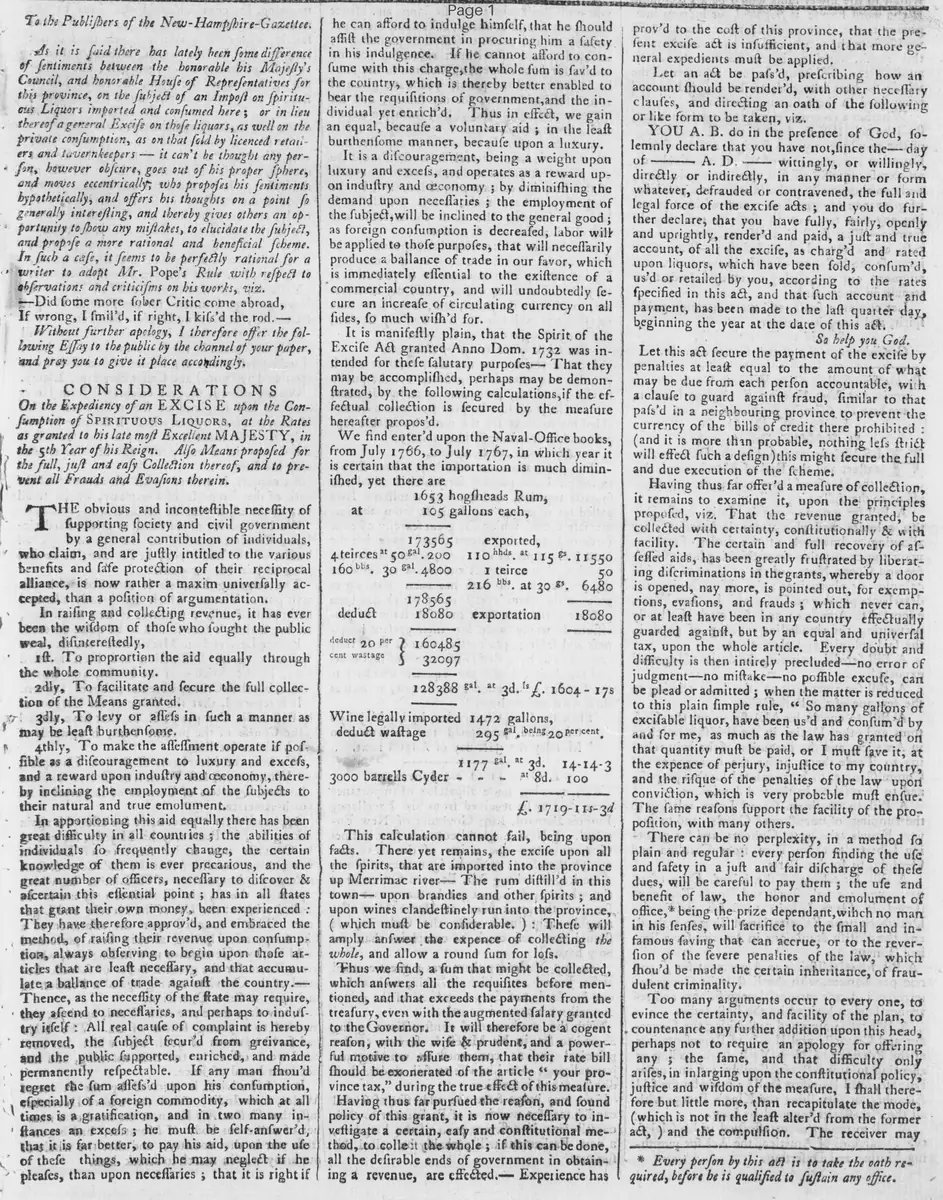
In such a case, it seems to be perfectly rational for a writer to adopt Mr. Pope's Rule with respect to observations and criticisms on his works, viz.
-Did some more sober Critic come abroad,
If wrong, I smil'd, if right, I kiss'd the rod.-
Without further apology, I therefore offer the following Essay to the public by the channel of your paper, and pray you to give it place accordingly.
CONSIDERATIONS
On the Expediency of an EXCISE upon the Consumption of Spirituous Liquors, at the Rates as granted to his late most Excellent MAJESTY, in the 5th Year of his Reign. Also Means proposed for the full, just and easy Collection thereof, and to prevent all Frauds and Evasions therein.
The obvious and incontestable necessity of supporting society and civil government by a general contribution of individuals, who claim, and are justly entitled to the various benefits and safe protection of their reciprocal alliance, is now rather a maxim universally accepted, than a position of argumentation.
In raising and collecting revenue, it has ever been the wisdom of those who sought the public weal, disinterestedly,
1st. To proportion the aid equally through the whole community.
2dly. To facilitate and secure the full collection of the Means granted.
3dly. To levy or assess in such a manner as may be least burthensome.
4thly. To make the assessment operate if possible as a discouragement to luxury and excess, and a reward upon industry and oeconomy, thereby inclining the employment of the subjects to their natural and true emolument.
In apportioning this aid equally there has been great difficulty in all countries; the abilities of individuals so frequently change, the certain knowledge of them is ever precarious, and the great number of officers, necessary to discover & ascertain this essential point; has in all states that grant their own money, been experienced:
They have therefore approved, and embraced the method, of raising their revenue upon consumption, always observing to begin upon those articles that are least necessary, and that accumulate a balance of trade against the country.
Thence, as the necessity of the state may require, they ascend to necessaries, and perhaps to industry itself: All real cause of complaint is hereby removed, the subject secured from grievance, and the public supported, enriched, and made permanently respectable. If any man should regret the sum assessed upon his consumption, especially of a foreign commodity, which at all times is a gratification, and in too many instances an excess; he must be self-answered, that it is far better, to pay his aid, upon the use of these things, which he may neglect if he pleases, than upon necessaries; that it is right if he can afford to indulge himself, that he should assist the government in procuring him a safety in his indulgence. If he cannot afford to consume with this charge, the whole sum is saved to the country, which is thereby better enabled to bear the requisitions of government, and the individual yet enriched. Thus in effect, we gain an equal, because a voluntary aid; in the least burthensome manner, because upon a luxury.
It is a discouragement, being a weight upon luxury and excess, and operates as a reward upon industry and oeconomy; by diminishing the demand upon necessaries; the employment of the subject, will be inclined to the general good; as foreign consumption is decreased, labor will be applied to those purposes, that will necessarily produce a balance of trade in our favor, which is immediately essential to the existence of a commercial country, and will undoubtedly secure an increase of circulating currency on all sides, so much wish'd for.
It is manifestly plain, that the Spirit of the Excise Act granted Anno Dom. 1732 was intended for these salutary purposes-- That they may be accomplished, perhaps may be demonstrated, by the following calculations, if the effectual collection is secured by the measure hereafter propos'd.
We find entered upon the Naval-Office books, from July 1766, to July 1767, in which year it is certain that the importation is much diminished, yet there are
17355
exported,
4 teirces at 50 gal 200
110 hhds at 115=11550
160 bbs at 30 gal.4800
1 teirce 50
216 bbs at 30 = 6480
.178565
deduct .18080
exportation 18080
Wine legally imported 1472 gallons,
deduct wastage 295 gal being 20 percent
1177 gal at 3d. 14-14-3
3000 barrells Cyder at 8d. 100 h. 1719-11s-3d
This calculation cannot fail, being upon facts. There yet remains, the excise upon all the spirits, that are imported into the province up Merrimac river-- The rum distilled in this town-- upon brandies and other spirits; and upon wines clandestinely run into the province, (which must be considerable.) : These will amply answer the expence of collecting the whole, and allow a round sum for loss.
Thus we find, a sum that might be collected, which answers all the requisites before mentioned, and that exceeds the payments from the treasury, even with the augmented salary granted to the Governor. It will therefore be a cogent reason, with the wise & prudent, and a powerful motive to assure them, that their rate bill should be exonerated of the article "your province tax," during the true effect of this measure.
Having thus far pursued the reason, and sound policy of this grant, it is now necessary to investigate a certain, easy and constitutional method, to collect it the whole; if this can be done, all the desirable ends of government in obtaining a revenue, are effected. Experience has proved to the cost of this province, that the present excise act is insufficient, and that more general expedients must be applied.
Let an Act be pass'd, prescribing how an account should be render'd, with other necessary clauses, and directing an oath of the following or like form to be taken, viz.
YOU A. B. do in the presence of God, solemnly declare that you have not, since the--- day of A. D. ---wittingly, or willingly, directly or indirectly, in any manner or form whatever, defrauded or contravened, the full and legal force of the excise acts; and you do further declare, that you have fully, fairly, openly and uprightly, render'd and paid, a just and true account, of all the excise, as charg'd and rated upon liquors, which have been sold. consum'd. us'd or retailed by you, according to the rates specified in this Act, and that such account and payment, has been made to the last quarter day, beginning the year at the date of this act.
So help you God.
Let this act secure the payment of the excise by penalties at least equal to the amount of what may be due from each person accountable. with a clause to guard against fraud, similar to that pass'd in a neighbouring province to prevent the currency of the bills of credit there prohibited: (and it is more than probable, nothing less strict will effect such a design) this might secure the full and due execution of the scheme.
Having thus far offer'd a measure of collection, it remains to examine it, upon the principles proposed, viz. That the revenue granted, be collected with certainty, constitutionally & with facility. The certain and full recovery of assessed aids, has been greatly frustrated by liberating discriminations in the grants, whereby a door is opened, nay more, is pointed out, for exemptions, evasions, and frauds; which never can, or at least have been in any country effectually guarded against, but by an equal and universal tax, upon the whole article. Every doubt and difficulty is then intirely precluded -no error of judgment--no mistake-no possible excuse, can be plead or admitted; when the matter is reduced to this plain simple rule, "So many gallons of excisable liquor, have been us'd and consum'd by and for me, as much as the law has granted on that quantity must be paid, or I must save it; at the expence of perjury, injustice to my country, and the risque of the penalties of the law upon conviction, which is very probable must ensue."
The same reasons support the facility of the proposition, with many others.
There can be no perplexity, in a method so plain and regular : every person finding the use and safety in a just and fair discharge of these dues, will be careful to pay them: the use and benefit of law, the honor and emolument of office,* being the prize dependant, which no man in his senses, will sacrifice to the small and infamous saving that can accrue, or to the reversion of the severe penalties of the law.' which should be made the certain inheritance, of fraudulent criminality.
Too many arguments occur to every one, to evince the certainty, and facility of the plan, to countenance any further addition upon this head, perhaps not to require an apology for offering any; the same, and that difficulty only arises, in enlarging upon the constitutional policy, justice and wisdom of the measure, I shall therefore but little more, than recapitulate the mode. (which is not in the least alter'd from the former act,) and the compulsion. The receiver may
Every person by this act is to take the oath required, before he is qualified to sustain any office.
require an account, and payment on individual consumption upon Oath ; this tendered. the subject is exonerated, unless positive proof appears which must be tried by a jury, then no other penalty is incurred, than the province law against fraud and perjury. No examination of houses-- no power to distress--no opportunity to oppress-- nay more ; it is here left at the option to pay a moderate sum lawful money as a composition per quarter, and no further questions asked. At present the taxes are gathered with less freedom and convenience. A man is rated by the Selectmen, ad libitum, unless he proves upon being aggrieved that he is over rated; and they may at pleasure necessitate him, to seek his relief from a court, which in the lower sums would be a Preclusion. If the word Excise is frightful, or induces imaginary terror, like other fanatic fears, it will vanish from the touch, and we have already made this touch, our duty, by an Act that we cannot annihilate. Without further argument, the whole is here intended, to be reduced to and comprised in the following question ? Whether a revenue. equal to the province tax, shall be collected totally for the use and benefit of the province, upon a foreign article of consumption ; a great part of which is undoubtedly an excess, equally assessed upon the whole, surely and constitutionally gathered without a possibility of grievance or oppression ; and without granting any new tax, but in fact by reducing the former- That shall be a discouragement to excess, and a reward upon industry--That shall increase the balance of trade in our favor, and augment our circulating currency ? or that we remain in uncertainty Let common sense, and more common public spirit, and integrity answer. Si quid novisti rectius istis, Candidus imperti ; si non, his utere mecum.
What sub-type of article is it?
What themes does it cover?
What keywords are associated?
What entities or persons were involved?
Letter to Editor Details
Recipient
The Printer
Main Argument
an excise tax on spirituous liquors is equitable, voluntary, least burdensome, discourages luxury and excess while rewarding industry, and can be collected easily and constitutionally via oaths and penalties, generating sufficient revenue to replace the province tax and improve trade balance.
Notable Details