Thank you for visiting SNEWPapers!
Sign up free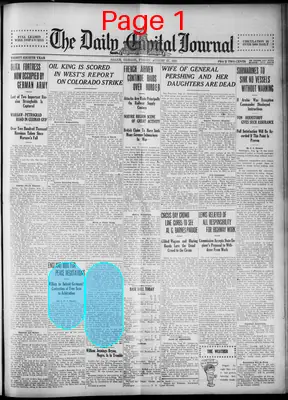
Daily Capital Journal
Salem, Marion County, Oregon
What is this article about?
Britain's Foreign Minister Sir Edward Grey responds to German peace suggestions by proposing arbitration on freedom of the seas and linking it to armament limits and no indemnity, while France's Premier Viviani vows to fight until Belgium is freed and Alsace-Lorraine reconquered. This marks initial informal peace talks amid WWI.
Clipping
OCR Quality
Full Text
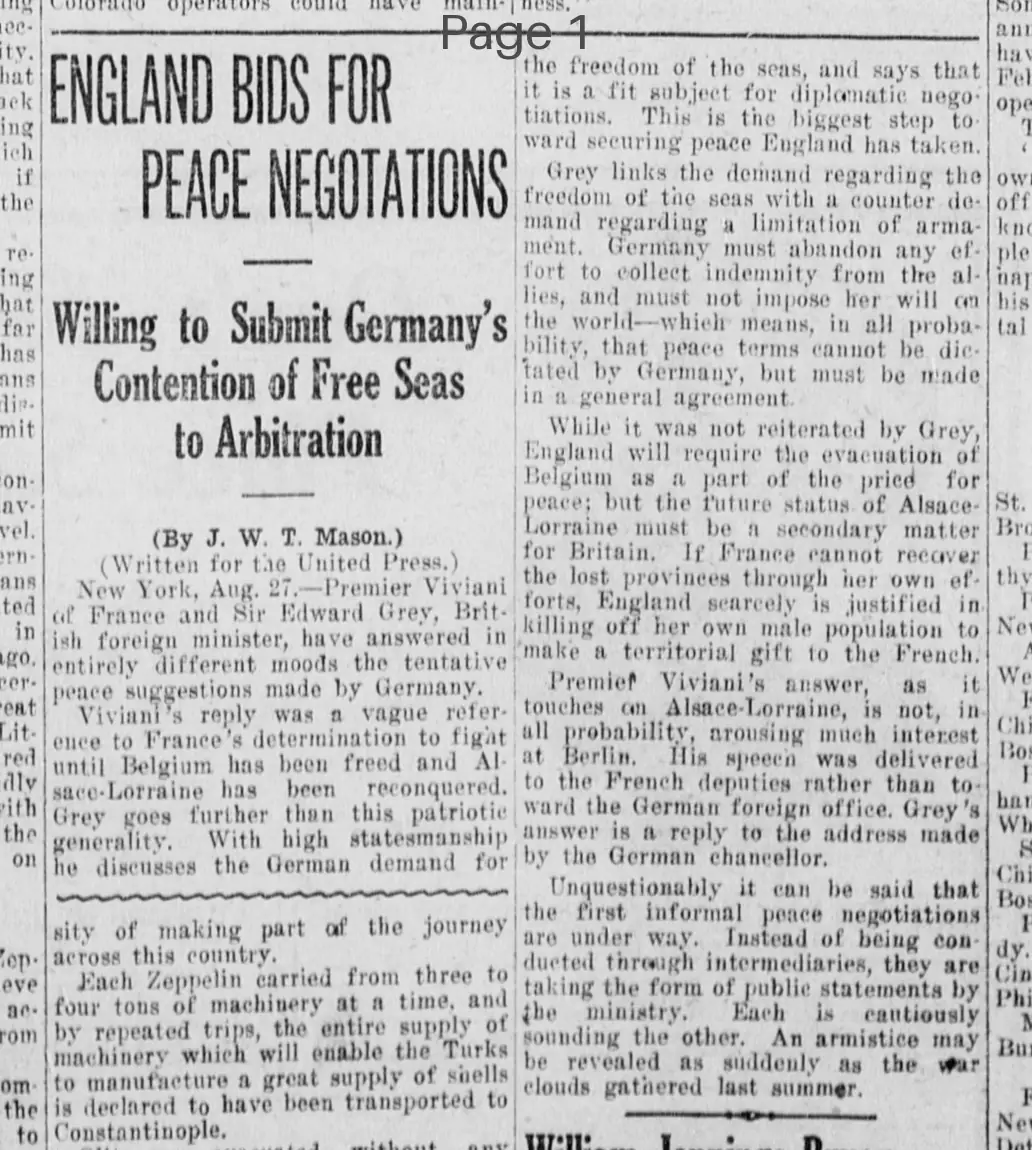
Willing to Submit Germany's Contention of Free Seas to Arbitration
(By J. W. T. Mason.)
(Written for the United Press.)
New York, Aug. 27. Premier Viviani of France and Sir Edward Grey, British foreign minister, have answered in entirely different moods the tentative peace suggestions made by Germany.
Viviani's reply was a vague reference to France's determination to fight until Belgium has been freed and Alsace-Lorraine has been reconquered.
Grey goes further than this patriotic generality. With high statesmanship he discusses the German demand for the freedom of the seas, and says that it is a fit subject for diplomatic negotiations. This is the biggest step toward securing peace England has taken.
Grey links the demand regarding the freedom of the seas with a counter demand regarding a limitation of armament. Germany must abandon any effort to collect indemnity from the allies, and must not impose her will on the world-which means, in all probability, that peace terms cannot be dictated by Germany, but must be made in a general agreement.
While it was not reiterated by Grey, England will require the evacuation of Belgium as a part of the price for peace; but the future status of Alsace-Lorraine must be a secondary matter for Britain. If France cannot recover the lost provinces through her own efforts, England scarcely is justified in killing off her own male population to make a territorial gift to the French.
Premier Viviani's answer, as it touches on Alsace-Lorraine, is not, in all probability, arousing much interest at Berlin. His speech was delivered to the French deputies rather than toward the German foreign office. Grey's answer is a reply to the address made by the German chancellor.
Unquestionably it can be said that the first informal peace negotiations are under way. Instead of being conducted through intermediaries, they are taking the form of public statements by the ministry. Each is cautiously sounding the other. An armistice may be revealed as suddenly as the war clouds gathered last summer.
the freedom of the seas, and says that it is a fit subject for diplomatic negotiations. This is the biggest step toward securing peace England has taken.
What sub-type of article is it?
What keywords are associated?
What entities or persons were involved?
Where did it happen?
Foreign News Details
Primary Location
England
Event Date
Aug. 27
Key Persons
Outcome
england proposes arbitration on freedom of the seas, links to armament limits, requires evacuation of belgium, no german indemnity or dictation of terms; france vows continued fight for belgium and alsace-lorraine; initial informal peace negotiations underway.
Event Details
Premier Viviani of France vaguely references determination to fight until Belgium is freed and Alsace-Lorraine reconquered in response to German peace suggestions. Sir Edward Grey, British foreign minister, discusses German demand for freedom of the seas as fit for diplomatic negotiations, the biggest step toward peace by England, linking it to counter demands for armament limitation, no indemnity from allies, and no imposition of German will, implying general agreement for peace terms. England requires Belgian evacuation but views Alsace-Lorraine as secondary. Viviani's speech to French deputies, Grey's to German chancellor's address. Informal negotiations via public statements, possible sudden armistice.