Thank you for visiting SNEWPapers!
Sign up free
Editorial
August 28, 1840
Southern Christian Advocate
Charleston, Charleston County, South Carolina
What is this article about?
Professor Stuart argues for the reality of future punishment or hell, emphasizing conscience's role in warning of divine judgment, the futility of denying it, and biblical support for eternal retribution separating the righteous from the wicked.
Merged-components note: Continuation of the editorial 'WHY IS THERE NOT A HELL' across pages; the second component was incorrectly labeled as 'story' and has been merged and relabeled to 'editorial'.
Clippings
1 of 2
OCR Quality
98%
Excellent
Full Text
WHY IS THERE NOT A HELL
BY PROFESSOR STUART.
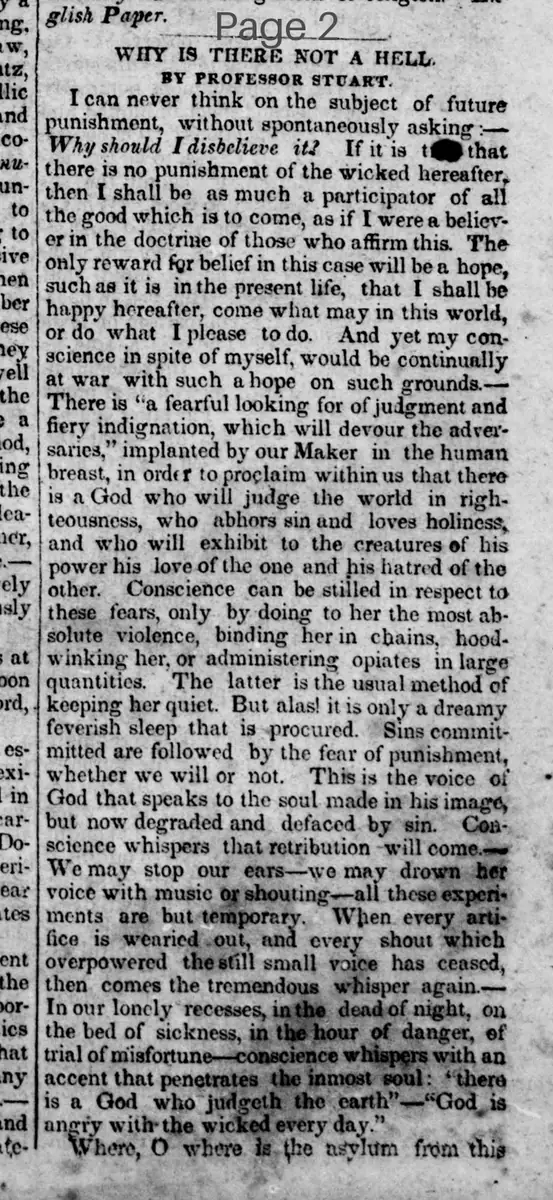
I can never think on the subject of future punishment, without spontaneously asking : Why should I disbelieve it? If it is true that there is no punishment of the wicked hereafter. then I shall be as much a participator of all the good which is to come, as if I were a believer in the doctrine of those who affirm this. The only reward for belief in this case will be a hope, such as it is in the present life, that I shall be happy hereafter, come what may in this world, or do what I please to do. And yet my conscience in spite of myself, would be continually at war with such a hope on such grounds.- There is "a fearful looking for of judgment and fiery indignation, which will devour the adversaries," implanted by our Maker in the human breast, in order to proclaim within us that there is a God who will judge the world in righteousness, who abhors sin and loves holiness. and who will exhibit to the creatures of his power his love of the one and his hatred of the other. Conscience can be stilled in respect to these fears, only by doing to her the most absolute violence, binding her in chains, hoodwinking her, or administering opiates in large quantities. The latter is the usual method of keeping her quiet. But alas! it is only a dreamy feverish sleep that is procured. Sins committed are followed by the fear of punishment, whether we will or not. This is the voice of God that speaks to the soul made in his image, but now degraded and defaced by sin. Conscience whispers that retribution -will come.. We may stop our ears-we may drown her voice with music or shouting--all these experiments are but temporary. When every artifice is wearied out, and every shout which overpowered the still small voice has ceased, then comes the tremendous whisper again.—- In our lonely recesses, in the dead of night, on the bed of sickness, in the hour of danger, of trial of misfortune-- conscience whispers with an accent that penetrates the inmost soul: "there is a God who judgeth the earth" "God is angry with the wicked every day." Where, O where is the asylum from this
small voice, more terrific than the seven thunders which shake the throne of heaven? Is it to be found in plunging deep into the pleasures of sense? But how can it be found there? These are short, unsatisfying, often attended with satiety and disgust even in the very height of them; and at all events, they are but temporary. Shall the refuge be found, then, in confident assertion, in presumptuous belief that there is no future punishment? But how will these alter the case? The measures of a just God are not to be influenced by our declarations, nor by our presumption. When we have scoffed at his justice, or derided the moral retribution which he intends to make--there is no change in him nor in his measures. When we call in question his word, or even labor to make it proclaim the future freedom of the wicked from all punishment: it is not the boldness of our assertions, nor the rashness of our criticisms on the scriptures, nor the zeal with which we may contend for our professed belief in the common happiness of the pious and the impious, which can change the declaration of the Scriptures, or repeal one awful communication which they contain. There the assurance is given that when the Saviour is seated on his throne of final judgment, and all nations are assembled before him, he will divide them as a shepherd divideth his sheep from the goats, to the one he will assign zoen aionion, to the other kolasin aionion. The punishment is characterized by the same adjective as the reward: and if the life be endless in this case, then the punishment must also be endless. If not, the whole declaration has no intelligible meaning.
With such an avowal before us as this, from the lips of him who is himself to be our final judge, is it acting a reasonable part to shut our ears against it, and, in accordance with our wishes, maintain that even the Bible itself establishes the doctrines of universal salvation, or at least, of ultimate universal restoration? The laws of exegesis remonstrate against this conclusion; and if they are not to be trusted, what confidence can we place in anything that we deduce from the Bible? It lies on the very face of the Scriptures, that heaven is no more affirmed to be endless than hell is. An interpretation which makes the latter temporary, must shake our faith in the permanency of the former. The whole matter stands or falls together.--Biblical Repository.
BY PROFESSOR STUART.
I can never think on the subject of future punishment, without spontaneously asking : Why should I disbelieve it? If it is true that there is no punishment of the wicked hereafter. then I shall be as much a participator of all the good which is to come, as if I were a believer in the doctrine of those who affirm this. The only reward for belief in this case will be a hope, such as it is in the present life, that I shall be happy hereafter, come what may in this world, or do what I please to do. And yet my conscience in spite of myself, would be continually at war with such a hope on such grounds.- There is "a fearful looking for of judgment and fiery indignation, which will devour the adversaries," implanted by our Maker in the human breast, in order to proclaim within us that there is a God who will judge the world in righteousness, who abhors sin and loves holiness. and who will exhibit to the creatures of his power his love of the one and his hatred of the other. Conscience can be stilled in respect to these fears, only by doing to her the most absolute violence, binding her in chains, hoodwinking her, or administering opiates in large quantities. The latter is the usual method of keeping her quiet. But alas! it is only a dreamy feverish sleep that is procured. Sins committed are followed by the fear of punishment, whether we will or not. This is the voice of God that speaks to the soul made in his image, but now degraded and defaced by sin. Conscience whispers that retribution -will come.. We may stop our ears-we may drown her voice with music or shouting--all these experiments are but temporary. When every artifice is wearied out, and every shout which overpowered the still small voice has ceased, then comes the tremendous whisper again.—- In our lonely recesses, in the dead of night, on the bed of sickness, in the hour of danger, of trial of misfortune-- conscience whispers with an accent that penetrates the inmost soul: "there is a God who judgeth the earth" "God is angry with the wicked every day." Where, O where is the asylum from this
small voice, more terrific than the seven thunders which shake the throne of heaven? Is it to be found in plunging deep into the pleasures of sense? But how can it be found there? These are short, unsatisfying, often attended with satiety and disgust even in the very height of them; and at all events, they are but temporary. Shall the refuge be found, then, in confident assertion, in presumptuous belief that there is no future punishment? But how will these alter the case? The measures of a just God are not to be influenced by our declarations, nor by our presumption. When we have scoffed at his justice, or derided the moral retribution which he intends to make--there is no change in him nor in his measures. When we call in question his word, or even labor to make it proclaim the future freedom of the wicked from all punishment: it is not the boldness of our assertions, nor the rashness of our criticisms on the scriptures, nor the zeal with which we may contend for our professed belief in the common happiness of the pious and the impious, which can change the declaration of the Scriptures, or repeal one awful communication which they contain. There the assurance is given that when the Saviour is seated on his throne of final judgment, and all nations are assembled before him, he will divide them as a shepherd divideth his sheep from the goats, to the one he will assign zoen aionion, to the other kolasin aionion. The punishment is characterized by the same adjective as the reward: and if the life be endless in this case, then the punishment must also be endless. If not, the whole declaration has no intelligible meaning.
With such an avowal before us as this, from the lips of him who is himself to be our final judge, is it acting a reasonable part to shut our ears against it, and, in accordance with our wishes, maintain that even the Bible itself establishes the doctrines of universal salvation, or at least, of ultimate universal restoration? The laws of exegesis remonstrate against this conclusion; and if they are not to be trusted, what confidence can we place in anything that we deduce from the Bible? It lies on the very face of the Scriptures, that heaven is no more affirmed to be endless than hell is. An interpretation which makes the latter temporary, must shake our faith in the permanency of the former. The whole matter stands or falls together.--Biblical Repository.
What sub-type of article is it?
Moral Or Religious
What keywords are associated?
Future Punishment
Hell
Conscience
Divine Judgment
Eternal Retribution
Biblical Exegesis
What entities or persons were involved?
Professor Stuart
God
Saviour
Biblical Repository
Editorial Details
Primary Topic
Defense Of Eternal Future Punishment
Stance / Tone
Strongly Affirmative Of Hell And Divine Retribution
Key Figures
Professor Stuart
God
Saviour
Biblical Repository
Key Arguments
Conscience Innately Warns Of Judgment And Fiery Indignation.
Attempts To Silence Conscience Through Pleasure Or Denial Are Temporary And Futile.
God's Justice Remains Unchanged By Human Presumption Or Scoffing.
Scriptures Affirm Eternal Punishment Parallel To Eternal Life, Using 'Aionion'.
Interpreting Hell As Temporary Undermines Belief In Eternal Heaven.
Biblical Exegesis Opposes Universal Salvation Or Restoration.