Thank you for visiting SNEWPapers!
Sign up free
Literary
November 13, 1933
The Daily Worker
Chicago, Cook County, Illinois
What is this article about?
Humorous essay on ping pong's cultural history: absent from art museums, dismissed as uninteresting in 1914 encyclopedia, now popular worldwide including in Soviet Union and American workers' clubs. Includes letter from United Front Supporters inviting to a benefit dance with ping pong exhibition.
Clipping
OCR Quality
95%
Excellent
Full Text
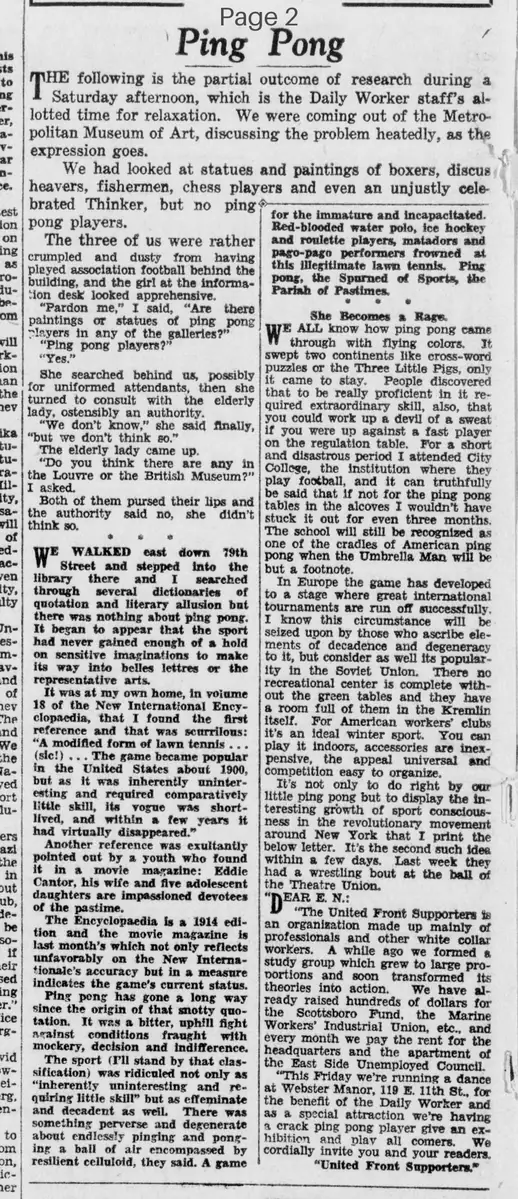
Ping Pong
THE following is the partial outcome of research during a Saturday afternoon, which is the Daily Worker staff's allotted time for relaxation. We were coming out of the Metropolitan Museum of Art, discussing the problem heatedly, as the expression goes.
We had looked at statues and paintings of boxers, discus throwers, fishermen, chess players and even an unjustly celebrated Thinker, but no ping pong players.
for the immature and incapacitated.
pong players.
The three of us were rather crumpled and dusty from having played association football behind the building, and the girl at the information desk looked apprehensive.
"Pardon me," I said, "Are there paintings or statues of ping pong players in any of the galleries?'
"Ping pong players?
"Yes."
She searched behind us, possibly for uniformed attendants, then she turned to consult with the elderly lady, ostensibly an authority.
"We don't know," she said finally "but we don't think so.
The elderly lady came up.
"Do you think there are any in the Louvre or the British Museum?"
I asked.
Both of them pursed their lips and the authority said no, she didn't think so.
WE WALKED east down 79th Street and stepped into the library there and I searched through several dictionaries of quotation and literary allusion but there was nothing about ping pong.
It began to appear that the sport had never gained enough of a hold on sensitive imaginations to make its way into belles lettres or the representative arts.
It was at my own home, in volume 18 of the New International Encyclopaedia, that I found the first reference and that was scurrilous:
"A modified form of lawn tennis ... (sic!) ... The game became popular in the United States about 1900, but as it was inherently uninteresting and required comparatively little skill, its vogue was short-lived, and within a few years it had virtually disappeared."
Another reference was exultantly pointed out by a youth who found it in a movie magazine: Eddie Cantor, his wife and five adolescent daughters are impassioned devotees of the pastime.
The Encyclopaedia is a 1914 edition and the movie magazine is last month's which not only reflects unfavorably on the New Internationale's accuracy but in a measure indicates the game's current status.
Ping pong has gone a long way since the origin of that snotty quotation. It was a bitter, uphill fight against conditions fraught with mockery, derision and indifference.
The sport (I'll stand by that classification) was ridiculed not only as "inherently uninteresting and requiring little skill" but as effeminate and decadent as well. There was something perverse and degenerate about endlessly pinging and ponging a ball of air encompassed by resilient celluloid, they said. A game for the immature and incapacitated.
Red-blooded water polo, ice hockey and roulette players, matadors and pago-pago performers frowned at this illegitimate lawn tennis. Ping pong, the Spurned of Sports, the Pariah of Pastimes.
She Becomes a Rage.
WE ALL know how ping pong came through with flying colors. It swept two continents like cross-word puzzles or the Three Little Pigs, only it came to stay. People discovered that to be really proficient in it required extraordinary skill, also, that you could work up a devil of a sweat if you were up against a fast player on the regulation table. For a short and disastrous period I attended City College, the institution where they play football, and it can truthfully be said that if not for the ping pong tables in the alcoves I wouldn't have stuck it out for even three months.
The school will still be recognized as one of the cradles of American ping pong when the Umbrella Man will be but a footnote.
In Europe the game has developed to a stage where great international tournaments are run off successfully. I know this circumstance will be seized upon by those who ascribe elements of decadence and degeneracy to it, but consider as well its popularity in the Soviet Union. There no recreational center is complete without the green tables and they have a room full of them in the Kremlin itself. For American workers' clubs it's an ideal winter sport. You can play it indoors, accessories are inexpensive, the appeal universal and competition easy to organize.
It's not only to do right by our little ping pong but to display the interesting growth of sport consciousness in the revolutionary movement around New York that I print the below letter. It's the second such idea within a few days. Last week they had a wrestling bout at the ball of the Theatre Union.
"DEAR E.N.:
"The United Front Supporters is an organization made up mainly of professionals and other white collar workers. A while ago we formed a study group which grew to large proportions and soon transformed its theories into action. We have already raised hundreds of dollars for the Scottsboro Fund, the Marine Workers' Industrial Union, etc., and every month we pay the rent for the headquarters and the apartment of the East Side Unemployed Council.
"This Friday we're running a dance at Webster Manor, 119 E. 11th St., for the benefit of the Daily Worker and as a special attraction we're having a crack ping pong player give an exhibition and play all comers. We cordially invite you and your readers.
"United Front Supporters."
THE following is the partial outcome of research during a Saturday afternoon, which is the Daily Worker staff's allotted time for relaxation. We were coming out of the Metropolitan Museum of Art, discussing the problem heatedly, as the expression goes.
We had looked at statues and paintings of boxers, discus throwers, fishermen, chess players and even an unjustly celebrated Thinker, but no ping pong players.
for the immature and incapacitated.
pong players.
The three of us were rather crumpled and dusty from having played association football behind the building, and the girl at the information desk looked apprehensive.
"Pardon me," I said, "Are there paintings or statues of ping pong players in any of the galleries?'
"Ping pong players?
"Yes."
She searched behind us, possibly for uniformed attendants, then she turned to consult with the elderly lady, ostensibly an authority.
"We don't know," she said finally "but we don't think so.
The elderly lady came up.
"Do you think there are any in the Louvre or the British Museum?"
I asked.
Both of them pursed their lips and the authority said no, she didn't think so.
WE WALKED east down 79th Street and stepped into the library there and I searched through several dictionaries of quotation and literary allusion but there was nothing about ping pong.
It began to appear that the sport had never gained enough of a hold on sensitive imaginations to make its way into belles lettres or the representative arts.
It was at my own home, in volume 18 of the New International Encyclopaedia, that I found the first reference and that was scurrilous:
"A modified form of lawn tennis ... (sic!) ... The game became popular in the United States about 1900, but as it was inherently uninteresting and required comparatively little skill, its vogue was short-lived, and within a few years it had virtually disappeared."
Another reference was exultantly pointed out by a youth who found it in a movie magazine: Eddie Cantor, his wife and five adolescent daughters are impassioned devotees of the pastime.
The Encyclopaedia is a 1914 edition and the movie magazine is last month's which not only reflects unfavorably on the New Internationale's accuracy but in a measure indicates the game's current status.
Ping pong has gone a long way since the origin of that snotty quotation. It was a bitter, uphill fight against conditions fraught with mockery, derision and indifference.
The sport (I'll stand by that classification) was ridiculed not only as "inherently uninteresting and requiring little skill" but as effeminate and decadent as well. There was something perverse and degenerate about endlessly pinging and ponging a ball of air encompassed by resilient celluloid, they said. A game for the immature and incapacitated.
Red-blooded water polo, ice hockey and roulette players, matadors and pago-pago performers frowned at this illegitimate lawn tennis. Ping pong, the Spurned of Sports, the Pariah of Pastimes.
She Becomes a Rage.
WE ALL know how ping pong came through with flying colors. It swept two continents like cross-word puzzles or the Three Little Pigs, only it came to stay. People discovered that to be really proficient in it required extraordinary skill, also, that you could work up a devil of a sweat if you were up against a fast player on the regulation table. For a short and disastrous period I attended City College, the institution where they play football, and it can truthfully be said that if not for the ping pong tables in the alcoves I wouldn't have stuck it out for even three months.
The school will still be recognized as one of the cradles of American ping pong when the Umbrella Man will be but a footnote.
In Europe the game has developed to a stage where great international tournaments are run off successfully. I know this circumstance will be seized upon by those who ascribe elements of decadence and degeneracy to it, but consider as well its popularity in the Soviet Union. There no recreational center is complete without the green tables and they have a room full of them in the Kremlin itself. For American workers' clubs it's an ideal winter sport. You can play it indoors, accessories are inexpensive, the appeal universal and competition easy to organize.
It's not only to do right by our little ping pong but to display the interesting growth of sport consciousness in the revolutionary movement around New York that I print the below letter. It's the second such idea within a few days. Last week they had a wrestling bout at the ball of the Theatre Union.
"DEAR E.N.:
"The United Front Supporters is an organization made up mainly of professionals and other white collar workers. A while ago we formed a study group which grew to large proportions and soon transformed its theories into action. We have already raised hundreds of dollars for the Scottsboro Fund, the Marine Workers' Industrial Union, etc., and every month we pay the rent for the headquarters and the apartment of the East Side Unemployed Council.
"This Friday we're running a dance at Webster Manor, 119 E. 11th St., for the benefit of the Daily Worker and as a special attraction we're having a crack ping pong player give an exhibition and play all comers. We cordially invite you and your readers.
"United Front Supporters."
What sub-type of article is it?
Essay
Satire
What themes does it cover?
Political
Social Manners
What keywords are associated?
Ping Pong
Sports History
Cultural Satire
Soviet Union
Workers Clubs
United Front Supporters
Daily Worker
Literary Details
Title
Ping Pong
Subject
Cultural History And Rise Of Ping Pong In Arts And Workers' Movements
Form / Style
Humorous Prose Essay With Dialogue
Key Lines
"A Modified Form Of Lawn Tennis ... (Sic!) ... The Game Became Popular In The United States About 1900, But As It Was Inherently Uninteresting And Required Comparatively Little Skill, Its Vogue Was Short Lived, And Within A Few Years It Had Virtually Disappeared."
Ping Pong, The Spurned Of Sports, The Pariah Of Pastimes.
There No Recreational Center Is Complete Without The Green Tables And They Have A Room Full Of Them In The Kremlin Itself.